How Tinylawn's Virtual Site Visit Reports Help You Quote Landscaping Jobs Faster
Tinylawn automatically generates property reports with satellite imagery, lot data, and AI analysis from just an address. Here is how it changes the quoting process.
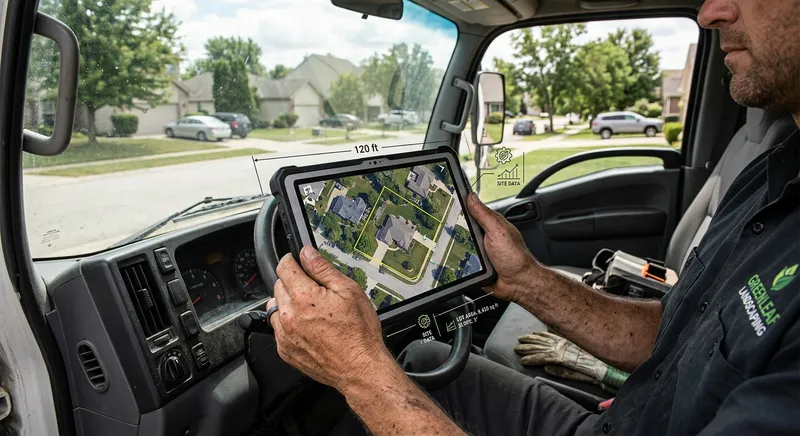
Table of Contents
A homeowner calls about a patio installation. You get their name, address, and a vague description of what they want. Now you need to drive 35 minutes to see the property before you can even begin to put together a quote.
You show up, walk the yard for 15 minutes, take some notes and photos, drive 35 minutes back — and then you still need to sit down and build the estimate. That’s nearly two hours of unbillable time before you’ve earned a dollar.
Multiply that by 5-10 quotes per week during peak season, and you’re spending 10-20 hours a week just looking at properties you haven’t been hired to work on yet.
Tinylawn’s virtual site visit reports change this equation. Every time a lead comes in — from a phone call or an online form — Tinylawn automatically generates a property intelligence package from just the caller’s address. No drive-by needed.
What You Get in a Virtual Site Visit Report
When a caller provides their address (either during a phone call with the AI receptionist or through an online form), Tinylawn’s system pulls public property data and runs an AI analysis. Here’s what’s included:
Property Data
- Lot size — the total lot acreage or square footage
- Building square footage — the structure footprint
- Property type — residential, commercial, multi-family, etc.
This information is pulled from public records automatically. No manual lookup required.
Satellite Imagery and Parcel Map
You get a current satellite view of the property plus a parcel boundary map showing the exact lot lines. For a landscaping business, this means you can see:
- The size and shape of the yard
- Existing hardscaping, driveways, and structures
- Tree coverage and landscape beds
- The relationship between the house and the lot boundaries
- Slopes or grading issues (visible in many satellite views)
AI-Powered Property Analysis
This is where Tinylawn goes beyond raw data. The AI analyzes the satellite imagery and generates a report that includes:
- Property overview and structural analysis — a summary of the property layout, structures, and lot characteristics
- Lawn and landscape analysis — current condition of grass, plantings, and landscape features visible from above
- Potential service challenges — things like steep grades, narrow access, proximity to structures, or drainage patterns
- Service recommendations — suggested services based on what the AI observes about the property
- Visible structure identification — sheds, pools, retaining walls, driveways, fences, and other features that might affect your scope of work
All of this is generated automatically when the lead is created. You don’t request it. You don’t configure it. It just appears in the lead record.
Caller-Submitted Photos
In addition to the satellite data, Tinylawn sends every caller an SMS with a link to upload photos of their property. When the homeowner snaps a few ground-level photos of their backyard, those images are attached to the lead record.
This gives you the one thing satellite imagery can’t: a ground-level view. You can see the actual condition of the turf, the state of existing plantings, drainage issues up close, and what the customer sees when they look at their yard.
Between satellite imagery, property data, AI analysis, and customer photos — you have a more complete picture of the property than many landscapers get from a 15-minute drive-by.
How This Changes the Quoting Workflow
Let’s walk through two scenarios to see the difference.
Without Virtual Site Visits
- Lead comes in. You get a name, phone number, and “I want a patio quote.”
- You call back to get the address and ask basic questions. (If you can reach them.)
- You schedule a site visit — drive 30-45 minutes each way.
- You walk the property — 15-20 minutes measuring, taking photos, assessing conditions.
- You drive back and put together the estimate.
- You send the quote — usually 24-48 hours after the initial call.
- Total unbillable time per quote: 2-3 hours
With Virtual Site Visits
- Lead comes in via Tinylawn. The AI qualifies the caller, captures the address, and books a consultation — all during the call.
- You check the lead record. Satellite image, lot size, parcel map, property analysis, and (often) customer photos are already there.
- You review the AI analysis. You know the lot is 8,500 sq ft, the backyard slopes east, there’s an existing retaining wall along the south fence, and the AI flagged potential drainage concerns.
- You build a preliminary estimate based on the data — before you’ve driven anywhere.
- You show up to the consultation prepared. You already know the property layout, potential challenges, and rough scope. The on-site visit confirms what you’ve already assessed and handles the details you can’t see from satellite.
- Total unbillable research time per quote: 10-15 minutes
The site visit still matters — you’re not quoting $15,000 jobs from satellite photos alone. But you’re arriving informed instead of cold. And you can often filter out poor-fit leads before making the drive.
Where This Saves the Most Time
Filtering out bad-fit leads
Before virtual site visits, you might drive 40 minutes to a property only to realize:
- The lot is too small for the project they described
- Access is too tight for your equipment
- The scope is a $500 job, not the $5,000 project you expected
With the property data and satellite view upfront, you can make that call from your truck in 2 minutes. A quick look at the lot size, property type, and satellite image tells you whether this lead is worth a visit — or whether a phone conversation is all that’s needed.
Preparing accurate quotes faster
When you already know the lot dimensions, structure footprint, and visible features, your quoting process speeds up significantly. You’re not starting from a blank page — you’re confirming measurements and adding details to an estimate you’ve already begun sketching.
For maintenance contracts, where you’re pricing properties by square footage or lot size, having the lot data upfront can turn a multi-step process into a single calculation.
Impressing the homeowner
Showing up to a consultation already knowing the property layout signals professionalism. When you say “I noticed from the aerial view that your yard slopes toward the southeast — that’s probably where the drainage issue is,” the homeowner knows they hired someone who did their homework.
This sounds small, but it’s a competitive edge. Most landscaping companies show up cold and start by asking “so, what are we looking at?” You’re showing up with answers.
What This Looks Like in Practice
Here’s a real example of the data flow for a design-build lead:
8:47 PM, Thursday. A homeowner calls about a patio and retaining wall project. Tinylawn answers the call, qualifies the lead, captures the address, and books a Monday morning consultation.
By 8:50 PM, the lead is in your Tinylawn dashboard with:
- Caller name and contact info
- Property address with satellite view
- Lot size: 12,400 sq ft
- Building footprint: 2,100 sq ft
- AI analysis flagging a grade change in the backyard and existing landscape beds along the fence line
- Parcel boundary showing the exact lot lines
- An SMS already sent to the homeowner asking for property photos
Friday morning, the homeowner uploads 4 photos: the backyard from the patio door, the slope where they want the retaining wall, the existing paver walkway, and the view from the property line.
Sunday evening, you spend 10 minutes reviewing the lead before your Monday appointment. You know the yard is ~6,000 sq ft of workable space after the house footprint, the grade drop is roughly 3 feet over 20 feet (visible in both the satellite view and the homeowner’s photos), and there’s an existing paver area that may need to be integrated or removed.
Monday morning, you show up prepared. The consultation takes 30 minutes instead of an hour because you’re confirming details, not discovering them.
The Bigger Picture: Quoting as a Competitive Advantage
For most landscaping companies, the quoting process is a bottleneck. Every site visit is unbillable time. Every day between “lead calls” and “quote delivered” is a day the homeowner might go with a competitor who moved faster.
Virtual site visit reports compress that timeline. You respond faster, quote more accurately, and show up more prepared — all without adding hours to your week.
Tinylawn’s virtual site visits are included in every plan — from Pro ($49/month) through Scale ($249/month). They’re generated automatically for every lead, whether the lead comes from a phone call or an online form. There’s nothing to configure and no per-report fee.
Related: See how the AI receptionist handles a full estimate call step by step, or explore AI receptionist solutions for landscaping businesses.