Termite Inspection No-Shows: The Hidden Daily Cost Most Pest Control Companies Never Calculate
Termite and WDIR inspection no-shows quietly eat 12 to 18 percent of a tech route. Here is the real cost — labor, lost route density, and downstream revenue — for a typical small pest control operation.
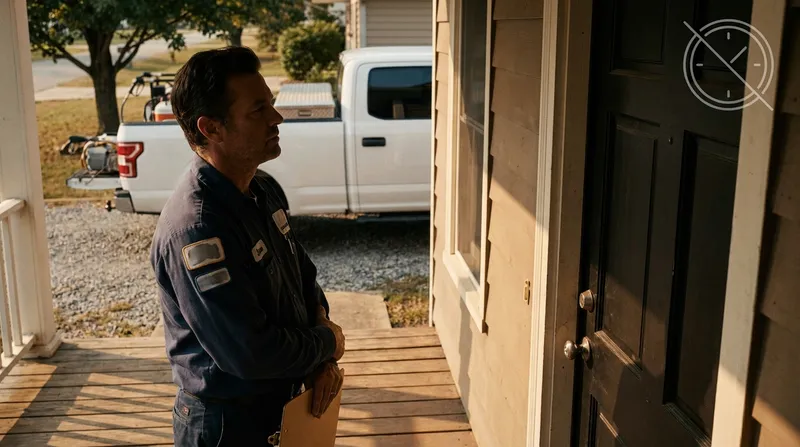
Table of Contents
A termite tech leaves the shop at 7:30 in the morning with five inspections on the route. Stop one is a real estate closing on the other side of town — a 35-minute drive. The agent confirmed yesterday. The tech rolls up, knocks, waits five minutes, calls the agent’s cell. No answer. Sits in the truck another ten minutes. Drives back across town.
Total cost of that single no-show: roughly $145 in tech labor, vehicle, and burn rate. But that is not actually what it costs. The real number is closer to $400 because of what happened to the rest of the route. Three of the four remaining stops are now running late, the second-to-last got rescheduled by the homeowner because the tech could not give a tight window, and the WDIR letter that was supposed to clear an afternoon closing has to wait until Wednesday.
Termite inspection no-shows are the most underpriced line item on most small pest control P&Ls. Most owners do not track them. The ones who do are usually shocked at the number.
This post is the math.
The benchmark: 12% to 18% no-show rates on termite inspections
Across pest control operators who actually measure it, 12 to 18 percent of scheduled termite inspections experience a no-show or a same-day reschedule. The number runs higher than for general pest because of two structural realities:
- Real estate is the dominant inspection driver. Roughly 60 to 75 percent of residential WDIR (Wood-Destroying Insect Report) inspections are tied to a real estate transaction. That means the appointment was booked by an agent on behalf of a buyer, the buyer is rarely on-site, and the access plan is “the lockbox code is…” More moving parts than a homeowner-initiated inspection.
- The window is tight and inflexible. Closings drive deadlines. Agents schedule the inspection for “Tuesday between 9 and 11” because the buyer’s lender needs it by Thursday. There is no slack in the system. The first hiccup becomes a cascade.
The 12 to 18 percent figure is the rough range across operators tracking it. Outliers exist — companies that bundle inspections with closing coordinators run lower (5 to 8 percent), while companies that take inspection appointments off Facebook or Yelp with no confirmation system run higher (22 to 30 percent).
What a single no-show actually costs
Add up the direct costs first.
| Item | Cost |
|---|---|
| Tech labor (1 hour at $32/hr loaded) | $32 |
| Truck operating cost (1 hour at $18/hr) | $18 |
| Drive time fuel (one way, ~15 mi) | $10 |
| Overhead allocation (1 hr) | $25 |
| Direct cost of the no-show itself | $85 |
That is the bare floor. It is also wrong, because it ignores the rest of the route.
A termite tech’s route is built around inspection windows. Each window is 60 to 90 minutes, with 20 to 30 minutes of drive time between. When stop one goes from “5 minutes of waiting and now I am leaving” to “20 minutes of waiting, two phone calls, then driving across town with no replacement stop,” the entire rest of the day compresses.
The downstream effects:
- One of the remaining four stops gets pushed to tomorrow. That is a deferred-revenue WDIR letter, plus a phone call from an irritated agent, plus the next-day tech route now has an inserted stop that disrupts its own density.
- The tech runs late on stops 2, 3, and 4. The buffer is gone. Each subsequent stop now has 10 to 15 minutes of pressure built in. If any of them goes long (a crawl space takes 40 minutes instead of 25, the homeowner has questions), the tail of the route cascades.
- The route’s last stop gets a “we are running about 90 minutes behind” call. The homeowner says, “I have to leave at 4, can we reschedule?” Now you have lost a second stop.
- The WDIR letter that should have cleared a closing on Thursday now has to wait until Wednesday. The agent calls the broker. The broker calls you. Customer-facing trust takes a hit even though the no-show was the buyer’s fault.
The true loaded cost of a single termite inspection no-show, accounting for one secondary rescheduled stop and one disrupted route, lands at $280 to $420 per incident.
Annual cost for a typical 2-truck operation
Let’s run real numbers for a 2-truck pest control shop with a meaningful termite line of business.
Inspection volume
- Two techs running termite-eligible routes 4 days per week
- 4 to 5 inspections per tech per day during peak (March through October)
- 2 to 3 per tech per day off-peak
- Annual inspections: roughly 1,800 to 2,200
No-show volume
At a 15% no-show rate:
- 270 to 330 no-shows per year
Annual no-show cost
At $350 per incident loaded cost:
- $94,500 to $115,500 per year
This is the line item that does not appear on any P&L because it is hidden across the labor, vehicle, and missed-revenue lines. Most owners think their termite program is profitable. It is — but it is leaving close to six figures of margin on the table to no-shows alone.
Why traditional confirmation systems fail
Pest control has tried to solve no-shows for decades. The default playbook is some version of: an SMS confirmation the day before, a phone call the morning of, a voicemail if no answer, and a “we are 10 minutes out” text from the tech.
It moves the needle a little. Not as much as owners think. Here is why:
The confirmation goes to the wrong person
The agent booked the inspection. The buyer needs to be on-site (or the lockbox needs to work). The seller probably did not get a copy of the agent’s email confirming the appointment. Your confirmation system has the agent’s number. The agent is in a closing meeting and does not check texts until 2 PM.
The communication chain is buyer → agent → you. When you confirm, you are confirming with the middle of the chain. The chain breaks at either end and you find out at the door.
The confirmation arrives at the wrong time
Most automated confirmations go out 24 hours in advance — at the time the original appointment was booked. That means a 7:30 AM inspection gets a confirmation text at 7:30 AM the previous day. The buyer is at work. They glance at it, plan to deal with it later, forget. By the time they remember, it is 9 PM and they do not want to bother anyone.
The right confirmation window for a morning real-estate-driven appointment is the evening before, between 6 and 8 PM, when the buyer is home and not at work. Nobody runs their confirmation cadence that way because the auto-batch ran when the office staff went home at 5.
“Confirm by replying YES” puts the work on the customer
The default SMS confirmation script asks the recipient to take an action. Reply YES. Click the link. Press 1 to confirm. Every additional action drops response rates by 20 to 40 percent.
The confirmations that actually work are written backwards: assume confirmation, ask for a reply only if there is a problem. “Your termite inspection is confirmed for Tuesday between 9 and 11 AM. Lockbox code on file is 4422. Reply STOP if you need to reschedule.” Response rates to a “reply only if rescheduling” message are usually 4 to 8 percent — which is exactly the no-show rate you want to catch.
The morning-of call comes too late
By 8 AM, the tech is already in the truck. If the morning-of call surfaces a problem, the route has already departed. The damage is done. A real confirmation has to surface problems the night before, when the route is still being adjusted.
What actually moves the needle
The companies that have driven no-show rates below 7 percent (less than half the industry average) tend to do four things, in roughly this order:
1. Two-touch confirmation, not one
A booking confirmation the moment the appointment is set, then a separate “evening before, 6-8 PM” confirmation. The second one is the one that catches problems. Operators who add just this second touchpoint see no-show rates drop 4 to 6 percentage points.
2. Confirm with the on-site party, not just the booker
Capture the buyer’s phone number at the time of booking — even if the agent booked it. Send the evening-before confirmation to both. The agent confirms availability. The buyer confirms access. Two different people verifying two different things.
3. Always-on phone coverage during booking-confirmation hours
Most “morning of” callbacks are buyers calling at 7:15 AM to say “I am stuck in traffic, can the tech come at 10 instead of 9?” These calls hit voicemail because the office opens at 8. The route already left. If those calls had been answered live, the tech could have rerouted stop 2 first and saved 45 minutes of dead drive time.
This is also the window — early mornings, late evenings — when real-estate-driven appointment changes happen. Agents work weird hours. Buyers in a closing window do too. If the only way to reach your office is between 8 AM and 5 PM Monday through Friday, you are taking the no-show on every call that lands outside that window.
4. Soft-hold replacement stops
A tech route built with one “soft-hold” maintenance stop in the middle of the day (a non-time-sensitive customer who agreed to a flexible window) gives you a recovery option. If the 9 AM no-shows, the soft-hold stop slides into the slot. The route stays full. The no-show is annoying but not financially catastrophic.
Most small operators do not build routes this way because soft-holds feel like wasted optionality on a tight day. Calculate the cost of a single no-show without one, though, and the math flips.
The math nobody wants to do
Run your own numbers. Here is the worksheet:
- Annual termite inspections completed (or attempted)? Round number is fine.
- No-show rate? If you do not measure it, assume 15 percent and use that as a starting point.
- Loaded cost per no-show? $300 is a conservative estimate for a small operation. Adjust up for longer service areas.
- Annual no-show cost = (1) × (2) × (3).
Most 1-to-2 truck shops land between $40,000 and $100,000. Most 3-to-5 truck shops land between $100,000 and $300,000. None of it shows up on a P&L line because it is hidden in the labor, vehicle, and “scheduled but not completed” accounting buckets.
The fix is not exotic. It is two-touch confirmations, a real on-site contact for every appointment, phone coverage during the booking-and-confirmation hours real estate actually runs in, and one soft-hold stop per route to absorb the inevitable.
If you have ever caught yourself saying “real estate is just like that, you take the hits and move on” — fair, but make sure you actually know what the hits cost. For most pest control operators, the termite inspection no-show is the most expensive thing on the schedule, and the only one they have never priced into the business.
For the broader picture of where the rest of the tech’s day actually goes — utilization metrics, stops-per-day benchmarks, the route-density math — the pest control technician day breakdown is the companion piece to this one.