AI Answering Service for Pest Control: What It Does and Whether You Need One
A straightforward explanation of how AI answering services work for pest control companies — what they handle, what they cost, and how to know if your business is ready for one.
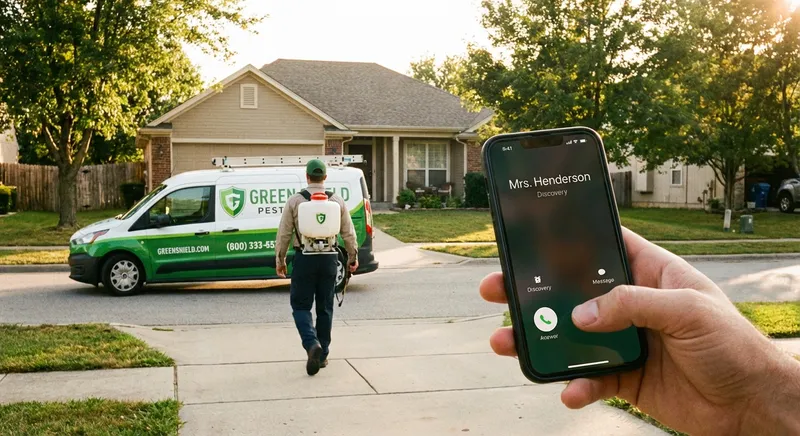
Table of Contents
You’re under a house treating for termites. Your phone rings. It’s a homeowner across town who just found bed bugs in their kid’s bedroom. They need someone today.
You can’t answer — you’re in a crawl space with a treatment wand in one hand and a flashlight in the other. By the time you crawl out, check your phone, and call back 45 minutes later, they’ve already booked with the company that picked up on the first ring.
This happens every day in pest control. Your highest-value leads call during the exact hours you can’t answer — because you’re doing the work that makes your business run.
An AI answering service solves this specific problem. Here’s what it actually does, what it costs, and how to decide whether your pest control business needs one.
What an AI answering service actually is
An AI answering service is software that answers your business phone, has a conversation with the caller, captures their information, and delivers a lead summary to you — all without a human involved.
It’s not voicemail. The caller talks to an AI that sounds like a real person, asks relevant questions, provides helpful answers, and handles the call the way a good receptionist would. The caller doesn’t need to know it’s AI — the experience feels like talking to a professional office staff member.
What the caller experiences:
- They call your business number
- The AI answers on the first ring with your company name: “Thanks for calling [Your Company], how can I help you?”
- They describe their pest problem
- The AI asks follow-up questions: What kind of pest? Where in the home? How long has this been happening?
- The AI answers common questions: “Yes, we handle bed bugs.” “Our products are safe for pets once dry.” “We serve the greater [City] area.”
- The AI confirms their contact information and address
- The call ends with: “We’ll have someone follow up with you shortly to schedule your service.”
- The caller receives a text with a link to upload photos of what they’re seeing
What you experience:
- You get a notification (text, email, or app alert) with a complete summary
- The summary includes: caller name, phone, address, pest type, severity, urgency, and any photos they uploaded
- You call back with full context — ready to quote, schedule, or triage
The entire process takes 2-3 minutes for the caller and zero minutes of your time during the call itself.
How it handles common pest control calls
“I’ve got roaches in my kitchen”
The AI captures what they’re seeing (size, quantity, location), asks whether they’ve seen them during the day (indicates severity — daytime roach activity means a large population), asks about property type and size, and confirms their address. Your callback lead shows: German cockroach likely, kitchen and bathroom, daytime activity, 2,200 sq ft single-family home.
You’re not starting from scratch on the callback — you’re confirming a diagnosis and quoting a treatment plan.
“How much do you charge for pest control?”
Instead of deflecting, the AI provides a configured answer: “Our general pest treatment starts at $175 for a standard home and varies based on the size of your property and what you’re dealing with. If you can share your address, we can give you a more accurate quote when we follow up.”
This keeps the caller engaged. A generic “Someone will call you back with pricing” answer loses 40% of callers who just wanted a ballpark before deciding whether to proceed.
“There are termites swarming in my living room RIGHT NOW”
The AI recognizes urgency — “right now,” “swarming,” “emergency” — and shifts to rapid intake. It captures the address and situation quickly, reassures the caller that this is being flagged as urgent, and sends you an immediate text alert rather than a standard email notification.
You see the alert on your phone, assess whether you can dispatch today, and call back within minutes — not hours.
“Is your stuff safe around my kids and pets?”
The AI answers with your configured response: “Yes — the products we use are EPA-registered and applied according to label directions. We ask that you keep children and pets off treated surfaces until dry, which is usually about 30 minutes. Our technician will walk you through any specific precautions during the visit.”
This FAQ handling is one of the highest-value features for pest control. Callers want reassurance, not a callback. Answering safety questions in real time builds confidence that you’re a professional operation.
“I need to schedule my quarterly treatment”
Existing customers calling for routine scheduling get the same professional experience. The AI captures their name, address, confirms they’re an existing customer, and notes what they need. Your callback (or your office person’s callback) is a 60-second scheduling conversation, not a 5-minute intake.
What it costs
Tinylawn uses monthly subscription pricing with included calls:
| Tier | Monthly cost | Calls included | Best for |
|---|---|---|---|
| Pro | $49 | 25 calls | Solo operators, 1 technician |
| Growth | $129 | 75 calls | Staffed, single-location operations |
| Scale | $249 | 150 calls | Multi-technician, high-volume operations |
What’s included on most plans:
- 24/7 call answering (nights, weekends, holidays)
- Simultaneous call handling (no busy signals)
- Call recordings and transcripts
- AI-generated summaries
- SMS photo upload links
- Spam call filtering
- Property intelligence (address validation, property data)
What you won’t pay:
- Per-minute fees (flat monthly rate)
- Setup fees (most offer free onboarding)
- Surprise overage penalties (the published per-call rate applies above the allowance)
For comparison: a part-time receptionist costs $1,500-2,500/month and only works business hours. A traditional answering service runs $200-600/month with per-minute charges that spike during termite season. AI can provide 24/7 coverage with a published base price and overage rate, so you can model the cost at peak volume.
The revenue impact for pest control companies
Let’s put real numbers on what an AI answering service is worth to a pest control operation.
The missed call problem
A typical 2-3 technician pest control company receives 25-40 calls per week during peak season and misses 35-50% of them. Of those missed calls, 70-80% don’t leave a voicemail.
The math:
- 30 calls/week × 40% missed = 12 missed calls
- 12 missed × 75% no voicemail = 9 lost leads per week
- 9 lost leads × 30% would have converted = 2.7 lost customers per week
The revenue recovery
| Customer type | First service value | Annual value (if recurring) |
|---|---|---|
| General pest (one-time) | $200-300 | $200-300 |
| General pest (quarterly plan) | $175-225 | $700-900 |
| Termite treatment | $1,200-2,500 | $1,500-3,000 (with monitoring) |
| Bed bug treatment | $800-3,000 | $800-3,000 |
| Mosquito seasonal plan | $75-150/treatment | $450-1,050 |
Blended first-year value per new customer: $800-1,200 (weighted toward the general pest customers who make up the majority of calls).
Revenue recovered per week: 2.7 customers × $1,000 = $2,700/week
Revenue recovered per month: $10,800/month
AI answering service cost: $210/month at roughly 120 calls on Growth
ROI multiple: 51x
Even at half these numbers — more conservative miss rates, lower conversion, lower customer value — the ROI is still substantial. Use your actual call volume and close rate before treating the illustration as a forecast.
The lifetime value multiplier
The calculation above uses first-year revenue only. But pest control customers who start on quarterly plans often stay for 3-5 years. A customer worth $800 in year one is worth $2,400-4,000 over their lifetime.
Every missed call you recover today generates revenue for years.
Do you need one? The diagnostic checklist
An AI answering service makes sense if you check 3 or more of these:
- You miss more than 5 calls per week during peak season
- You’re the primary person answering the phone AND doing field work
- You frequently return calls 2+ hours after they come in
- You get calls after 5pm and on weekends that go to voicemail
- You’ve lost jobs because a competitor answered first
- Termite or bed bug calls come in when you can’t answer
- You’re spending 1+ hours per day on phone calls instead of billable work
- Your customer reviews mention “hard to reach” or “slow to respond”
If you checked 5+, you should have implemented this yesterday.
If you checked 3-4, you’re in the sweet spot — the AI will have an immediate and measurable impact.
If you checked 1-2, you may be managing fine with your current setup. Consider testing during your peak season to see if the data changes your mind.
When you might NOT need one
You have a full-time office person who handles 95%+ of calls. The AI adds value for after-hours and overflow, but the incremental gain is smaller.
You’re brand new with very low call volume. If you’re getting fewer than 5 calls per week total, your problem is marketing, not phone answering. Invest in lead generation first.
You’re not ready to follow up on leads. The AI captures leads. If you can’t call them back within 2-4 hours, the leads go cold regardless of how they were captured. Fix your callback process before investing in capture.
How to set it up for pest control
Setup for a pest control AI answering service typically takes 15-30 minutes. Here’s what you’ll configure:
Your services
List every service you offer:
- General pest control (interior/exterior)
- Termite inspection and treatment
- Bed bug treatment
- Rodent control and exclusion
- Mosquito treatment
- Ant treatment
- Wasp/bee removal
- Wildlife removal
- Commercial pest management
The AI uses this list to understand what callers are asking about and route conversations appropriately.
Your FAQs
Configure answers to the questions you get most:
- “What areas do you serve?” → [Your service area]
- “How much does a treatment cost?” → [Your starting price or range]
- “Are your products safe for pets/kids?” → [Your standard safety answer]
- “Do you offer free inspections?” → [Your policy]
- “Do you handle termites/bed bugs/rodents?” → [Yes/No for each]
- “What are your hours?” → [Your service hours]
- “Do you offer emergency/same-day service?” → [Your policy]
- “Are you licensed?” → [Your license information]
Your notification preferences
Configure how you want to receive lead notifications:
- Text alerts for urgent calls (termite swarms, bed bug emergencies, wildlife)
- Email summaries for routine calls (quarterly scheduling, general pest inquiries)
- Immediate push notifications for after-hours emergency calls
Your greeting
Customize how the AI answers: “Thanks for calling [Company Name], your local pest control experts. How can I help you today?”
Keep it simple and professional. The caller should feel like they reached a real business, not an automated system.
What happens after setup
Day 1-3: The AI starts handling calls. You’ll probably listen to a few recordings to make sure the conversations sound right. Adjust any FAQ answers that need refinement.
Week 1: You’ll notice the lead flow — every call produces a detailed summary in your inbox or app. You develop a callback rhythm: check leads in the morning, midday, and end of day.
Week 2-4: The pattern becomes second nature. You stop worrying about missed calls. Your callbacks are faster and better-informed. You’re closing leads that would have called a competitor two weeks ago.
Month 2+: You have data. You can see exactly how many calls the AI handled, how many converted, and what the revenue impact is. Most pest control companies see the ROI clearly enough by month two to know this is permanent infrastructure, not an experiment.
For a detailed look at what the first 30 days look like, see our post on what to expect in your first month with an AI receptionist.
The bottom line
An AI answering service for pest control does one thing exceptionally well: it makes sure that every homeowner who calls your company — at any hour, during any situation — talks to someone, gives their information, gets their questions answered, and becomes a lead you can follow up on.
It doesn’t replace you. It replaces the voicemail that was replacing you.
With plans starting at $49/month, you can recover revenue from calls you’re currently missing, reduce the stress of constant phone management, and give every caller a professional experience that builds your reputation.
The pest control company that answers first wins the job. An AI answering service makes sure that company is always you.
Related: Pest control virtual receptionist | How to schedule pest control customers | Best AI receptionist for pest control