AI Receptionist ROI for a 2-Truck Pest Control Operation: A Year in Numbers
Is an AI receptionist actually worth $99-249/month for a 2-truck pest control company? Here is the year-one math — missed calls, conversion rates, recurring revenue, and the break-even point.
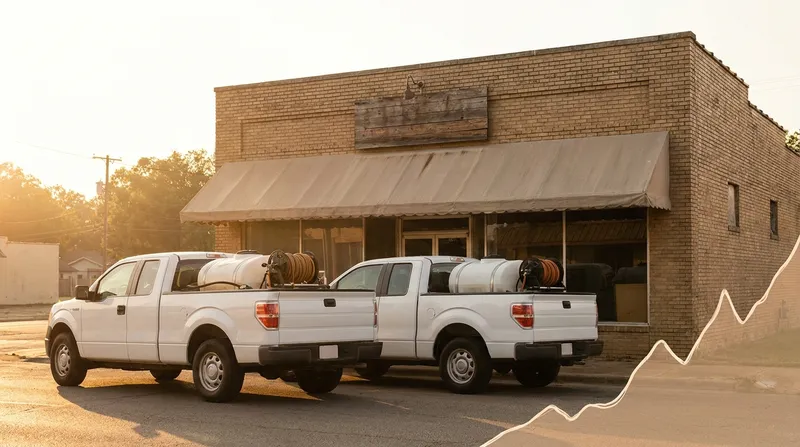
Table of Contents
You run two trucks. You and one tech in the field most days, your spouse or a part-time admin running the office, and a phone that rings whenever it feels like it — including at 6:15 AM, during the spray, and right when you’ve finally sat down for dinner.
Someone sent you a link to an AI receptionist. It costs $99-249/month depending on call volume. You’re trying to figure out if that’s a real investment or just another SaaS bill on a P&L that’s already too crowded.
This post is the math. Year one. Two trucks. Real numbers from real pest control benchmarks. By the end you’ll know what the ROI actually looks like for your size of shop — and where the break-even sits.
The size of operation we’re modeling
Before we do the math, let’s lock in what “2-truck pest control” looks like. If your numbers are bigger or smaller, the proportions still hold.
- Trucks on the road: 2 (you + 1 technician)
- Active customer base: 350-600 recurring + ad hoc emergency
- Annual revenue: $400K-$650K
- Inbound calls per week (peak season): 70-120
- Inbound calls per week (off season): 35-55
- Existing answering setup: Voicemail, your spouse, or a part-time admin who answers when she can
The numbers below assume a small but established 2-truck operation in a market with mixed residential and light commercial work. Termite, general pest, mosquito, rodent — the standard mix.
Step 1: How many calls are you missing right now?
Most pest control owners think they answer “most” of their calls. The actual data, when you measure it, is uncomfortable.
A 2-truck operation typically misses calls in three windows:
After-hours and weekends (5 PM - 8 AM, Saturday and Sunday)
The National Pest Management Association and multiple industry call-tracking studies put after-hours call volume at 35-40% of total inbound for residential pest control. For emergency-driven calls (rodents, wasps, cockroach sightings, swarmers), the percentage is even higher.
If your phone rings 90 times a week in peak season, that’s 32-36 calls outside business hours.
Route hours (your crew is in the field, your admin is at lunch / on another line)
A part-time admin covering 20-25 hours a week has gaps. The phone rings during those gaps. Industry call-tracking data shows in-business-hours miss rates of 25-40% for shops with no dedicated full-time receptionist.
That’s another 12-20 missed calls per peak week.
Combined miss rate
Add the two and a typical 2-truck shop is missing 40-55 calls per peak week — roughly half of total inbound. Even allowing for some duplicate callers and wrong numbers, you are losing 30-40 real prospects every week during the busy months.
Step 2: What are those missed calls worth?
Not every missed call is a job. But pest control has unusually favorable conversion economics, especially on emergency calls.
Conversion rate of answered emergency calls
Live-answered pest emergency calls (cockroaches, rodents inside, wasp nests, swarmers) convert at 70-85% in industry benchmarks. The caller is in distress. They are calling the first number that loads on Google. If you answer, you almost always book.
Conversion rate of answered routine calls
Routine inquiries — quarterly service shoppers, mosquito programs, scheduled inspections — convert at 30-45% when answered live, because the caller is comparison shopping.
What a callback gets you
Speed-to-response data is consistent across home services. A callback within 5 minutes converts at 60-78% of the live-answer rate. By 30 minutes, it’s down to 30-40%. By 2 hours, it’s under 20%. By next morning, the lead is effectively dead.
For a 2-truck shop where the owner is on a route, “5 minutes” is fantasy. Real callback times average 3-6 hours, which means most missed calls do not become customers no matter how disciplined you are with the callback list.
Step 3: What is one captured customer worth?
Here’s where pest control stands apart from a lot of field service work — the lifetime value of a captured customer is high because the recurring service plan is sticky.
The first transaction
- Emergency treatment: $175-$350
- Initial general pest treatment: $150-$250
- Termite inspection + treatment: $400-$1,800 (highly variable)
- Wasp/hornet nest removal: $125-$275
Average first-transaction revenue, weighted across the typical mix: ~$210.
The recurring relationship
Industry surveys consistently show that 40-60% of new pest customers convert to a recurring service plan when the technician offers it on-site. For a 2-truck operation that has trained techs to upsell, the high end of that range is achievable.
- Quarterly general pest: $40-$60/visit × 4 = $160-$240/year
- Bi-monthly service: $45-$70/visit × 6 = $270-$420/year
- Annual termite monitoring: $250-$400/year
- Mosquito or tick program: $300-$600/year (seasonal)
Blended average annual recurring revenue per customer who signs a plan: ~$320/year.
Average retention
Pest control retention is healthy when service is good. Industry data points to 3-4 year average customer tenure for residential plans.
Lifetime value math (single new customer captured)
- First transaction: $210
- Probability of conversion to recurring (50%): 0.5 × ($320/yr × 3.5 years) = $560
- Annual upsells (termite inspection, seasonal programs): ~$120/year × 3.5 × 0.5 = $210
- Total expected lifetime value per captured call: ~$980
Round it down to $900 LTV per new customer to stay conservative.
Step 4: The math on captured calls
You don’t need a giant capture rate for the math to work. You just need a realistic one.
Assume your AI receptionist does the following on missed calls:
- Answers every after-hours and overflow call live
- Captures name, address, pest issue, urgency
- Books straight onto your calendar for any standard service
- Texts you immediately for anything urgent or out-of-scope
- Doesn’t pretend to be human, doesn’t lie, doesn’t push the caller into a script
A reasonable performance assumption for a well-set-up AI on inbound pest control calls:
| Call type | % of missed calls | Conversion rate | Captured customers |
|---|---|---|---|
| Emergency / urgent | 25% | 65-75% | High |
| Routine recurring shopper | 45% | 25-35% | Medium |
| Existing customer (rescheduling, billing) | 20% | 90%+ retention | Saved relationship |
| Wrong number / spam | 10% | 0% | N/A |
Translating that into captured new customers from a typical 2-truck weekly miss rate of 35-40 calls:
- 25% emergency × 35 calls × 70% capture = ~6 new emergency customers/week
- 45% routine × 35 calls × 30% capture = ~5 new routine customers/week
- Total new customers captured: ~11/week during peak season
Peak season runs roughly 28 weeks (March-October in most markets). Off-peak captures are 30-40% of peak. Annualized:
- Peak weeks: 11 × 28 = 308 captured customers
- Off-peak weeks: 4 × 24 = 96 captured customers
- Annual captured customers: ~400
That number probably looks high. It is — because the missed-call problem at a 2-truck shop is bigger than most owners realize. Even if you cut it in half to be skeptical, the math still works.
Step 5: Year one revenue from captured calls
Using $900 LTV per new customer:
- Conservative case (200 captures): 200 × $900 = $180,000 in lifetime revenue
- Realistic case (400 captures): 400 × $900 = $360,000 in lifetime revenue
But “lifetime” isn’t year one. Let’s pull just year-one revenue:
- First transaction at capture: 400 × $210 = $84,000
- Recurring plans signed (50% conversion): 200 × $320 partial year (avg 6 months in year 1) = $32,000
- Year one revenue from captured calls: ~$116,000
Even cutting that in half for the skeptical 2-truck owner who doesn’t fully buy the capture rate: ~$58,000 in year one.
Step 6: What the AI actually costs
A typical AI receptionist priced for a 2-truck pest control shop:
- Entry plan (low call volume, business hours backup only): $49-99/month
- Standard plan (24/7, full overflow + after-hours): $149-249/month
- Premium plan (high call volume, integrations, multi-line): $299-499/month
For a 2-truck pest control operation handling 70-120 calls/week peak, the standard plan at ~$199/month is the realistic fit.
- Annual cost: $2,388
- Setup/onboarding (one-time): $0-$500 depending on provider
- Year one all-in: ~$2,888
Step 7: The ROI
Conservative case:
- Year one revenue: $58,000
- Year one cost: $2,888
- Net year one: $55,112
- ROI: 1,908%
Realistic case:
- Year one revenue: $116,000
- Year one cost: $2,888
- Net year one: $113,112
- ROI: 3,915%
Lifetime case (3.5 year average retention):
- Lifetime revenue: $360,000
- Cost over 3.5 years: $10,058
- Net lifetime: $349,942
Break-even is reached when the AI captures 3-4 customers per year. Three. Per year.
What the math doesn’t capture (but matters)
The ROI calculation above is only the easy-to-measure part. Three other effects are real but harder to quantify:
Reviews and referrals
Every captured emergency call is a candidate for a 5-star review and 1-2 referrals over the next year. Pest emergencies generate disproportionately enthusiastic reviews because the emotional contrast (panic → relief) is so high. More reviews → more inbound calls → compounding effect on next year’s revenue.
Existing customer retention
A 2-truck shop loses 5-15 existing customers per year to “I called and nobody picked up, so I switched.” An AI that answers reschedule and billing calls reliably saves a meaningful percentage of those relationships. At $320/year recurring + $900 LTV, even saving 5 customers/year is $4,500 in retained LTV.
Owner sanity
The 2-truck stage is where most pest control owners burn out. The phone is the single biggest interrupter — during routes, during dinner, during weekends. Removing the phone interrupt doesn’t show up in revenue line items but it changes the trajectory of the business and the owner’s willingness to keep growing.
When the math doesn’t work
Honest disclosure: AI receptionist ROI is not unconditional.
It does not work well when:
- You answer most calls already (truly under 10% miss rate) — rare but possible if you have a full-time office manager
- Your call mix is heavy commercial with complex multi-stakeholder bids that need a senior person on the line
- You operate in a market where price-shopping is the dominant call type and your conversion is already ceiling-bound
- You haven’t configured your services, business hours, FAQs, and intake fields properly — the AI is only as good as the setup
The honest version: at a 2-truck residential pest shop with a meaningful miss rate, the math is so favorable it’s almost embarrassing. The cost to get it wrong is $200/month. The cost to keep doing what you’re doing is in the tens of thousands per year.
How to verify the math for your specific operation
Don’t take this post’s word for it. Run your own numbers in three steps:
- Pull your call log for the last 30 days. Count missed calls. Multiply by 12 for annualized estimate. Most owners are shocked by the number.
- Estimate your average new-customer LTV. First transaction + recurring × retention years. Use real pricing from your last 20 invoices.
- Multiply missed calls × 25% capture × LTV. That’s your conservative annualized opportunity. Compare to $2,400/year in AI cost.
If the answer is anywhere close to “the AI pays for itself 10x over,” you have a structural revenue leak that’s costing more than any piece of equipment in your truck.
The 2-truck stage is the hardest one in pest control — too big to answer your own phone, too small to justify a full-time office hire. The AI receptionist exists for exactly this stage, and the math is why.