Answering Service vs AI Receptionist: Landscaping Costs
An honest comparison of traditional answering services, hiring a receptionist, and AI receptionists for landscape maintenance businesses. Real pricing, real capabilities, real trade-offs.
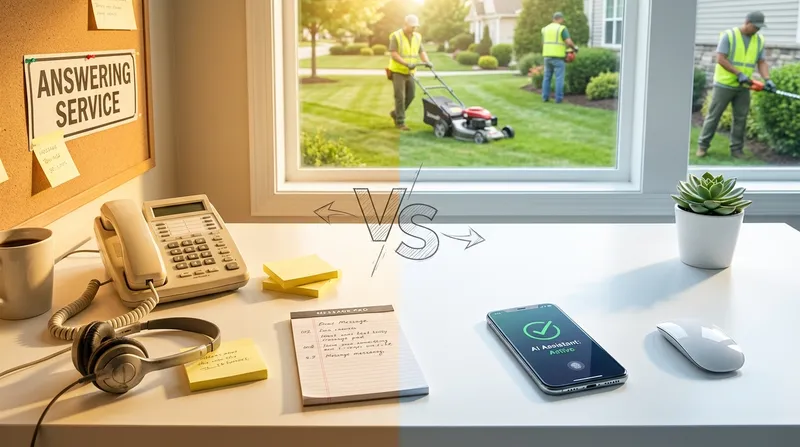
Table of Contents
Your phone won’t stop ringing in April. New clients, existing clients, people asking about spring cleanups, weekly mowing, mulch delivery, fertilizer schedules — all at once.
If you run a landscape maintenance company, you’ve probably looked into getting help with the phones. The options are familiar: hire a receptionist, use an answering service, or try one of the newer AI receptionists.
This article breaks down the real costs, capabilities, and trade-offs of each option. No sales pitch — just the numbers and an honest comparison so you can make the right call for your business.
Option 1: Hire a Receptionist
The most obvious solution. Put someone at a desk (or on your payroll) to answer calls.
What It Costs
- Average receptionist salary: $38,480-$41,510/year (US News, 2024; Indeed)
- True cost with benefits, taxes, PTO: $45,000-$55,000+/year (Salary.com, 2026)
- Part-time (20 hrs/week): ~$18,600-$21,500/year in wages alone
What You Get
- A real human who knows your business
- Can handle complex conversations and angry customers
- Builds relationships with repeat clients
- Available during their scheduled hours
The Problems
- Only covers 40-50 hours/week. Landscape maintenance companies generate 60-70% of annual revenue between April and September (Relay Financial). Spring call volume can spike 2-4x over winter levels. A single receptionist can’t handle that surge, and you still miss after-hours calls.
- Fixed cost regardless of volume. You pay the same in January (low call volume) as in April (phones ringing off the hook). For a business with seasonal cash flow, that’s tough.
- They call in sick, take vacations, and quit. The median tenure for receptionists is about 2 years. Training a replacement takes time you don’t have in the middle of peak season.
- They can’t scale. When you get 30 calls in a day during spring rush, one person physically can’t answer them all.
Best for: Established companies doing $1M+ with year-round call volume and an office where the receptionist can handle other admin tasks.
Option 2: Traditional Answering Service
These are call centers staffed by human operators who answer on your behalf. They follow a script, take a message, and forward it to you.
What It Costs
- Per-minute pricing: $0.75-$1.95 per minute (Nextiva, 2026; DesignRush, 2025)
- Per-call pricing: $1.75-$4.00 per call (Specialty Answering Service)
- Monthly plans: $135-$400/month for most small businesses (GoodCall, 2025; Dialzara)
- Peak season reality: If you’re getting 200+ calls/month in spring, expect $300-$800/month or more
What You Get
- 24/7 live human answering
- Basic message taking (name, number, reason for call)
- Some services offer simple appointment scheduling
- Call patching/transfer for urgent calls
The Problems
- They don’t know your business. The person answering your calls also answers for a plumber, a dentist, and a roofing company. They’re reading a generic script. When a homeowner asks “Do you do weekly mowing with edging and blowing included?” the operator says “I’ll have someone call you back.”
- They can’t qualify leads. A good landscape maintenance lead qualification needs property address, lot size, current service schedule, specific services needed, and budget. Answering services take a name and number. That’s it.
- They can’t book appointments. Most answering services don’t integrate with your calendar. They take a message, you call back, and by then the homeowner has booked with someone else.
- Per-minute pricing punishes longer calls. A detailed landscaping inquiry might take 3-5 minutes. At $1.50/minute, that’s $4.50-$7.50 per call. Multiply by 150 calls/month and you’re at $675-$1,125/month.
- Quality varies wildly. Some operators are great. Others sound bored, rush through the script, or make errors. You have no control over who answers your calls.
Best for: Businesses that primarily need after-hours coverage and are okay with message-taking (no scheduling or qualification needed).
Option 3: AI Receptionist
AI receptionists use conversational AI to answer calls, qualify leads, schedule appointments, and send you detailed summaries. The technology has improved dramatically — callers generally can’t tell they’re talking to AI.
What It Costs (Using Tinylawn as Example)
- Pro plan: $49/month (25 calls included), $2.00/additional call
- Growth plan: $129/month (75 included), $1.80/additional call
- Scale plan: $249/month (150 included), $1.60/additional call
- Peak season reality: At 200 calls/month, Scale costs $249 + (50 × $1.60) = $329/month
What You Get
- 24/7/365 answering — every call picked up in under 3 seconds
- Lead qualification — asks about property address, services needed, lot size, budget, timing
- Automatic appointment scheduling — books directly on your calendar while the caller is on the phone
- Property intelligence — pulls satellite imagery and lot size automatically from the property address
- Spam filtering — blocks robocalls and solicitation calls
- Call recording and transcription — full record of every conversation
- Bilingual support — English and Spanish
- Instant text notifications — get a summary of every call with lead details
- Connected workflows — use recent call details in ChatGPT or Claude alongside other connected tools
- Automatic new-lead handoffs — send leads to supported CRM, calendar, and work tools through Zapier
The Limitations
- Complex emotional conversations — an upset long-term client who needs personal attention should talk to you, not AI
- Highly custom negotiations — if a commercial property manager wants to negotiate a 3-year maintenance contract, that’s a you conversation
- Brand-new technology comfort — some older homeowners may prefer a human voice, though this is becoming less common
Best for: Solo operators through multi-crew landscape maintenance companies who need 24/7 coverage, lead qualification, and scheduling without the overhead of staff or the limitations of traditional answering services.
The Real Comparison: Side by Side
Here’s how the three options stack up for a typical landscape maintenance company getting 150 calls per month during peak season:
| Feature | Receptionist | Answering Service | AI Receptionist |
|---|---|---|---|
| Monthly cost | $3,750-$4,580 | $300-$800+ | $49-$249 |
| Annual plan price | $45,000-$55,000 | $3,600-$9,600 | $490-$2,490 before overage |
| Hours of coverage | 40-50 hrs/week | 24/7 | 24/7 |
| Answers in | Varies | 15-45 seconds | Under 3 seconds |
| Qualifies leads | Yes (if trained) | No (takes messages) | Yes (automated) |
| Books appointments | Yes | Rarely | Yes (real-time) |
| Handles seasonal spikes | No (one person) | Yes (but costs spike) | Yes (flat/predictable) |
| Knows your services | Yes | Generic script | Trained on your business |
| After-hours | No | Yes | Yes |
| Spanish support | If bilingual | Sometimes | Yes |
| Property data | No | No | Yes (satellite + lot size) |
| Call transcripts | No | Sometimes | Yes (every call) |
The Seasonal Math That Matters
Landscape maintenance is seasonal. That’s the elephant in the room for any phone solution.
Your call volume might look like this:
- November-February: 30-50 calls/month (existing clients, snow removal inquiries)
- March: 80-100 calls/month (spring ramp-up)
- April-May: 150-250 calls/month (spring rush)
- June-September: 100-150 calls/month (steady season)
- October: 80-120 calls/month (fall cleanups, winterization)
With a receptionist, you’re paying $3,750+/month in January for 30 calls, and that same $3,750 in April when you need three receptionists.
With a per-minute answering service, your costs spike right when your cash flow is tightest (you’ve spent on equipment, materials, and seasonal hires).
With Tinylawn, you choose a plan for the features and operating limits your business needs, while overage absorbs seasonal spikes. At 250 spring calls, Scale costs $409. In winter, a solo operator using 40 calls would pay $79 on Pro. The pricing can flex with your revenue cycle without turning features into a per-minute meter.
What Actually Matters for Landscape Maintenance
Here’s what I’d focus on when making this decision:
1. Can it book appointments?
This is the single biggest differentiator. 80% of callers who reach voicemail don’t leave a message (AMBS Call Center, 2026). Even if someone takes a message, you still have to play phone tag to schedule.
If your phone solution can’t book an estimate or service visit on the spot, you’re losing leads in the handoff. Period.
2. Can it handle your spring rush?
Landscape maintenance companies generate 60-70% of annual revenue during the growing season (Relay Financial). Search volume for landscaping services peaks in April at roughly 4x winter baseline (Evergrow Marketing, 2024).
Your phone solution needs to handle 3-4x your normal volume without degrading quality or breaking the bank.
3. Does the cost make sense year-round?
Landscape maintenance has thin margins. Industry profitability averages around 13% (IBISWorld, 2025). Spending $4,000/month on a receptionist when your off-season revenue is $15,000/month eats into that fast.
Your phone cost should scale with your call volume and revenue — not stay fixed while your income fluctuates.
4. Does it give you useful data?
A message slip that says “John called about lawn service” isn’t actionable. You need to know:
- What services they want
- Where the property is (and how big)
- What their timeline and budget look like
- Whether they’re a one-time job or a recurring contract opportunity
The more data captured on the first call, the fewer callbacks you need and the faster you can close.
The Hybrid Approach
Some landscape maintenance companies use a combination:
- AI receptionist as the primary answering system 24/7
- Transfer rules for VIP commercial clients or urgent calls
- Owner callback for high-value contract negotiations
This gives you the coverage and lead capture of AI with the personal touch for your most important relationships. Growth and Scale support call transfers and handoffs for exactly this scenario.
Related: See how Tinylawn works for lawn maintenance companies specifically, or explore the full feature set to understand what’s included.