Best AI Answering Service for Lawn Care Businesses (2026)
Comparing the top AI answering services for lawn care companies — what they cost, how they handle lawn care calls, and which fits your business size.
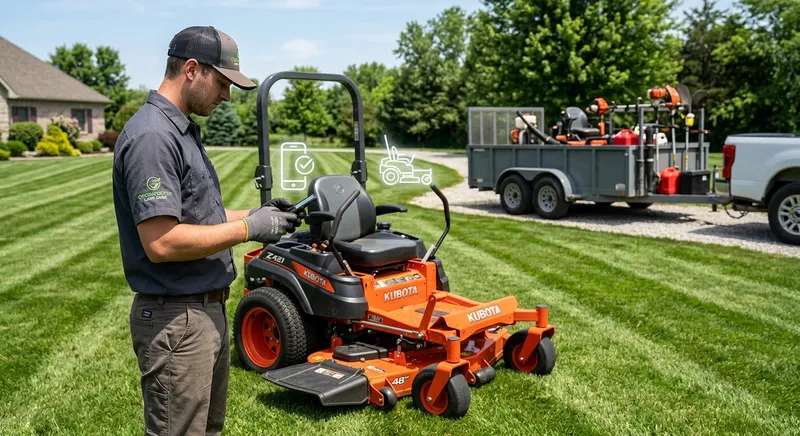
Table of Contents
Lawn care is a volume business. You’re running 15-25 stops per day on a mower, and every one of those stops is a window where you can’t answer the phone. Meanwhile, homeowners are Googling “lawn care near me” and calling the first company that shows up.
The companies that answer get the customer. The companies that don’t, don’t. It’s that simple during peak season.
An AI answering service handles this — but the options have different strengths depending on whether you’re a solo operator with 40 accounts or a multi-crew shop pushing 300. Here’s what to actually compare.
Why lawn care calls need specific handling
Lawn care calls differ from other home service calls in a few important ways:
High volume, low complexity. Most lawn care calls are straightforward: “I need someone to mow my lawn” or “I want to start weekly service.” The AI doesn’t need to handle complex technical discussions — it needs to efficiently capture the basics and move on to the next call.
Seasonal surges are extreme. A lawn care company might get 5 calls per week in January and 40 per week in April. The answering solution needs to handle that 8x spike without degrading.
Upsell opportunities are buried in calls. A homeowner who calls about mowing might also need aeration, overseeding, or weed treatment. An AI that only takes a message misses the chance to ask about additional services. One that can reference your service menu during the call surfaces revenue you’d otherwise miss.
Price sensitivity is real. Lawn mowing is a commodity in most markets. Homeowners are comparing prices. An AI that can share your pricing ranges during the call pre-qualifies leads and saves you from calling back people who were never going to pay your rate.
The options, ranked for lawn care
1. Tinylawn
Why it ranks first for lawn care: It’s the only answering service built specifically for lawn care and adjacent green industry businesses. During setup, you select “lawn care” and it pre-loads services like weekly mowing, spring cleanup, aeration, overseeding, fertilization, and weed control. You’re answering real calls within 15 minutes, not spending an hour teaching a general tool what “dethatching” means.
The property intelligence feature is especially useful for lawn care. After every call, the system pulls lot size data from public records and satellite imagery. For a business where pricing is heavily tied to square footage, having the lot size before you call back means you can quote faster — and in many cases, quote directly from the property data and photos without a site visit.
FAQ handling during calls matters for lawn care because the questions are so repetitive: “How much for my yard?” “Do you include edging?” “What’s your schedule — weekly or biweekly?” Program these once and the AI handles them on every call.
Pricing: $49/month (25 calls), $129/month (75 calls), $249/month (150 calls). The free trial ends after 14 days — no credit card required.
Best for: Solo operators through multi-crew lawn care companies. Particularly strong for businesses that quote based on lot size.
2. Jobber (AI receptionist add-on)
Why it works for lawn care: If you’re already running Jobber for routing, invoicing, and customer management — which many lawn care companies are — the AI receptionist add-on integrates directly. New leads from AI-answered calls flow into your existing Jobber workflow without manual entry.
Where it falls short: The AI is an add-on, not the main product. The phone answering capability is less mature than dedicated answering platforms. You also can’t use it without a Jobber subscription, which makes it expensive if you only need phone answering.
Pricing: Jobber plans start at $49/month for one user ($29/month billed annually), plus $29/month for Receptionist, which includes 100 conversations per month.
Best for: Lawn care companies already invested in Jobber who want to add AI answering without switching platforms.
3. Smith.ai
Why it works for lawn care: Smith.ai is a well-established brand with strong call quality. It offers both AI-only and live human receptionist options, which some business owners prefer for higher-stakes calls (commercial contracts, large property estimates). The platform is polished and reliable.
Where it falls short: Not built for lawn care. You’ll need to configure custom scripts for lawn care terminology and services. No property data, no lot size estimates, no seasonal awareness. The per-call pricing structure can get expensive during spring when you’re getting 30-40+ calls per week.
Pricing: Free AI plan for 25 calls/month ($3.00 per extra call); Pro from $150/month for 75 calls. Human-first receptionist plans start at $300/month for 30 calls.
Best for: Lawn care companies that want a premium, established brand and value the option of live human receptionists for some calls.
4. Rosie AI
Why it works for lawn care: Strong appointment scheduling — if your primary need is booking estimate appointments or service start dates, Rosie handles that workflow well. It learns your services from your website and Google Business Profile, and it speaks English and Spanish.
Where it falls short: Built for general small-business call answering, not property-based services. Doesn’t capture lot size, property type, or other details that lawn care companies use for quoting. Plans are metered by minutes, so long spring calls use up the allowance faster.
Pricing: $49/month for 250 minutes; $149/month for 1,000 minutes with calendar booking and live transfers; $299/month for 2,000 minutes. 7-day free trial.
Best for: Lawn care companies where the phone is primarily used for booking consultations, not quoting or qualifying.
5. Sameday AI
Why it works for lawn care: Sameday is an AI front office for home services, with AI agents, a phone system, texting, and outbound campaigns in one platform. Its landscaping page describes separating one-time cleanups from recurring maintenance, offering maintenance and seasonal plans on the call, and handling spring-rush surges and weather reschedules.
Where it falls short: It’s built and priced for companies with an office team of CSRs. No property data, lot size, or satellite imagery is described on its landscaping page. Sales are demo-led, and no free trial is shown.
Pricing: Launch from $449/month (500 minutes); Scale from $789/month (1,000 minutes).
Best for: Larger lawn and landscape companies with in-house CSRs that want AI, phones, and follow-up campaigns in one system.
6. Traditional answering services (Ruby, AnswerConnect, PATLive)
Why they work for lawn care: Real humans answer the phone. For business owners who are skeptical about AI or whose customers skew older and might not engage well with an AI voice, human answering services remain an option.
Where they fall short: Per-minute billing makes them expensive during peak season. A 3-minute lawn care call at $1.50-$2.50/minute costs $4.50-$7.50 per call. At 30 calls per week during spring, that’s $540-$900/month — far more than any AI option. Operators follow scripts but can’t answer lawn care questions beyond what’s written down. Hold times during peak periods (every field service company is getting spring calls simultaneously) can result in abandoned calls.
Pricing: $1.00-$2.50/minute, typically with monthly minimums of $100-$300.
Best for: Lawn care companies that absolutely require a human voice and are willing to pay 3-5x more for it.
The cost comparison that matters: peak season
Most pricing comparisons use average monthly volume. That’s misleading for lawn care because your call volume isn’t average — it’s feast or famine.
Here’s what each option actually costs during a peak April week with 35 inbound calls:
| Service | Monthly cost at 35 calls/week (~140/month) | Notes |
|---|---|---|
| Tinylawn | About $246/month (Growth: 75 included + 65 overage) | Flat base plus per-call overage |
| Smith.ai | About $270/month (Pro, 150-call tier) | $1.80 per call at that tier |
| Jobber AI | $78-$228/month (Jobber plan + $29 add-on) | Add-on includes 100 conversations; platform required |
| Rosie AI | $149/month (Scale, 1,000 minutes) | Assumes calls average about 3 minutes |
| Goodcall | $79/month (Starter) | 100 unique callers, about 150 calls by Goodcall’s estimate |
| Sameday AI | $449/month (Launch, 500 minutes) | Assumes calls average about 3 minutes |
| Ruby/AnswerConnect | $600-$1,050/month | Per-minute billing |
AI vendor prices were checked against each vendor’s website in October 2026.
The gap between this AI scenario (about $246/month) and traditional human services ($600-$1,000+/month) is massive during peak season. This is why AI answering has been adopted so quickly in lawn care — the economics are dramatically better during the months that matter most.
What to test during your trial
Most options offer some form of trial. Here’s how to evaluate them for lawn care:
Test call #1: Basic mowing inquiry
Call and say: “I’m looking for someone to mow my lawn. It’s about a quarter acre, front and back. How much would that cost?”
What to evaluate: Does the AI capture the lot size? Can it share your pricing range? Does it ask about frequency (weekly vs. biweekly)? Does it capture the address?
Test call #2: Multiple services
Call and say: “I need spring cleanup and I want to start weekly mowing. I also need to know if you do aeration.”
What to evaluate: Does the AI handle a multi-service request? Does it capture each service mentioned? Can it answer the aeration question from your FAQs?
Test call #3: After-hours urgent request
Call at 7 PM and say: “My HOA just sent me a violation letter for my lawn. I need someone out this week.”
What to evaluate: Does the system work after hours? Does it capture the urgency? Is the notification you receive clear enough to prioritize this call the next morning?
Test call #4: Price-sensitive caller
Call and say: “What do you charge for mowing? My current guy charges $35 for my small front yard.”
What to evaluate: Can the AI share your pricing range without committing to a specific quote? Does it handle the implied price comparison gracefully?
Run these four scenarios with any service you’re evaluating. The one that captures the most detail, answers the most questions, and sends you the clearest lead record is the one that’ll perform best with real callers.
The decision framework
Revenue under $100K/year (solo or small crew): Start with the cheapest option that answers the phone 24/7 and captures enough detail for intelligent callbacks. At this stage, any AI answering service is better than voicemail. The $49-$79/month tier of most platforms is sufficient.
Revenue $100K-$500K (growing, 2-5 crews): You’re getting enough calls that detail quality and FAQ handling matter. You’re also quoting enough jobs that property data saves meaningful time. Look for platforms with stronger lead capture and any property intelligence features.
Revenue $500K+ (established, 5+ crews): Integration with your existing business software (CRM, routing, invoicing) becomes important. Either choose a platform that integrates with your stack or one that’s part of a larger ecosystem (like Jobber).
At every revenue level, the math is the same: if the answering service captures even 2-3 additional jobs per month that would have gone to a competitor, it pays for itself several times over. The question isn’t whether to use one — it’s which one fits your specific situation.