The Hidden Cost of Missed Calls for Pool Service Companies
Pool service leads call once and move on. Here is what missed calls are actually costing your pool business every month during peak season.
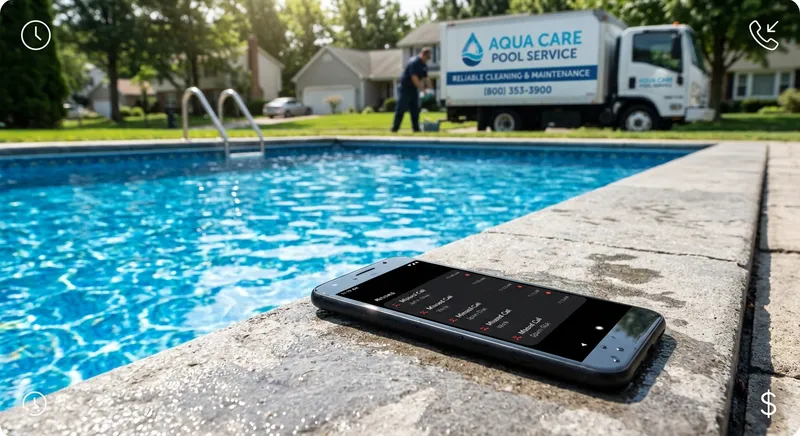
Table of Contents
You’re elbow-deep in a pump basket at a backyard pool in a gated community. Your phone buzzes in the truck. Then it buzzes again. And again.
It’s the second week of April — pool opening season — and every homeowner who forgot to book their spring startup is calling today. You can’t answer because you’re standing in someone else’s backyard with wet hands and a basket full of leaves.
By the time you get back to the truck, you have four missed calls from numbers you don’t recognize. One left a voicemail. The other three? Gone. They called the next company on Google.
Why missed calls hit pool service companies harder than you think
Pool service has a call pattern that makes missed calls especially expensive. Understanding why starts with how pool customers actually behave.
The calls cluster in short, intense windows
Pool service doesn’t get a steady trickle of calls year-round. It gets waves:
- Spring opening season (March-April): Homeowners who overwintered their pools realize the cover is sagging, the water is green, and they need someone out this week. Call volume can spike 3-5x over winter baseline in a matter of days.
- First heat wave of the season: Every pool owner whose water turns cloudy or green during the first sustained 90°F week picks up the phone.
- Post-storm surges: After heavy rain, wind events, or power outages that knock out pump timers, you’ll get a burst of urgent calls.
- Fall closing season (September-October): A smaller but real spike as homeowners book winterization.
These surges are when you make your money — and when you’re least able to answer the phone, because you’re servicing the customers who already booked.
Pool leads are high-intent and low-patience
When a homeowner calls a pool service company, they’re usually looking at a problem they want solved now. Green water. A broken pump. A pool they need opened before a Memorial Day party.
These aren’t comparison shoppers spending two weeks getting quotes. They want someone who can come this week — ideally tomorrow. Research from ServiceTitan’s field service benchmark reports consistently shows that speed-to-answer is the single strongest predictor of booking rate for urgent home service calls.
The data on voicemail tells the same story across every home service vertical: roughly 80% of callers who reach voicemail don’t leave a message. For a pool call — where the caller is staring at a green pool and wants action — the patience threshold is even lower. They hang up and call the next result.
One missed call often means one lost route customer
This is where pool service economics diverge from one-time services like pressure washing or gutter cleaning. When a homeowner calls for a pool opening and you don’t answer, you don’t just lose one job. You lose the entire potential relationship:
- Spring opening: $200-$400
- Weekly maintenance contract (May-September): $120-$180/month × 5 months = $600-$900
- Fall closing: $200-$350
- Chemical and equipment upsells: $100-$300/year
- Total first-year value of one residential pool route customer: $1,100-$1,950
And because pool maintenance is a recurring service with high retention — most homeowners stick with their pool company for years unless something goes wrong — the lifetime value extends well beyond year one.
One missed call in April can cost you $5,000+ over a three-year customer relationship. That math changes how you think about your phone.
The revenue math during peak season
Let’s run the numbers for a typical pool service company during spring opening season.
Conservative assumptions:
- Inbound calls per week during April-May: 20-35
- Percentage missed (on route, hands wet, after hours, screening unknown numbers): 40-50%
- Missed calls per week: 8-18
- Of those, percentage who leave voicemail: 20%
- Lost leads per week: 6-14
Now the revenue impact:
- New route customers among those leads: ~40% (some are existing customers, some are one-time service calls)
- First-year value per new route customer: $1,100-$1,950
- Close rate on answered calls: 55-70%
Weekly lost revenue potential: $1,450-$7,640
Even at the conservative end — losing 6 leads per week, 40% being potential route customers, closing 55% — that’s roughly $1,450 per week in first-year revenue walking out the door. Over an 8-week spring rush, that’s $11,600 in new customer revenue you never captured.
And that only counts the first year. Factor in multi-year retention, and the true cost of spring season missed calls for a growing pool service company is easily $30,000-$50,000 in lifetime customer value.
The compounding problem: missed calls during route season
Spring opening gets the attention, but the ongoing missed-call problem during weekly route season (May through September) is just as damaging — it’s just less visible.
During route season, you’re in the field servicing pools from 7 AM to 4 PM. Your phone rings while you’re testing water chemistry, cleaning filters, or driving between stops. You can’t answer.
These calls are a mix of:
- Existing customers with questions, concerns, or problems (water turned green, equipment noise, filter pressure high)
- New leads who found you on Google or were referred by a neighbor
- Emergency calls (broken pump, pool leak, green pool before a party)
Missing calls from existing customers erodes trust and satisfaction — the two things that keep pool routes sticky. A homeowner who calls about green water and doesn’t hear back for 6 hours starts wondering if they should switch to the company their neighbor uses.
Missing calls from new leads during route season is the same math as spring — you lose the customer before you even know they existed.
Where the calls actually go
When you miss a pool service call, here’s the typical path:
- Homeowner calls your number. Voicemail or rings out.
- No message left. They call the next company on the search results page.
- Second company answers. They sound professional, ask the right questions, and book the service.
- You call back 2-4 hours later. The homeowner says “Oh, I already found someone, thanks.”
- The competitor now has a new route customer who’ll pay $150/month for the next three years.
The frustrating part is that you were probably the better option. You might have better reviews, more experience, and better pricing. None of that matters if you don’t answer the phone.
The “I’ll call them back” trap
Most pool service operators know they miss calls. The common response is: “I’ll call them back when I’m done with this pool.”
Here’s why that doesn’t work:
Speed-to-response data is unforgiving. A widely cited study by Lead Connect found that 78% of customers buy from the company that responds first. For pool service — where the caller has an immediate, visible problem — the window is even tighter. A callback 2-3 hours later is often too late.
Your callback list grows faster than you can work it. By the time you finish your route and sit down to return calls at 4 PM, you have 8-12 missed calls to sort through. Some are spam. Some are existing customers. Some are leads. You don’t know which is which until you call each one. By the time you’ve worked through the list, it’s 5:30 PM and you haven’t started on tomorrow’s chemical prep.
The mental load is invisible but real. Knowing you have a growing list of unanswered calls creates a low-grade stress that follows you through every stop on your route. It’s the kind of thing that makes pool service operators work 60-hour weeks — not because the pool work takes that long, but because the business management bleeds into every evening and weekend.
This isn’t about working harder
The instinct is to try answering more calls — keeping the phone in your pocket on route, pulling over between stops, asking your spouse to answer during the day.
These approaches create their own problems. Answering the phone while you’re servicing a pool means that pool gets shortchanged. Pulling over between stops adds 30-45 minutes to your route day. Asking family members to field technical pool questions rarely goes well.
The real issue is structural. You can’t physically answer the phone when you’re doing the work that generates revenue. The more your business grows — more pools, more routes, longer days — the worse the problem gets. Growth makes you harder to reach at exactly the moment when more people are trying to reach you.
The pool service companies that break through this ceiling figure out how to separate call handling from field work. How they do it varies — some hire office staff, some use answering services, some use technology. But the ones still trying to do both simultaneously are the ones that plateau at 40-50 accounts and can’t figure out why they’re not growing.
The phone is either a growth tool or a bottleneck. For most pool service companies right now, it’s both — and that’s the problem worth solving.
Missed calls are the acute version of this problem. The chronic version — customers slipping away quietly at season boundaries — is covered in why pool service companies lose customers every spring.