Hidden Cost of Missed Calls for Pressure Washing Businesses
Pressure washing leads call once and move on. If you miss the call, you lose the job. Here is what that is actually costing your business every month.
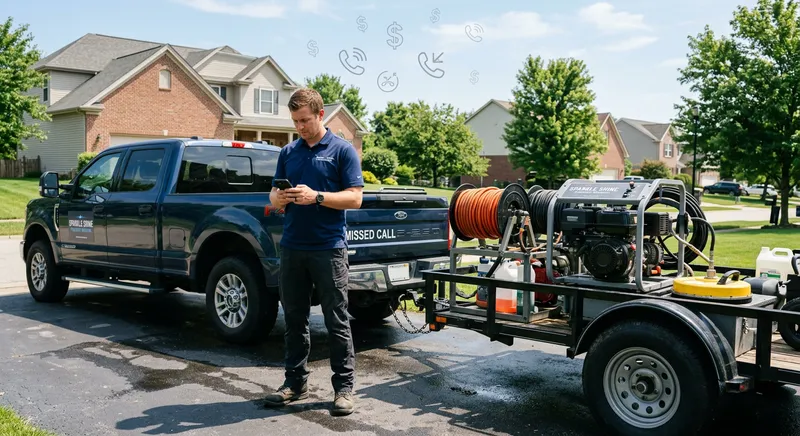
Table of Contents
A homeowner walks outside Saturday morning, looks at their green-streaked vinyl siding, and decides to get it pressure washed. They pull out their phone, Google “pressure washing near me,” and call the first company with decent reviews.
It rings four times. Voicemail.
They don’t leave a message. They call the next company. That one answers. Job booked.
You’ll never know that $350 house wash just went to your competitor. And it probably happened two or three more times this week.
Pressure Washing Leads Are Different From Other Home Services
Understanding why missed calls hit pressure washing businesses harder than most starts with how these leads behave.
They’re impulse-driven
Unlike a kitchen remodel or a landscaping redesign — where homeowners spend weeks planning — pressure washing is usually an impulse decision. Someone notices a problem (dirty driveway, moldy deck, green siding) and wants it fixed now. The buying window is short. If you don’t catch them in that moment, the urgency fades and they move on with their day.
They don’t comparison shop as aggressively
For a $300-$500 residential job, most homeowners aren’t getting five quotes. They’re calling 1-2 companies and going with whoever answers first, sounds professional, and can schedule the work within a reasonable timeframe. Research from Vendasta consistently shows that the first business to respond wins the majority of service-category leads.
They almost never leave voicemail
The general figure across home services is stark: roughly 80% of callers who reach voicemail hang up without leaving a message. For pressure washing — where the decision is low-urgency and the caller has dozens of alternatives — the drop-off rate is likely even higher. There’s simply no reason for a homeowner to wait for a callback about a $350 job when the next company is one Google search away.
They don’t call back
Once a pressure washing lead goes to a competitor, they’re gone. This isn’t like a $15,000 landscaping project where the homeowner might circle back if their first choice falls through. It’s a sub-$500 job. They book with whoever answers and forget they ever called you.
The Revenue Math (It Adds Up Faster Than You Think)
Let’s run the numbers for a typical solo or small-crew pressure washing operation during peak season.
Conservative assumptions:
- Inbound calls per week during peak months: 15-25
- Percentage you miss (on a job, driving, after hours, screening unknown numbers): 40%
- Missed calls per week: 6-10
- Of those, percentage who leave voicemail: 20%
- Lost leads per week: 5-8
Now the revenue impact:
- Average residential pressure washing job: $300-$500 (house wash, driveway, deck, or combo)
- Close rate on answered calls: 50-65% (pressure washing has high conversion because callers are ready to buy)
- Revenue lost per week: $750-$2,600
- Revenue lost per month: $3,000-$10,400
- Revenue lost over a 6-month peak season: $18,000-$62,400
Even at the conservative end — missing 5 leads per week at $300 average and a 50% close rate — you’re leaving $18,000 on the table per season.
For a pressure washing business doing $80K-$150K in annual revenue, that’s 12-23% of your top line that you never see.
And this only counts new residential leads. If you also do commercial work — where a single contract for quarterly building washes can be worth $5,000-$20,000 per year — one missed commercial lead can equal an entire month of residential revenue.
Why This Problem Is Worse for Pressure Washers Than Landscapers
Landscaping companies have some built-in cushions that pressure washers don’t:
Recurring revenue. A mowing company with 40 weekly accounts has steady income regardless of lead flow. A pressure washing business is almost entirely project-based — every dollar comes from winning new jobs or rebooking one-time customers.
Longer selling windows. A homeowner planning a patio installation might call 3-4 companies over 2 weeks. A homeowner who wants their driveway pressure washed calls one company, maybe two, in the next 10 minutes.
Higher repeat rates. Lawn care customers come back weekly or biweekly. Pressure washing customers might call once a year — maybe twice. Every missed call is potentially the only opportunity you’ll get from that customer this year.
Lower switching costs for customers. There’s very little brand loyalty in pressure washing. If you did a great job last year but don’t answer the phone this year, they’ll hire whoever does. The barrier to switching is essentially zero.
All of this means that your phone is your sales pipeline. If the phone isn’t being answered, you don’t have a marketing problem — you have a revenue problem that no amount of advertising can fix.
The Advertising Waste Problem
Here’s where it gets painful. If you’re spending money on marketing — Google Ads, Yelp, Thumbtack, yard signs, truck wraps, door hangers — every missed call is money you’ve already spent to acquire that lead, now going directly to a competitor.
The average cost per lead in pressure washing varies by market, but $15-$50 per lead from paid channels is common. If you miss 5 paid leads per week, that’s $75-$250 per week in wasted ad spend — on top of the lost revenue from those jobs.
You’re essentially paying to generate leads for the company that picks up the phone.
“I’ll Call Them Back When I’m Done”
This is the most common response from pressure washing owners, and the data doesn’t support it.
Speed-to-lead research consistently shows that the odds of qualifying a lead drop dramatically with every minute that passes. Within 5 minutes of reaching voicemail, the majority of callers have already found another provider. By the end of the day, the job is booked elsewhere.
And the callback itself creates more problems:
- Phone tag. You call back during your lunch break. They don’t answer. They call back while you’re on a job. You don’t answer. By the third round, nobody is calling anyone.
- Lost context. By the time you connect, the urgency has faded. “Oh, I actually decided to wait on that” or “I went with someone else” are the most common responses.
- Time cost. Every callback attempt takes 5-10 minutes of your time. Multiply that by 5-8 missed calls per week and you’re spending 2-3 hours per week on callbacks that mostly don’t convert.
The math is brutal: you lose the job most of the time, and you spend hours trying not to.
What the Numbers Look Like When Every Call Gets Answered
Let’s redo the math from earlier, but assume every call gets picked up:
Same scenario, every call answered:
- Inbound calls per week: 20
- Calls answered: 20 (100%)
- Close rate on answered calls: 55%
- Jobs booked per week: 11
- Average job value: $400
- Weekly revenue: $4,400
Compare that to the original scenario (40% missed):
- Calls answered: 12
- Close rate: 55%
- Jobs booked: 6.6
- Weekly revenue: $2,640
The difference: $1,760 per week — or $10,560 over a 6-month peak season from the same number of inbound leads.
You don’t need more marketing. You need to answer the phone.
Getting Ahead of the Problem
The pressure washing businesses growing fastest share a common pattern: they’ve separated “doing the work” from “answering the phone.”
The specific method varies. Some hire a spouse or part-time office person. Some use answering services. Some use AI receptionists that answer every call in seconds, qualify the lead, and book the job — all while the owner is on a job site.
What matters isn’t the method. It’s the principle: every inbound call gets a live answer within seconds, not a voicemail.
The cost of any of these solutions is a fraction of what you’re already losing. A part-time office person costs $12,000-$20,000/year. An AI receptionist costs $50-$300/month. Compare either number to $18,000-$62,000 in lost revenue per season, and the math speaks for itself.
Want to see your specific numbers? Calculate what missed calls cost your pressure washing business — it takes 30 seconds and the result will probably make you uncomfortable.