The Hidden Cost of Pest Control No-Shows on Quarterly Service Days
Quarterly pest control no-shows quietly cost a 2-tech operation $30K–$60K a year. Here is exactly where the money disappears and how to track the leak.
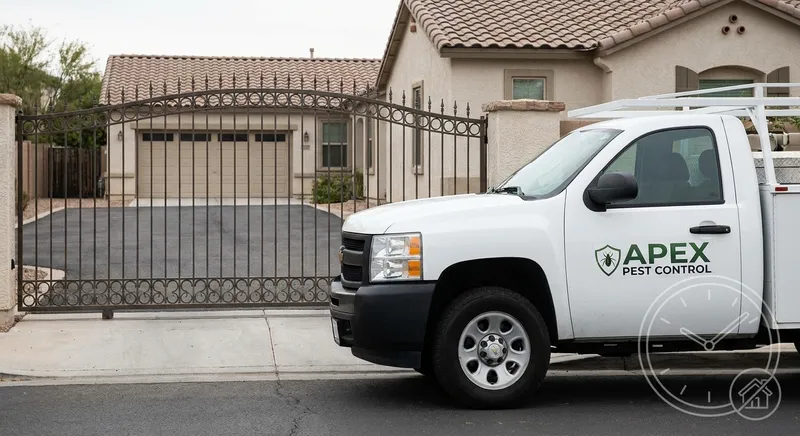
Table of Contents
It’s a Wednesday morning. Your tech rolls up to a quarterly service appointment in a quiet cul-de-sac. The customer signed up six months ago and has been on the route ever since. Today they’re not home, the gate is locked, and the dog is in the backyard.
The tech sits in the truck for eight minutes, calls the customer (no answer), texts the customer (no reply), notes the no-show in the route software, and drives to the next stop. Total time burned: 20 minutes including the drive time waste. Total revenue earned: zero.
If this happens twice a week per tech on a 2-tech operation, you’re looking at roughly 200 no-shows per year. The real cost — once you factor in lost route density, future churn, and the cascade effects — is closer to $30K–$60K annually. Here’s where it actually leaks.
What “no-show” actually means in pest control
Different from a restaurant reservation. A pest control no-show usually falls into one of four buckets, each with a different cost profile:
- Locked gate / inaccessible property (customer forgot or didn’t realize service was scheduled)
- Dog not crated (active treatment areas inaccessible even though the property isn’t)
- Customer requested reschedule that didn’t get into the system
- Customer is “done” with service but never called to cancel
The first three are operational. The fourth is the silent killer — these customers will churn within 90 days regardless, and the no-show is just the first visible symptom.
Most pest control owners track all four as the same category. They shouldn’t.
The direct cost: 22 minutes of route capacity per no-show
A typical quarterly exterior pest control visit takes 18–25 minutes door-to-door. A no-show usually consumes 15–22 minutes of route capacity (drive time, attempt to contact, documentation, drive to next stop without the offset of a successful visit).
For a 2-tech operation running 18 stops per tech per day:
- Daily route value: 36 stops × $89 (average quarterly per-visit) = $3,204
- Cost per no-show in lost capacity: $89–$132 (the visit revenue plus the drag on subsequent stops)
- Annual no-show count at 2/week/tech: ~200
- Direct annual cost: $17,800–$26,400
That’s just the appointments themselves. The cascade effects are usually larger.
Cascade 1: Re-routing forces lower density
Every no-show kicks off a chain reaction. The tech has to:
- Decide whether to reschedule immediately or push it to the next route day
- If immediately, find a slot in the same week, often at a different time of day, that adds drive time
- If pushed, the next quarter’s route is now off-cycle for this customer
The re-routing cost is invisible on any single day but adds up. Industry route optimization data — see Field Service News coverage of route density — suggests that 5–8% no-show rates degrade overall route efficiency by 12–18% because of the re-route burden.
For a 2-tech operation, that’s roughly an additional $8,000–$15,000 in annual lost capacity from re-routes that come from no-shows.
Cascade 2: Customer churn correlation
Here’s the part most pest control owners don’t track. Quarterly customers who no-show even once have a dramatically higher cancellation rate within the next two visits than customers who consistently honor their appointments.
Why? A no-show is rarely an accident. It’s usually one of:
- The customer is questioning whether they need service
- The bill arrived and felt high
- They had a bad experience with a previous visit they didn’t complain about
- They’re shopping competitors
The no-show is a signal. The customers who don’t engage with the rescheduling outreach are 3–4x more likely to cancel within 60 days. If your operation churns 50 customers a year from no-show-related issues, and the average LTV per customer is $1,200 over 2 years, that’s another $60,000 in lost lifetime revenue — most of which never shows up in any single quarter’s books.
Cascade 3: Tech morale and tenure
This one is harder to quantify but bigger than most owners realize. Techs who burn 30–60 minutes per day on no-shows lose route flow. They get frustrated. The route they were running clean starts to feel disorganized. By 2pm they’re behind, doing rushed service to catch up, which generates customer complaints.
Pest control tech retention is a known problem — we covered this in why pest control technicians quit at the 18-month mark. No-show frustration isn’t the #1 reason techs leave, but it’s reliably in the top 5 of every exit interview. The cost of techs cycling out — recruiting, training, lost productivity during ramp — runs $8,000–$15,000 per tech turnover.
Where the no-shows actually come from
Most pest control owners assume no-shows are random. They’re not. When you actually segment by cause:
- ~40% are calendar/communication failures (customer didn’t get a reminder, forgot, or got the wrong time)
- ~25% are gate/dog/access issues (the customer is home but the property isn’t accessible)
- ~20% are silent cancellations (customer has mentally moved on but hasn’t called)
- ~10% are weather/conflict driven (legitimate same-day issues)
- ~5% are scheduling errors on your side (booking mistakes, route changes that didn’t get communicated)
The first two — 65% of no-shows — are 80% preventable with better communication systems. The third bucket (silent cancellations) is a retention problem that needs a different fix.
What actually moves the no-show rate
The pest control operations that get no-show rates below 3% (industry average is 5–8%) do most of these things:
1. Multi-channel reminders, 48 and 24 hours out
A single reminder text the morning of service is too late. The best-performing reminder cadence is:
- 48 hours out: Email or text — “We’re scheduled to service your property on Wednesday morning, 9am–11am window”
- 24 hours out: Text — “Reminder: pest control service tomorrow. Please unlock the gate and bring pets inside between 9–11am”
- Morning-of: Text 30 minutes before arrival — “Your tech is 30 minutes out”
This three-touch cadence cuts no-shows by 50–70% compared to no reminders at all.
2. Easy reschedule via the same channel
If the customer needs to reschedule, they should be able to reply to the text or email directly. Friction kills compliance. If rescheduling requires a phone call during business hours, half of the customers who would’ve called won’t — they’ll just no-show.
For operations using an AI receptionist, reschedules can flow through the same phone line the customer would call anyway, even after hours. The customer calls, the AI handles the rebooking, the route software updates automatically.
3. Tight arrival windows
A “between 8am and 4pm” window means the customer has to be available all day, which means they often aren’t available at all. A “9am–11am” window is dramatically more likely to be honored.
Route software like ServSuite, PestPac, and FieldRoutes lets you set 1–2 hour windows and update the customer in real time as the route progresses. Use those features — the no-show reduction is bigger than the route flexibility cost.
4. Real same-day arrival texts
The customer who got a 48-hour reminder, a 24-hour reminder, and a “tech is 30 minutes out” text is paying attention. The customer who got nothing forgets.
This is operationally cheap and one of the highest-ROI changes most pest control operations can make. If your current route software doesn’t support automatic ETA texts, that’s a feature worth switching software for — not a minor convenience.
5. Triaging silent cancellations
The customers who no-show repeatedly and don’t respond to reschedule attempts are telling you something. Most pest control operations keep trying to schedule them for another 90 days, then quietly drop them.
Better approach: after two consecutive missed appointments with no reschedule response, send a direct email or text: “We’ve had a couple of missed appointments and want to make sure we’re still the right fit. Reply with ‘continue’ to stay on the schedule, or let us know if you’d like to pause or cancel service.”
About 40% will reply with “continue” and become more reliable customers. About 35% will pause or cancel — better to know now than to keep trying to schedule them. The remaining 25% don’t reply and quietly churn anyway.
How to calculate your own no-show cost
Spend 15 minutes pulling this data from your route software:
- Last 90 days, how many scheduled stops became no-shows? (Most software tracks this as a status — “Could Not Service,” “Locked Out,” “No Access,” etc.)
- Multiply that by 4 to annualize.
- Multiply by your average per-visit revenue to get the direct cost.
- Multiply by 1.5 to capture cascade costs (re-routes, churn correlation).
- Compare against your route software’s cost. Most pest control operations are leaving 5–10x the cost of better scheduling software on the table in no-show losses.
A 2-tech operation that runs 4,000 quarterly stops a year with a 6% no-show rate is burning roughly $32,000–$48,000 annually. Cutting that to 3% (achievable with multi-channel reminders and tight windows) recovers $16,000–$24,000 in margin. Almost none of that requires hiring or changing your service.
The bottom line
No-shows look like minor operational friction. They’re not. They’re one of the highest-cost, lowest-tracked leaks in a typical pest control business, and the cost compounds because the customers who no-show are also the customers most likely to churn.
The companies that take this seriously — three-touch reminders, tight windows, easy rescheduling, direct outreach on repeat misses — pull their no-show rates from industry average (5–8%) down to under 3%. The revenue recovery is usually 6–15x what they spend implementing the changes.
It’s not glamorous. It’s not the part of the business you’ll post on Instagram. But it’s the difference between a pest control operation that compounds and one that grinds.