How Landscape Maintenance Companies Keep Routes Full During the Off-Season
Mowing stops in November but your overhead does not. Here are the services, strategies, and systems that keep landscape maintenance companies profitable through winter.
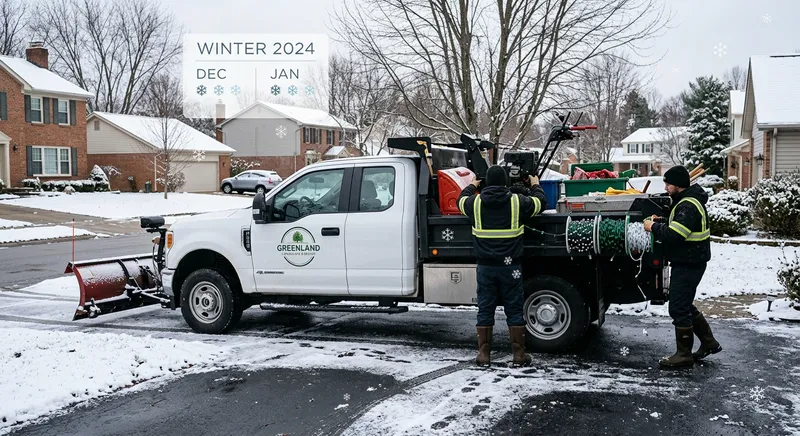
Table of Contents
November hits. The last leaves are down, the final mowing invoice goes out, and your route board goes blank. For the next 3–5 months — depending on your market — the work that generates 70–80% of your annual revenue doesn’t exist.
But your truck payments still exist. Insurance still exists. Your best crew members still need paychecks, and if you lay them off, they’ll find other work and won’t come back in April. Your marketing needs to keep running so you don’t start spring from zero. And your own mortgage doesn’t take a seasonal break.
This is the structural problem with landscape maintenance companies: the business model assumes year-round overhead on seasonal revenue. The companies that survive and grow aren’t the ones who white-knuckle through winter on savings from summer. They’re the ones who figured out how to keep routes productive — or close to it — twelve months a year.
Here’s how they do it.
The Off-Season Revenue Gap (and Why It Matters More Than You Think)
For a landscape maintenance company in a four-season climate, revenue typically follows this pattern:
- April–October (7 months): 75–85% of annual revenue
- November–March (5 months): 15–25% of annual revenue
A company doing $500K annually might earn $400K in-season and $100K off-season. Monthly revenue swings from $57K/month in peak season to $20K/month in winter.
Your fixed costs don’t follow the same curve:
- Truck and equipment payments: Same every month
- Insurance: Same every month
- Office/shop rent: Same every month
- Key employee wages (if you want to retain them): Same or slightly reduced
- Marketing spend (if you want to ramp fast in spring): Should be maintained
A typical 3–4 crew operation has $15,000–$25,000/month in fixed overhead. If winter revenue is $20,000/month, you’re barely breaking even — and one slow month puts you in the red.
The companies that thrive aren’t working harder in summer to build a bigger cash cushion (though that helps). They’re building off-season revenue streams that cover fixed costs and keep the operation running.
Service Diversification: What Actually Works
Snow and ice management
Revenue potential: High — $30K–$150K+ per season depending on market and contract volume
This is the most common off-season pivot for landscape maintenance companies, and for good reason: the equipment overlap is significant (trucks, loaders, spreaders), the customer overlap is strong (commercial properties that need mowing in summer need plowing in winter), and the margins can be excellent on contract work.
What makes it work:
- Sell contracts before the first snowfall. The best snow operators have 80–90% of their winter revenue under contract by October. Per-push pricing is fine for residential, but commercial clients want fixed monthly pricing or seasonal contracts. Lock in revenue before the weather is even a factor.
- Use your existing commercial relationships. If you maintain the grounds at an office park in summer, you should be the first call for winter services. The property manager already trusts you. Bundling lawn care and snow removal into an annual contract increases retention for both seasons.
- Price for profitability, not volume. Snow work looks profitable until you factor in equipment wear, salt costs, liability exposure, and 2 AM labor rates. According to the Snow & Ice Management Association (SIMA), companies that price snow contracts based on historical snowfall data and actual operational costs — rather than undercutting competitors — achieve 15–30% net margins. Companies that guess on pricing often break even or lose money.
The retention bonus: Offering snow removal to your existing landscape maintenance clients creates a year-round relationship. Customers who use you for both seasons churn at significantly lower rates than mowing-only accounts, because switching providers means finding two replacements instead of one.
Holiday lighting installation
Revenue potential: Moderate — $15K–$60K per season for a dedicated effort
Holiday lighting has exploded as an off-season service for landscape companies over the past decade. The work window is compressed (install in November, remove in January), the margins are strong (50–65% gross on installation), and the customer base is your existing residential and commercial clients.
What makes it work:
- Sell it as a full-service package: Design, installation, maintenance, takedown, and storage. The recurring storage and reinstallation model is where the real value lives — a customer who buys year one comes back at 70–80% of the cost in year two (no new materials, just labor).
- Start small and grow intentionally. You don’t need $20K in inventory to start. Begin with 10–15 residential jobs using standard commercial-grade LED strings. Reinvest revenue into expanding your material inventory each year.
- Price for the full service, not just installation. Residential holiday lighting jobs run $500–3,000+ depending on the home size and complexity. A typical 2,500 sq ft home with roofline, bushes, and a tree runs $800–1,500 for first-year installation. Takedown and storage add $200–400.
The upsell angle: Holiday lighting customers are, by definition, homeowners who invest in their property’s appearance. They’re prime candidates for landscape enhancement projects in spring.
Winter pruning and dormant-season tree work
Revenue potential: Moderate — $10K–$40K depending on crew capability
Many landscape maintenance companies already have crew members capable of basic pruning. Winter is the ideal time for structural pruning on deciduous trees and shrubs — the canopy is bare, the plant is dormant, and disease transmission risk is lower.
What makes it work:
- Market it to your existing customers in October. “While your trees are dormant this winter, it’s the best time to shape them and remove dead wood. We’ll include a pruning plan with your fall cleanup invoice.”
- Partner with a certified arborist if your crew doesn’t have tree care expertise. You handle the scheduling and client relationship; the arborist handles the technical work. Split the revenue or charge a project management fee.
- Focus on ornamental and small-caliper trees. You don’t need to compete with tree care companies on large removals. Ornamental pruning on Japanese maples, crape myrtles, fruit trees, and hedge shaping is accessible work that landscape crews can do safely.
Hardscape and landscape construction
Revenue potential: High — $20K–$100K+ depending on crew skill and market
In many markets, the ground doesn’t freeze hard enough to prevent construction work through November and into early December — and again in February and March. Patios, retaining walls, fire pits, walkways, and drainage projects can fill the shoulder seasons.
What makes it work:
- Bid projects in September–October for November–March installation. Homeowners often want hardscape work done before spring entertaining season. Position the off-season as a benefit: “We can start your patio in November and have it ready for spring.”
- Offer off-season pricing incentives. A 5–10% discount on projects scheduled during your slow months fills your calendar without devaluing your peak-season rates. The customer gets a deal; you get revenue when you need it most.
- Use the project revenue to retain crew. A $15,000 patio job in December keeps 2–3 crew members employed for two weeks. That’s two weeks you don’t have to worry about them finding other work.
Landscape design and planning
Revenue potential: Low-to-moderate in direct revenue, but high in pipeline value
Winter is when homeowners dream about their yards. They’re browsing Pinterest, watching HGTV, and thinking about what they want to do in spring. A landscape maintenance company that offers winter design consultations and planning services can convert those dreams into booked spring projects.
What makes it work:
- Offer free or low-cost winter consultations to existing maintenance clients. Walk the property (or review satellite imagery), discuss their goals, and present a phased plan. The consultation costs you an hour; the resulting project could be worth $5,000–$30,000.
- Build your spring pipeline in January. Every design consultation that results in a signed proposal is revenue that’s already booked before the first mow of the season. A landscape company that enters April with $50K–$100K in pre-sold project work has a fundamentally different financial outlook than one starting from zero.
Systems That Smooth the Revenue Curve
Service diversification puts work on the calendar. But the companies that truly eliminate the off-season revenue gap also build systems that shift revenue timing.
Annual contracts with level billing
Instead of billing $200/month for 7 months of mowing and $0 for 5 months, bill $117/month for 12 months. The customer pays the same annual total ($1,400), but you receive predictable monthly revenue year-round.
Level billing benefits everyone:
- For you: Predictable cash flow, easier budgeting, and retained customers (level-billed customers are less likely to cancel because they’ve committed to a 12-month cycle)
- For the customer: Predictable monthly expenses instead of high summer bills and nothing in winter. Many homeowners prefer this — it’s how they pay for electricity, insurance, and every other recurring service.
NALP data suggests that landscape companies using annual contracts with level billing retain 10–20% more customers than those using seasonal billing. The reason is behavioral: once a customer is on an annual payment cycle, canceling requires an active decision. Seasonal billing, by contrast, requires an active decision to renew — and some percentage always don’t.
Pre-selling spring work in fall
The best time to sell spring services is October — when the customer is looking at their property after a full season and can see what needs improvement.
During fall cleanups, your crews are on every property. Train them to note — on a simple checklist or via text to the office — things like:
- Mulch beds that need refreshing
- Thin spots in the lawn that need overseeding
- Shrubs that need replacement or reshaping
- Drainage areas that pooled during fall rains
- Hardscape that’s settling or cracking
Turn those notes into proposals before Thanksgiving. Customers who sign in November feel proactive (“I’ve already got my spring landscaping planned”). You enter the new year with pre-sold revenue.
Retainer agreements for commercial clients
Commercial landscape maintenance clients — HOAs, property management companies, office parks — are often receptive to annual retainer agreements that bundle summer maintenance, fall cleanup, winter services (snow, pruning, holiday décor), and spring preparation into a single monthly fee.
The retainer model transforms your commercial accounts from seasonal clients into year-round partners. A property management company paying $3,000/month for 12 months is more valuable and more stable than one paying $5,000/month for 7 months — even though the annual total is higher with the retainer. The predictability is worth the difference.
Keeping Your Crew Through Winter
Every off-season strategy ultimately serves one goal: retaining your crew. Hiring and training a landscaping crew is expensive — estimates from NALP suggest that replacing a single skilled crew member costs $3,000–$5,000 in recruiting, training, and lost productivity. Losing an entire crew over winter and rebuilding in spring can cost $10,000–$20,000 and delays your ability to service spring accounts.
The companies that retain crews through winter share a few practices:
Communicate the plan early. By September, your crew should know what winter work looks like: “We’re doing snow removal, holiday lighting, and hardscape through the winter. Hours will drop from 45/week to 30–35/week, but we’ll have work through March.” Certainty prevents people from job-hunting.
Offer cross-training as a benefit. Crew members who learn hardscaping, irrigation, or tree pruning during the off-season become more valuable — and they know it. Frame winter as a development opportunity, not a downgrade.
Maintain benefits and base wages where possible. Even at reduced hours, keeping health insurance and a consistent base wage signals commitment. The crew member who gets laid off every November and rehired every April is always one winter job offer away from never coming back.
Start With One Off-Season Service
You don’t need to launch five new services this November. Pick one that fits your market, equipment, and crew skills:
- Already have trucks and commercial accounts? Snow removal is the natural first step.
- Strong residential customer base in affluent neighborhoods? Holiday lighting has the best margins for the effort.
- Crew with construction experience? Hardscape projects in the shoulder seasons are the highest-ticket option.
- None of the above? Start with annual contracts and level billing on your existing mowing accounts. It doesn’t add a new service — it restructures the revenue you already have.
The goal isn’t to make winter as profitable as summer overnight. It’s to cover your fixed costs, retain your crew, and enter spring with momentum instead of debt.
Related: AI receptionist for lawn maintenance companies | How to price landscape maintenance contracts | Seasonal cash flow: why profitable landscaping businesses run out of money in winter | Off-season revenue in lawn care | Landscaping off-season prep for 2027