How Pest Control Companies Handle High Call Volume During Termite Season
Termite season floods pest control phones with urgent calls. Here are the real options for handling the surge without losing leads or burning out your office staff.
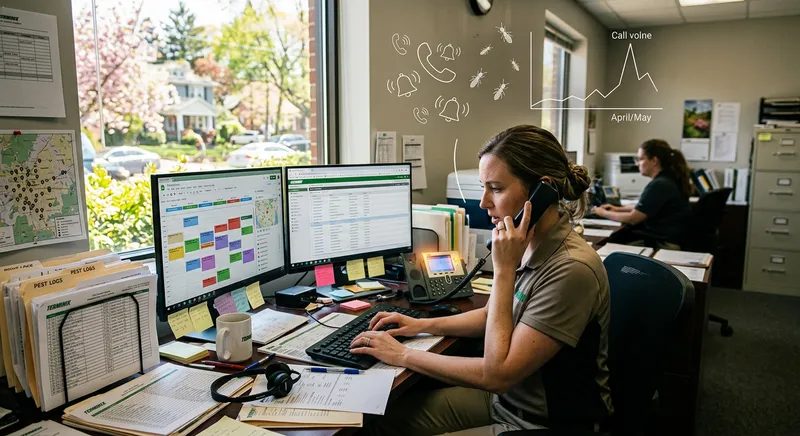
Table of Contents
A homeowner sees a cloud of winged insects pouring out of a crack in their foundation wall. They don’t know if they’re termites or flying ants, but they’re panicking. They Google “pest control near me” and start calling.
Your phone rings. And rings. And rings again. For the next six weeks, this is your life — because termite swarming season has arrived, and every homeowner in your service area who spots a swarm is calling within minutes.
The question isn’t whether your phones will get overwhelmed during termite season. It’s whether you’ve built a system to handle it before the swarms start.
Why Termite Season Creates a Unique Call Problem
Most pest control companies deal with steady, manageable call volume for 9-10 months of the year. General pest control — ants, roaches, spiders, rodents — generates consistent leads spread across the calendar.
Then termite season hits.
The volume spike is sudden and extreme
Termite swarms are triggered by weather — typically warm temperatures following rain in spring. When conditions align, swarms happen across an entire region within days. The National Pest Management Association (NPMA) estimates that termites cause over $5 billion in property damage annually in the United States, and the majority of new termite discoveries happen during swarming season — typically March through June, depending on region and species.
This means your call volume doesn’t gradually increase. It spikes. A company that normally handles 8-12 calls per day might get 30-50 during peak swarming weeks.
Every call feels urgent to the caller
A homeowner who just watched hundreds of winged insects emerge from their wall is not in a research phase. They want someone on the phone immediately. They want an inspection scheduled this week. If you don’t answer, they’re calling the next company before your phone stops ringing.
The calls cluster at predictable times
Swarms typically happen in the morning or early afternoon. Homeowners discover evidence after work or on weekends. This means your heaviest call periods are:
- Early morning (before your office opens)
- Late afternoon and evening (after homeowners get home from work)
- Weekends (when people are doing yard work and notice damage)
These are exactly the times when a small pest control office is least likely to have someone available to answer.
Missed termite calls have outsized revenue impact
A general pest control call might be worth $150-$300 for a one-time treatment. A termite call is different:
- Initial termite inspection: $75-$150 (or free as a loss leader)
- Termite treatment: $1,500-$3,000+ depending on method and property size
- Annual monitoring contract: $200-$400/year
- Lifetime customer value: $3,000-$8,000+
Missing a termite lead doesn’t cost you a $200 service call. It costs you a multi-thousand-dollar treatment plus years of monitoring revenue. Five missed termite leads in a week can easily represent $10,000-$15,000 in lost revenue.
What Happens When You Can’t Keep Up
The pattern is predictable. Swarming starts. Your two office staff are on the phone constantly. A third call comes in and goes to hold. A fourth goes to voicemail. The caller hangs up and calls your competitor.
Meanwhile, your technicians in the field are getting calls from customers trying to reach the office. Your office staff are too overwhelmed to properly qualify leads — they’re just taking names and numbers as fast as they can. Nobody is following up on yesterday’s messages because today’s phones won’t stop ringing.
Within a week, the cracks show:
- Lead quality drops because nobody has time to ask the right qualifying questions
- Scheduling becomes chaotic because appointments are being booked without checking technician availability
- Customer experience suffers because hold times increase and callbacks take 24+ hours
- Your best revenue opportunity of the year gets partially squandered because you can’t process the demand
The cruel irony: you spent all winter marketing for termite season, and now that the leads are arriving, you can’t handle them.
Option 1: Hire Temporary Office Staff
The traditional approach — bring on seasonal help to answer phones during peak months.
What works:
- Human judgment on complex calls
- Can handle scheduling, follow-ups, and other admin tasks between calls
- Callers talk to a real person
What doesn’t:
- Lead time. You need to hire and train before the surge starts. Termite swarming is weather-dependent — you can estimate the window but not the exact week. Hire too early and you’re paying for idle time. Hire too late and you’ve already missed the peak.
- Cost. A temporary office employee costs $2,500-$4,000/month after taxes and overhead. For a 2-3 month peak season, that’s $5,000-$12,000.
- Coverage gaps. A temp employee covers 40 hours a week. Your heaviest call times — evenings, weekends, early mornings — fall outside those hours.
- Training. They need to learn your services, pricing, scheduling system, and service area. For a 6-8 week stint, the training-to-value ratio is poor.
Best for: Companies with $1M+ revenue that can absorb the cost and need someone handling admin work beyond just phones.
Option 2: Overflow Answering Service
Answering services provide human operators who pick up calls your office can’t handle — either after a set number of rings or during off-hours.
What works:
- Immediate activation. Most services can start within 24-48 hours.
- 24/7 coverage. Calls get answered evenings, weekends, and holidays.
- Scalable. You pay per minute or per call, so it flexes with volume.
What doesn’t:
- No lead qualification. Operators take a message — name, number, “they said something about termites.” You still have to call back and qualify.
- No scheduling. They can’t check your calendar or book inspections.
- Generic scripts. They’re answering for dozens of businesses simultaneously. Don’t expect them to explain the difference between subterranean and drywood termites.
- Cost at volume. At $1.50-$3.00 per minute, a 4-minute call costs $6-$12. During peak season with 20+ overflow calls per day, monthly bills can hit $2,000-$4,000+.
Best for: Companies that already have office staff but need a safety net for overflow and after-hours during the surge.
Option 3: AI Receptionist
AI receptionists answer calls using artificial intelligence — they have natural conversations, qualify leads, capture property details, and can book appointments without human involvement.
What works:
- Handles multiple simultaneous calls. When 5 homeowners call at the same time after a swarm, all 5 get answered immediately. No hold queue.
- Lead qualification built in. The AI asks about the type of pest, property details, severity, and timeline — so you get a qualified lead summary, not just a name and number.
- Appointment booking. Some AI receptionists check your availability and schedule inspections while the caller is still on the phone. No callback needed.
- 24/7 with flat pricing. Monthly rates mean peak-season call surges don’t blow up your bill the way per-minute answering services do.
- Consistent quality. Call #1 of the day gets the same professional handling as call #47.
What doesn’t:
- Complex situations. Highly unusual pest issues or emotional callers may need human follow-up. Good systems flag these for you.
- Setup time. You need to configure your services and common questions upfront — usually under 15 minutes.
Options in this category include industry-specific platforms like Tinylawn (a pest control answering service that also covers other home service verticals) as well as general-purpose AI receptionist platforms. Pricing typically ranges from $49-$300/month depending on call volume.
Best for: Small-to-mid pest control companies (1-15 technicians) that need full-time coverage without full-time payroll. Particularly effective during seasonal surges when call volume is unpredictable.
Option 4: Online Booking and Self-Service
Adding online scheduling to your website lets homeowners book inspections without calling at all.
What works:
- Reduces inbound call volume. If 20-30% of leads book online, that’s significantly fewer calls to handle.
- Always available. Works at 2 AM on a Sunday when nobody is answering phones.
- Low cost. Most scheduling tools cost $20-$50/month.
What doesn’t:
- Panicking homeowners prefer calling. Someone who just discovered termites swarming in their living room is not going to calmly fill out a web form. They want to talk to someone now.
- No qualification. A web form captures what the customer tells you, which is often incomplete or inaccurate. “I think I have termites” could be termites, carpenter ants, or a completely different issue.
- Doesn’t solve the phone problem. Online booking supplements phone answering — it doesn’t replace it. The calls still come in.
Best for: A complement to any of the above options, not a standalone solution for termite season call surges.
The Smart Play: Layer Your Approaches Before the Surge
The pest control companies that capture the most termite-season revenue don’t rely on a single system. They layer solutions before the swarms start.
Before swarming starts (January-February):
- Set up a pest control answering service or overflow coverage so it’s ready before you need it
- Add online booking to your website for non-urgent inquiries
- Pre-build your termite inspection schedule with dedicated time slots
During peak season:
- Office staff handles complex calls, follow-ups, and scheduling adjustments during business hours
- AI receptionist or answering service catches overflow and after-hours calls
- Online booking captures leads from homeowners who prefer self-service
- Every call gets answered. Every lead gets captured. Nothing falls through the cracks.
After the surge:
- Review your call data to see where leads were lost
- Calculate your capture rate compared to previous years
- Keep your after-hours system running — termite calls don’t stop completely after swarming season ends
The Bottom Line
Termite season is the highest-revenue window of the year for most pest control companies. The businesses that grow fastest aren’t necessarily the ones with the best marketing or the lowest prices — they’re the ones that can handle the call volume when it arrives.
Whether you hire seasonal staff, add an overflow service, deploy an AI receptionist, or combine all three — the principle is the same: build the system before you need it. By the time swarms start, it’s already too late to set something up without losing leads.
Start planning your termite season phone strategy now. Your competitors already are.
Want to see what missed calls are costing you? Calculate your revenue loss in 30 seconds.