How Snow Removal Companies Handle 2 AM Storm Calls Without Losing Sleep or Contracts
Snow removal companies lose contracts when they miss storm-night calls. Here are the approaches that keep you responsive at 2 AM without burning out your team.
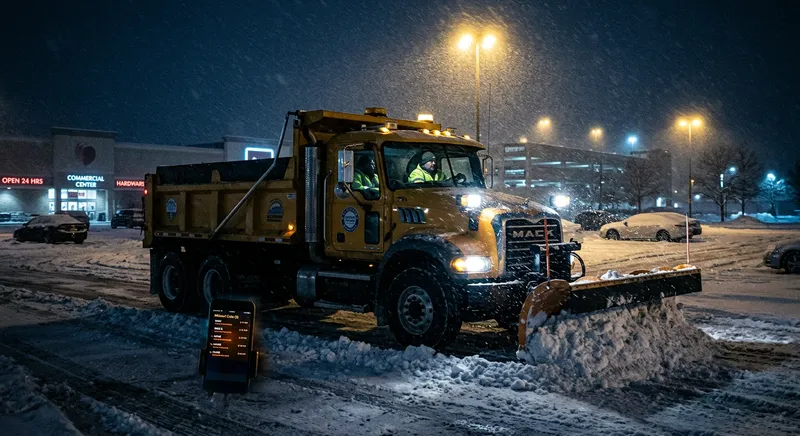
Table of Contents
It’s 2:17 AM. The storm that weather models showed arriving at midnight is dumping 3 inches per hour. Your phone lights up on the nightstand.
First call: your biggest commercial client — a 200-unit apartment complex — wants to confirm you’re coming. Second call: a property manager with 6 retail locations needs an ETA. Third call: a homeowner on your residential route asking if driveways are included in the service or just the main lot.
By 2:45 AM, you’ve taken 4 calls and you’re already behind on your route. Your lead driver is asking whether to start the east side or the west side. Your phone rings again while you’re pulling on boots.
This is every snow removal company’s reality during storm events. The calls come at the worst possible time — when you need to be plowing, not talking — and missing them carries real consequences. A property manager who can’t reach you at 2 AM during a storm doesn’t just complain. They find another contractor.
Why storm-night calls are different from any other service call
Most field-service businesses deal with missed calls during business hours. Snow removal has a unique problem: the critical calls come during the hours when no human should reasonably be expected to answer a phone.
The timing mismatch:
- Storms hit at night. The National Weather Service data shows that roughly 60% of significant snowfall events in the northern U.S. have peak accumulation between 10 PM and 6 AM.
- Property managers need confirmation during the storm, not the next morning. They’re responsible for tenant safety, slip-and-fall liability, and parking lot access. Waiting until 7 AM to confirm your crew is working isn’t acceptable.
- Residential customers panic at odd hours. They see 6 inches on the ground at 5 AM and call to make sure their driveway will be clear before they leave for work at 7.
The stakes:
- A commercial property manager who can’t reach you during a storm will add a backup contractor. By the second storm where you’re unreachable, the backup becomes the primary. You’ve lost the contract without a formal cancellation — it just migrated.
- Slip-and-fall liability makes property managers aggressive about documentation. They want a text, a call, or an email confirming what time you serviced the property. If they can’t reach you to get that confirmation, they feel exposed.
- Residential customers who can’t reach you during a storm will cancel for next year. They don’t care that you were plowing at 3 AM and couldn’t answer — they expected someone to pick up.
The five approaches snow removal companies use
Approach 1: The owner handles everything
The owner sleeps with the phone on the pillow and answers every call between plowing runs. This is the default for companies under $200K in snow revenue.
Why it breaks:
- Sleep deprivation during multi-day storm events is dangerous. You’re operating heavy equipment on icy roads at 3 AM on 2 hours of sleep while answering calls. This is how accidents happen.
- You can’t answer while plowing. A call that comes in while you’re pushing a lot goes to voicemail — and the property manager interprets that as “my contractor isn’t working.”
- Storm events can last 24–72 hours. No single person can handle calls, dispatch crews, and plow for three days straight.
Real cost: $0 in dollars. Enormous in burnout, safety risk, and missed calls.
Approach 2: A dispatcher on the overnight shift
You designate one person — a spouse, a retired employee, a trusted office person — to be the overnight phone handler during storm events. They answer calls, relay messages, confirm service times, and update property managers.
Why it works:
- Separation of duties. The plowing crews plow. The dispatcher communicates. Nobody is trying to do both.
- Human judgment. A dispatcher can triage calls: the apartment complex manager gets an immediate callback, the homeowner asking about sidewalks can wait until morning.
- Real-time coordination. The dispatcher knows where crews are and can give property managers accurate ETAs.
Why it’s hard:
- Finding someone willing to work the 10 PM–6 AM shift during storm events is difficult and expensive. These shifts are unpredictable (weather-dependent), miserable (you’re up all night), and infrequent enough that you can’t hire a full-time overnight person.
- If you pay $20–25/hour for 8 hours per storm event, and you have 15–25 significant events per season, that’s $2,400–$5,000/season just for the dispatcher — plus the management overhead of coordinating them.
- Backup coverage. What if your dispatcher is sick during a storm? What if two storms hit in the same week?
Real cost: $2,400–$5,000/season for a part-time overnight dispatcher.
Approach 3: Automated status updates
Instead of waiting for clients to call, you push updates proactively via text or email. Before the storm: “Storm expected tonight, crews will begin at midnight, your property is on our route.” During the storm: “Crews are active, estimated service time for your property: 3–5 AM.” After: “Your property was serviced at 4:15 AM. Next pass if accumulation continues.”
Why it works:
- Eliminates 60–70% of inbound calls. Most storm-night calls are “are you coming?” and “when will you be here?” Proactive updates answer those questions before they’re asked.
- Documentation. Text and email updates create a timestamped record that protects both you and the property manager in liability situations.
- Professional impression. Property managers who receive proactive updates perceive your company as organized and reliable — even if your actual plowing timeline is the same as a competitor who doesn’t communicate.
Why it’s not enough on its own:
- It doesn’t handle inbound calls. New inquiries, schedule changes, emergency requests, and unusual situations still require someone (or something) to answer the phone.
- Setup time. You need a system to send bulk texts/emails to your client list. Group texting, a CRM with automation, or a bulk SMS service like Textline or SimpleTexting adds $25–100/month.
- Some clients want a conversation, not a text. A property manager dealing with a tenant emergency (car stuck, slip-and-fall, access issue) needs to talk to someone, not read a status update.
Real cost: $25–100/month for a texting platform, plus 15–30 minutes per storm event to send updates.
Approach 4: Traditional answering service
You route calls to a live answering service during storm events. Operators answer with your company name, take messages, and forward them to you via text or email.
Why it works:
- Human voice at 2 AM. The property manager calls and reaches a person, not voicemail. This alone retains contracts.
- 24/7 availability without your personal involvement.
Why it falls short for snow removal:
- Operators can’t answer operational questions. “When will my lot be plowed?” requires knowledge of your route, your crew positions, and the storm progression. The operator says “I’ll have someone call you back” — which is better than voicemail but doesn’t solve the property manager’s actual need.
- Per-minute billing during storms. A busy storm night might generate 20–40 calls, many of them 3–5 minutes long. At $1.00–$1.50/minute, a single storm event can cost $100–$300 in answering service fees. Over a season, that’s $1,500–$7,500.
- No integration with your operations. The operator takes a message. You still have to call back between plowing runs.
Real cost: $1,500–$7,500/season depending on call volume and storm frequency.
Approach 5: AI answering service
An AI receptionist answers calls 24/7, handles simultaneous calls during storm surges, collects caller information, answers FAQs you’ve configured (route timing, services included, emergency procedures), and sends you a notification with a summary.
Why it works for snow removal specifically:
- Simultaneous calls during surges. When 8 clients call in the same 30-minute window during a storm, all 8 get answered. No hold queue, no busy signal, no voicemail. This is the biggest advantage over both a human dispatcher and a traditional answering service.
- Configured storm responses. You pre-load FAQ answers for storm-night questions: “Our crews are currently active and servicing properties on our standard route. Your property is scheduled for service between [X] and [Y] AM. If conditions require an additional pass, we’ll return within 4 hours of the first service.” The AI delivers this consistently to every caller.
- Classification and triage. The AI categorizes calls automatically — existing client check-in, emergency request, new inquiry, spam — so when you check your phone between lots, you can see at a glance which calls need your attention and which were handled.
- Cost stability. Flat monthly fee regardless of storm intensity. A 5-storm season costs the same as a 25-storm season (assuming you stay within your plan’s call limit, with modest per-call overages above it).
- No staffing headaches. No overnight dispatcher to recruit, train, and manage. No sick days during the biggest storm of the year.
The limitations:
- The AI can’t give real-time ETAs based on crew position. It can give the scheduled service window you’ve configured, but not “your lot will be done in 20 minutes” — that requires real-time operational knowledge.
- It can’t handle genuinely complex situations. A property manager reporting a slip-and-fall needs a human. The AI captures the details and flags the call as urgent, but resolution requires your judgment.
- Some long-standing commercial clients expect to reach you personally. For your top 3–5 accounts, you may want to keep your direct cell number available and route everything else to the AI.
Real cost: Tinylawn’s base plans run $49–$249/month before overage. The right tier depends on billable call volume, and seasonal overage can apply after the monthly allowance.
The hybrid setup that most snow removal companies land on
In practice, the best storm-night communication setup combines approaches:
Pre-storm: Send proactive status updates to all clients (Approach 3). This eliminates the majority of “are you coming?” calls before they happen.
During the storm: AI or an answering service handles all inbound calls (Approach 4 or 5). Calls are answered, information is captured, FAQs are addressed. You get notifications for anything that needs your attention.
Your role during the storm: Plow. Check notifications between lots — takes 60 seconds. Call back anything flagged as urgent. Everything else was handled.
Post-storm: Send completion confirmations (Approach 3 again). “Your property was serviced at [time]. Photo attached.” This closes the loop and gives the property manager documentation for their records.
This combination costs $50–$300/month depending on volume and tool choices — a fraction of what a lost commercial contract would cost.
The contract retention angle
This isn’t just about comfort or convenience. Storm-night communication is a contract retention issue.
Commercial snow removal contracts are typically awarded in September or October for the coming winter. Property managers evaluate vendors based on the previous season’s performance. The three factors they weight most heavily:
- Reliability of service. Did the contractor show up on time, every storm?
- Communication during events. Could the property manager reach the contractor during storms? Did they receive timely updates?
- Price. Competitive, but rarely the deciding factor if #1 and #2 are strong.
A contractor who plows perfectly but is unreachable at 2 AM will lose contracts to one who plows adequately and communicates well. Property managers can tolerate a lot — delayed service during heavy storms, an occasional missed pass — as long as they know what’s happening. What they can’t tolerate is silence.
Measuring what matters
Track these numbers across the season:
- Storm-night calls received vs. answered. If more than 10% go to voicemail during storms, your system has a gap.
- Average response time for urgent calls. How long between a flagged notification and your callback? Target: under 15 minutes for emergencies, under 1 hour for non-emergencies.
- Client check-in calls before vs. after implementing proactive updates. If proactive texts reduce inbound calls by 50–60%, the system is working — your clients feel informed and aren’t calling to ask “are you coming?”
- Contract renewal rate. The ultimate metric. If you retain 90%+ of commercial contracts year over year, your communication system is doing its job.
The bottom line
The snow removal companies that hold commercial contracts for 5, 10, 15 years aren’t necessarily the biggest or the cheapest. They’re the ones that answer the phone at 2 AM.
You don’t have to personally answer every storm-night call. You need a system that does — whether that’s a dispatcher, an AI, a proactive update system, or a combination. The cost of any of these solutions is trivial compared to the cost of losing a $30,000–$100,000 commercial contract because a property manager couldn’t reach you during the one moment when reaching you mattered most.
Build the system before the first flake falls. Your future self — the one who’s plowing a parking lot at 3 AM while the phone rings — will be grateful.
Related: AI receptionist for snow removal companies | After-hours answering service | Flat rate vs. per-push snow removal pricing | Snow removal appointment scheduling software