How to Bid Commercial Landscape Maintenance Contracts
A practical guide to bidding commercial landscape maintenance contracts — from measuring properties to calculating costs to presenting proposals that win.
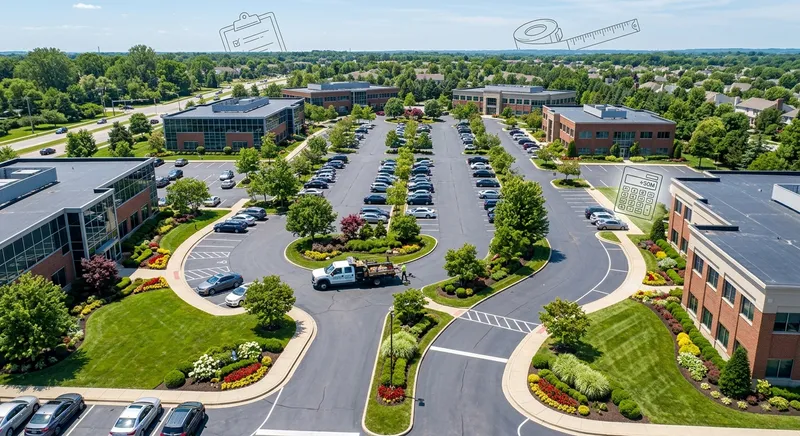
Table of Contents
A property manager emails you a bid request for a 12-acre office park. Mowing, edging, bed maintenance, seasonal color, irrigation checks, snow removal, and “general grounds maintenance.” They want a monthly price.
You drive out, walk the property for 30 minutes, and sit in your truck trying to figure out what to charge. Too high and you don’t get the contract. Too low and you’re locked into 12 months of losing money on the biggest property you’ve ever serviced.
Commercial landscape maintenance bidding is where many residential-focused companies stumble. The properties are bigger, the scopes are more complex, the clients are more sophisticated, and the margins are thinner if you don’t know what you’re doing. But commercial contracts are also the most reliable revenue in the landscaping business — 12-month agreements with predictable monthly payments that don’t depend on weather or homeowner impulse.
Here’s how to bid them accurately.
Step 1: Understand the scope before you measure anything
Commercial bid requests (RFPs) vary dramatically in specificity. Some spell out every task with frequency. Others say “maintain the grounds” and leave the interpretation to you.
Before you measure a single square foot, make sure you understand:
What’s included:
- Mowing: How often? Weekly? Biweekly? Growing season only or year-round?
- Edging and string trimming: Every visit or periodic?
- Bed maintenance: Weeding, mulch, pruning — how often and to what standard?
- Seasonal color: Annual flower installations — how many beds, how many rotations per year?
- Irrigation: Basic monitoring or full management including repairs?
- Snow and ice: Included in the grounds contract or separate?
- Leaf removal: Fall cleanup — how many visits?
- Fertilization and weed control: Turf applications included?
- Tree and shrub care: Pruning cycles — annual, semi-annual, as-needed?
What’s the standard? An office park headquarters wants pristine grounds. An industrial warehouse complex wants it mowed and presentable. The service frequency and detail level for each are completely different — and so is the pricing.
What’s the contract term? One year? Three years? Month-to-month? Longer terms justify tighter pricing because you have revenue certainty. Short terms or month-to-month should carry a premium.
Who is the decision-maker? Property managers, HOA boards, facility managers, and building owners all evaluate bids differently. Property managers care about reliability and documentation. HOA boards care about resident complaints. Understanding the evaluator helps you tailor the proposal.
Step 2: Measure the property thoroughly
This is where bids are won or lost. An inaccurate measurement leads to inaccurate pricing, which leads to either losing the bid (too high) or losing money (too low).
What to measure
Turf areas (in square feet or acres). Break these into categories:
- Open turf (rideable): Areas your largest mower can handle efficiently
- Trimming-intensive turf: Narrow strips, areas around bollards/signs/islands, steep slopes
- Non-mowable turf: Slopes too steep to mow, areas requiring hand work
The ratio of open turf to trimming-intensive turf matters enormously. A 5-acre property that’s 90% open field is a very different job than a 5-acre property with 200 parking lot islands, 30 bollards, and extensive fence line.
Bed areas (in square feet). Count and measure:
- Total bed square footage
- Number of annual color beds and approximate square footage each
- Mulch depth expectation and total cubic yards needed per application
- Shrub count for pruning estimates
Hardscape edges (in linear feet). Total linear feet of curb, sidewalk, and building edges that need string trimming or edging per mowing visit.
Irrigation zones. If irrigation management is included, count zones, note controller locations, and assess system condition.
Unique features. Anything that adds time: retention ponds requiring bank mowing, berms, monument signs with detail landscaping, playground areas, dog parks, athletic fields.
Tools that help
- Measuring wheel for hardscape edges and bed perimeters
- Satellite measurement tools (Google Earth Pro is free) for turf and bed areas — measure from overhead, then ground-truth the key sections
- Property site maps — ask the property manager if they have a landscape plan on file. Many commercial properties have as-built drawings that show bed locations, irrigation layouts, and turf areas. This saves hours of measuring.
Step 3: Calculate your costs
Labor hours per visit
This is the core of your bid. For each service task, estimate the labor hours per visit:
Mowing:
- Production rate for open turf: 1-2 acres/hour per mower (varies by mower size and terrain)
- Production rate for trimming-intensive areas: 0.3-0.5 acres/hour
- String trimming and edging: estimate linear feet ÷ your crew’s production rate (typically 3,000-5,000 linear feet per hour per trimmer)
- Blowing: 15-30 minutes per visit depending on hardscape area
Example: A 5-acre office park with 4 acres of open turf, 0.5 acres of trimming-intensive areas, and 3,000 linear feet of edging:
- Riding mow: 4 acres ÷ 1.5 acres/hr = 2.7 hours
- Trimming areas: 0.5 acres ÷ 0.4 acres/hr = 1.25 hours
- String trim/edge: 3,000 ft ÷ 4,000 ft/hr = 0.75 hours
- Blowing: 0.5 hours
- Total per mow: 5.2 crew hours
Bed maintenance: Estimate visits per month and hours per visit based on total bed area and weed pressure. Typical ranges: 2-4 visits/month during growing season at 1-4 hours per visit depending on total bed area.
Seasonal color: Hours per installation × number of rotations per year. Budget 20-30 minutes per flat of annuals for install plus bed prep.
Pruning: Estimate total shrub count, group by size, and apply production rates. Typical: 15-30 shrubs per crew hour for maintenance pruning.
Hourly cost calculation
Your fully loaded cost per crew hour includes:
| Cost component | Typical range per crew hour |
|---|---|
| Labor (wages + payroll taxes + workers’ comp) | $25-$45 |
| Equipment (amortized: mowers, trimmers, blowers, truck) | $15-$30 |
| Fuel | $5-$10 |
| Insurance (GL, auto) | $3-$8 |
| Overhead allocation (office, admin, phone, software) | $5-$15 |
| Total fully loaded cost per crew hour | $53-$108 |
Your market, crew size, and equipment determine where you fall in this range. If you don’t know your actual cost per hour, calculate it before you bid a commercial contract. Guessing is how you end up locked into a money-losing agreement for 12 months.
Target billing rate
Your billing rate should be 1.5-2.5x your fully loaded cost, depending on your market and the competitiveness of the bid. For commercial maintenance:
- Competitive markets (many bidders): 1.5-1.8x
- Average markets: 1.8-2.2x
- Premium positioning or specialized services: 2.2-2.5x
At a fully loaded cost of $75/hour and a 2.0x multiplier, your target billing rate is $150/crew hour.
Step 4: Build the monthly price
Take your labor estimates, multiply by your billing rate, add materials, and divide by 12 for a monthly price.
Example for the 5-acre office park:
| Service | Annual labor hours | Annual cost (at $150/hr) | Annual materials |
|---|---|---|---|
| Mowing (40 visits × 5.2 hrs) | 208 hrs | $31,200 | $800 (fuel, blades) |
| Bed maintenance (7 months × 3 visits × 2 hrs) | 42 hrs | $6,300 | $400 (herbicide) |
| Mulch (2 applications × 80 cu yd × $6/hr install) | 24 hrs | $3,600 | $3,200 (mulch) |
| Seasonal color (2 rotations × 6 hrs) | 12 hrs | $1,800 | $1,200 (plants) |
| Pruning (3 cycles × 8 hrs) | 24 hrs | $3,600 | $200 |
| Fall cleanup (3 visits × 6 hrs) | 18 hrs | $2,700 | $300 |
| Irrigation monitoring (monthly checks) | 14 hrs | $2,100 | $0 |
| Total annual | 342 hrs | $51,300 | $6,100 |
Total annual contract value: $57,400 Monthly price: $4,783
Step 5: Sanity-check your bid
Before submitting, run these reality checks:
Per-acre comparison. Divide your total annual price by the total maintained acreage. Commercial landscape maintenance typically runs $8,000-$15,000 per acre per year for full-service grounds maintenance (mowing, beds, mulch, seasonal color, pruning). If your number is far outside this range, recheck your labor estimates.
For the example above: $57,400 ÷ 5 acres = $11,480/acre. That’s solidly in the typical range for a well-maintained office park.
Profit margin check. Your total cost (labor cost + materials) should be 40-65% of the contract value. If your costs are above 65%, the margin is too thin for the risk of a 12-month contract. If they’re below 40%, you’re either very efficient or you’re missing costs.
Comparable contracts. If you’re already maintaining similar properties, compare the per-acre cost and the monthly price. Significant deviations should have a clear explanation (higher bed density, more seasonal color, irrigation management included, etc.).
Step 6: Present the proposal
Commercial bid proposals should include:
Scope of work. List every service with frequencies — not vague descriptions like “maintain grounds,” but specific commitments: “Mow all turf areas weekly during growing season (April-October), biweekly November and March.”
Material specifications. Mulch type and depth, annual flower varieties and sizes, fertilizer program details. This shows professionalism and prevents scope arguments later.
Monthly pricing with optional line items. Present the base monthly price for included services. List optional services (snow removal, irrigation repairs, tree work) as separate line items so the client can choose.
Insurance documentation. Commercial clients want proof of general liability ($1M minimum, often $2M), auto insurance, and workers’ comp. Have certificates of insurance ready.
References. Two to three existing commercial clients with similar property types. Include the property manager’s name and contact information (with their permission).
Photos of comparable work. Your best commercial property photos. If you’re bidding your first commercial contract, use your best residential work and be transparent about your growth trajectory.
Common bidding mistakes
Underestimating trimming time. Commercial properties have significantly more linear footage of trimming (curbs, islands, bollards, signs, fences) than residential properties. This is the most commonly underestimated line item and can represent 25-35% of total mowing labor.
Ignoring seasonal variation. Mowing happens 35-42 times per year in most markets, but bed work, pruning, and cleanup are concentrated in specific months. If you calculate monthly cost by dividing annual costs by 12, make sure your cash flow can handle the months when you’re delivering more service than you’re billing for.
Bidding below cost to “win” the contract. A commercial contract you lose money on is worse than no contract at all. It consumes your crew’s time and equipment for 12 months while preventing you from taking profitable work. Be willing to lose bids that don’t pencil out.
Not visiting the property multiple times. One 30-minute walkthrough isn’t enough for a major commercial bid. Visit during different times of day (morning irrigation, afternoon shade patterns), and ideally after rain (to see drainage issues). Each visit reveals details that affect your labor estimate.
Forgetting the contract escalation clause. Multi-year contracts should include an annual price escalation of 3-5% to cover labor and material cost increases. If you lock in a 3-year contract with no escalation, you’re giving yourself a pay cut every year.
The best commercial bids are built on accurate measurement, honest cost accounting, and clear communication. The property manager who receives a detailed, well-organized proposal at a fair price is far more likely to select you than one who receives the lowest number on a one-page sheet — because they know you’ve done the work to understand their property.
Pricing the bid accurately is only half of commercial work. The other half is getting invited to bid in the first place — for the sales and prospecting side, see how to get commercial landscaping contracts. Those invitations often start as a phone call. If the office is on a mower when the property manager rings, a landscaping answering service keeps the request from dying in voicemail.