How to Upsell Lawn Care Customers Into Higher-Margin Services
Your mowing customers are already paying you to show up every week. Here is how to turn those visits into aeration, fertilization, and landscape work without being pushy.
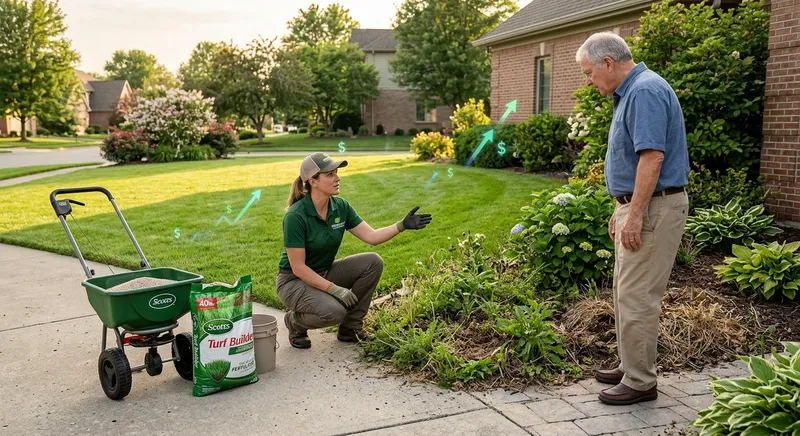
Table of Contents
You show up every Tuesday, mow the lawn, blow the clippings, and leave. The customer pays you $45 a visit. You’ve been doing it for two years. The relationship is solid.
Meanwhile, they hired a different company to aerate last fall. They paid a fertilization service $65 per application, six times a year. Their neighbor recommended a guy for the mulch beds. And when the backyard drainage started pooling after every rain, they called a landscaper they found on Google.
You were on their property 40 times last year. You saw the compacted soil, the thinning turf, the bare mulch beds, and the drainage issue. But you never mentioned it. So they hired four other companies to do work you could have done — and probably would have done better, since you already know the property.
This is the upsell gap, and it’s the single biggest revenue leak in residential lawn care.
Why Upselling Matters More Than Adding New Customers
Most lawn care companies focus their growth energy on acquiring new customers. More doors, more mailers, more Google Ads. That works — but it’s expensive. Industry data from the National Association of Landscape Professionals (NALP) suggests that acquiring a new lawn care customer costs 5–7x more than selling additional services to an existing one.
Your current mowing customers are your cheapest, warmest sales pipeline. They already trust you. They already have a payment relationship with you. They see you on their property every week. And most of them need services beyond mowing — they just don’t know you offer them, or they haven’t been prompted to think about it.
The math is straightforward:
- 100 weekly mowing customers at $45/visit = $4,500/week in mowing revenue
- If 20% add fertilization (6 apps/year at $65) = $7,800/year in new revenue
- If 15% add fall aeration ($150/lawn) = $2,250 in new revenue
- If 10% add a mulch/bed maintenance package ($400/year) = $4,000/year in new revenue
- Total upsell revenue: ~$14,050/year from the same customer base
That’s a 10–15% revenue increase with zero customer acquisition cost. No new routes, no new marketing spend, no cold leads to chase.
The Services Worth Upselling (Ranked by Margin)
Not all add-on services are created equal. Here’s how common lawn care upsells stack up on margin and ease of delivery:
Tier 1: High margin, low additional effort
Fertilization and weed control programs. This is the single best upsell in lawn care. A 6-application fertilization program on a property you already mow takes 10–15 minutes per visit. Product cost is $8–15 per application for a standard residential lawn. You charge $55–75 per application. That’s 70–80% gross margin on a service where you’re already on the property.
The key: sell it as a program, not a one-time application. A customer who buys a single spring fertilization is worth $65. A customer who signs up for a full-year program is worth $390.
Aeration and overseeding. Fall core aeration is a half-day add-on that generates significant revenue in a compressed window. A single-pass aeration on a quarter-acre lot takes 20–30 minutes and sells for $125–200. If you overseed at the same time, add $75–150. Equipment rental (if you don’t own an aerator) runs $150–250/day — and you can aerate 8–12 lawns in a day.
The margin math: aerate 10 lawns in a day at $150 each = $1,500 gross. Equipment rental: $200. Seed cost: $300 (if overseeding). Crew labor: $400 (2 people for 8 hours). Net: roughly $600 in profit for one day’s work. That’s better than most mowing days.
Tier 2: Good margin, moderate effort
Mulch installation and bed maintenance. Mulch is a volume play. A typical residential mulch job uses 3–8 cubic yards at a material cost of $30–45/yard and a selling price of $75–100/yard installed. A 5-yard mulch job takes 2–3 hours and grosses $375–500 with a material cost of $150–225. Good margins, and the work is straightforward.
Sell it as an annual spring refresh tied to the mowing season start. “We’re starting your mowing in two weeks — want us to freshen up the beds while we’re there?”
Leaf removal. In markets with significant fall foliage, leaf removal is a seasonal upsell window. Charge by the visit ($75–150 per cleanup) or by a seasonal package (4–6 visits for $400–700). The labor is real, but you’re using equipment you already own and you’re already driving the route.
Tier 3: Higher effort, but high ticket
Landscape bed renovation. When you notice a customer’s beds are overgrown, edging is lost, or shrubs are leggy and unshapen, that’s a project quote waiting to happen. Bed renovations run $500–2,500 depending on scope. The margin depends on your crew’s skill level, but 40–50% gross is typical.
Drainage and grading. If you notice standing water or erosion on a mowing property, a drainage solution (French drain, regrading, dry creek bed) is a $1,500–5,000 project. This requires more expertise and possibly subcontracting, but the ticket size makes it worth pursuing — especially since you’re the one who sees the problem every week.
Irrigation maintenance. If a customer’s lawn has dry spots, brown patches despite rain, or heads that spray the sidewalk, that’s an irrigation issue you’re seeing before the customer notices. Basic irrigation repairs and head adjustments are quick add-ons. If you don’t do irrigation work, partnering with a local irrigation company for referral fees is easy revenue.
How to Bring It Up Without Being Pushy
The biggest reason lawn care owners don’t upsell is discomfort. You’re a landscaper, not a salesperson. Pitching services to a customer feels awkward.
Here’s the shift: you’re not selling. You’re observing and recommending. You’re on the property every week. You see things the homeowner doesn’t. When a doctor notices something during a routine checkup and says “we should keep an eye on this,” that’s not a sales pitch — it’s professional advice. Your upsell should feel the same way.
The “I noticed” approach
The most effective upsell technique in residential lawn care is observation-based. You’re not cold-pitching a service — you’re pointing out something you saw on their property and offering to fix it.
Examples:
- “I noticed your soil is pretty compacted in the backyard — the mower leaves ruts after any rain. Core aeration this fall would help a lot. Want me to put together a price?”
- “Your beds are looking a little thin on mulch. I can refresh them when I come for mowing next week — usually runs about $300–400 for a property this size.”
- “The grass in the strip along your driveway is thinning out. A round of fertilization and overseeding would fill that back in. I do a 6-application program if you’re interested.”
This approach works because it’s specific (you’re pointing at a real thing they can see), it’s timely (you’re already there), and it positions you as the expert (you noticed something they didn’t).
The seasonal prompt
Certain times of year create natural upsell moments. Build these into your calendar:
- Early spring (March–April): Mulch refresh, spring cleanup, first fertilization application, pre-emergent weed control
- Late spring (May): Irrigation checkup, bed edging, shrub trimming
- Summer (June–August): Grub control, spot seeding bare patches, drainage assessment (after a heavy rain)
- Early fall (September–October): Core aeration, overseeding, fall fertilization, leaf removal packages
- Late fall (November): Final leaf cleanup, winterizer fertilization, gutter cleaning (if you offer it)
At each of these windows, you have a natural reason to mention a service. It’s not a hard sell — it’s seasonal advice from the person who knows their property best.
The leave-behind
If face-to-face conversations feel awkward, use a simple leave-behind. A door hanger or printed card that says:
While we were here today, we noticed: ☐ Your lawn could benefit from aeration this fall ☐ Mulch beds are due for a refresh ☐ Fertilization would help with the thin spots in the backyard ☐ [Custom note] Want us to take care of it? Call or text us at [number].
This is low-pressure, specific, and gives the customer time to think about it. Many will call or text within a day or two.
The Compounding Effect
Upselling doesn’t just add revenue in the current season. It changes the long-term value of every customer relationship.
A mowing-only customer at $45/week for 30 weeks = $1,350/year.
A mowing + fertilization + aeration customer = $1,350 (mowing) + $390 (6 fert apps) + $150 (aeration) = $1,890/year.
A full-service customer (mowing, fert, aeration, mulch, spring/fall cleanup) = $1,350 + $390 + $150 + $400 + $300 = $2,590/year.
That’s nearly double the revenue from the same customer, with marginal additional cost since you’re already on the property.
But the real compounding happens with retention. Customers who buy multiple services from you are significantly less likely to cancel. Industry data consistently shows that multi-service customers have retention rates 20–40% higher than single-service customers. The logic is simple: switching lawn care providers is easy when all they do is mow. It’s much harder when they handle your mowing, fertilization, aeration, and bed maintenance — finding a single replacement who does all of that is a hassle most homeowners won’t bother with.
So upselling doesn’t just increase revenue per customer — it also increases how long each customer stays. The lifetime value difference between a mowing-only customer and a full-service customer can easily be 3–4x.
Common Upsell Mistakes to Avoid
Upselling before you’ve earned trust. Don’t pitch add-on services to a brand-new mowing customer in the first month. Let them see your work, confirm you’re reliable, and establish trust. Most lawn care owners find that 60–90 days into the mowing relationship is the natural window for the first upsell conversation.
Pitching services you can’t deliver well. If you don’t have experience with drainage or hardscaping, don’t sell it just because the margin looks good. A botched upsell job can cost you the mowing account. Stick to services you can execute at the same quality level as your mowing — then expand as your skills and crew allow.
Treating every customer the same. A customer on a $4,000/year full-service plan has different upsell potential than a customer who negotiated your mowing price down by $5. Focus your energy on customers who value quality and are willing to invest in their property. Not every customer is an upsell candidate.
Quoting too high on the first add-on. The first upsell should be easy to say yes to. A $150 aeration or a $65 fertilization application is a low-risk entry point. Once a customer buys one additional service and sees the result, the next conversation is much easier. Don’t lead with a $2,500 landscape renovation — start small and build.
Not following up. If a customer says “let me think about it” on an aeration quote, follow up in a week. Half the time, they forgot. The other half, they were waiting for you to ask again. One follow-up text — “Just checking in on the aeration quote from last week. We’re booking up for October, so let me know if you’d like a spot.” — converts a surprising number of maybes into yeses.
Start With One Service, One Season
You don’t need to overhaul your business to start upselling. Pick one additional service for one season and offer it to your existing mowing customers.
The easiest starting point for most lawn care companies: fall aeration and overseeding. It’s seasonal (natural urgency), it’s a one-time service (low commitment for the customer), the margin is high, and the results are visible (the customer sees their lawn improve, which builds trust for the next upsell).
Send a text or email to your mowing customers in mid-August: “We’re booking fall aeration for September–October. It’s the best thing you can do for your lawn before winter. [Price] for your property. Want a spot?”
Track how many say yes. Track the revenue. Then do it again next season with a second service added to the menu.
The customers are already yours. The properties are already on your route. The revenue is sitting there — you just have to ask.
Related: AI receptionist for lawn care companies | What lawn care customers actually care about | Automate your appointment scheduling