Plant Health Care Programs for Tree Care Businesses
Tree removal is one-time revenue. Plant health care is recurring. Here is how tree care businesses are adding PHC programs to smooth out seasonal income and keep customers longer.
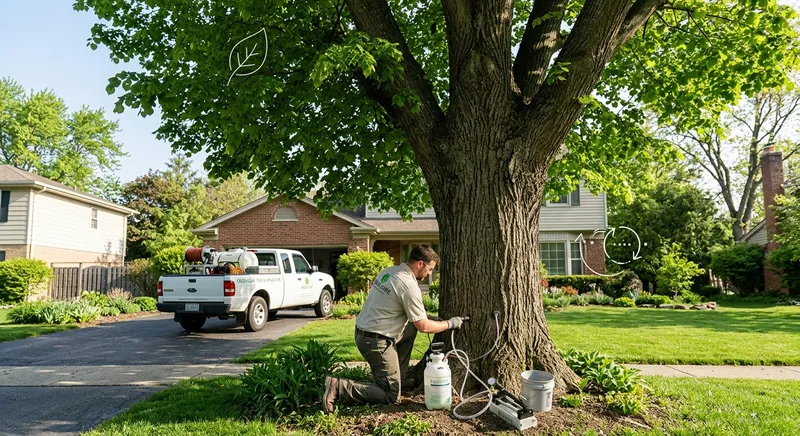
Table of Contents
Most tree care companies run on project revenue. A homeowner calls about a dead ash. You remove it. They pay you $3,500. You never hear from them again — unless another tree dies.
That’s the fundamental business model problem in tree care: your best-paying work is one-time. A $3,500 removal is great revenue, but the customer has no reason to call you next month. Your relationship ends when the stump grinder leaves the property.
Meanwhile, the landscaping company mowing their lawn collects $175 every week — $4,550 over a 26-week season. They see that customer 26 times a year. You saw them once.
Plant health care (PHC) is how tree care companies solve this. It converts one-time removal clients into recurring maintenance accounts, smooths out seasonal revenue, and builds the kind of predictable income that lets you hire, invest, and plan — instead of hoping the phone rings next month.
What Plant Health Care Actually Includes
PHC is the arborist equivalent of preventive medicine. Instead of waiting for trees to die and then removing them, you’re treating problems early, building resistance, and maintaining the health of the urban forest on each property.
A typical residential PHC program includes some combination of:
Core treatments
- Deep root fertilization. Injecting slow-release fertilizer directly into the root zone, typically once or twice per year (spring and fall). Addresses nutrient deficiencies that cause decline in urban soils, which are often compacted and depleted compared to forest soils.
- Insect and disease management. Preventive and curative treatments for common pests: emerald ash borer (EAB), Japanese beetles, aphids, scale, and spider mites. Disease treatments for issues like apple scab, anthracnose, oak wilt, and Dutch elm disease. Treatments are timed to pest life cycles — usually 2–4 applications per year.
- Soil health management. Mycorrhizal inoculants, biochar, organic amendments, and decompaction. Addresses the root-zone issues that cause slow decline in urban trees — compaction, poor drainage, and microbial depletion.
Monitoring and assessment
- Annual tree inspections. Walk the property, assess every significant tree, note changes since last visit, update the management plan. This is the relationship-building piece — the customer sees you on their property regularly and trusts your recommendations.
- Risk assessments. Formal evaluation of tree structure and hazard potential. Often required by insurance companies or municipalities for large trees near structures.
Supporting services
- Trunk injections. Direct injection of insecticides, fungicides, or nutrients into the vascular system. Used for EAB treatment (where it’s the primary management tool), Dutch elm disease prevention, and certain nutrient deficiencies. Typically annual or biennial.
- Growth regulator applications. Paclobutrazol and similar products that slow canopy growth, redirect energy to root development, and improve stress tolerance. Useful for trees in constrained spaces or trees recovering from construction damage.
- Lightning protection. Copper cable systems installed on high-value or high-risk trees. One-time installation with periodic inspection.
The Business Case for PHC
Recurring revenue vs. project revenue
The most obvious benefit: PHC generates predictable, recurring income.
A residential PHC program for a property with 8–12 significant trees (typical suburban lot with mature landscaping):
- Deep root fertilization (2 applications/year): $300–$500
- Insect and disease treatments (3–4 applications/year): $400–$800
- Annual inspection and monitoring: $150–$250
- Total annual PHC revenue per customer: $850–$1,550
That’s per customer, per year, recurring. Compare that to the average residential tree removal ($2,000–$4,000) that happens once and never repeats.
Scale it up:
- 50 residential PHC clients at $1,200/year average = $60,000/year in recurring revenue
- 100 clients = $120,000/year
For a tree care company doing $400K–$700K in annual revenue, adding $60K–$120K in PHC revenue represents a 10–25% revenue increase — and it’s the most predictable 10–25% of your income.
Higher margins than removal work
PHC treatments are typically faster per dollar of revenue than removal work. A deep root fertilization appointment takes 30–45 minutes and generates $150–$250 in revenue. A tree removal that generates $3,000 takes a full crew 6–8 hours.
Revenue per labor hour:
- Tree removal: $80–$120/crew-hour (after overhead)
- PHC treatments: $150–$300/tech-hour (one person, one truck, lower equipment costs)
PHC margins run 40–60% gross for most tree care companies, compared to 30–45% gross for removal work. The labor is skilled but less physically demanding, the equipment costs are lower (no chipper, no crane), and the work is faster per dollar.
Retention and upsell
PHC customers stay with you dramatically longer than removal-only customers. A homeowner whose only interaction with you was a one-time removal has no ongoing relationship. A homeowner on an annual PHC program sees you 4–6 times per year. They know your name. They trust your recommendations. When a tree does need removal, they call you — not Google.
PHC customers also convert at much higher rates for additional work:
- Pruning: A PHC customer who hears “your red maple would benefit from a structural prune this winter” during an annual inspection is far more likely to say yes than a cold lead. They already trust your arboricultural judgment.
- Removal: When a PHC tech identifies a tree in irreversible decline, the customer accepts the recommendation because it comes from someone who’s been monitoring their trees — not a stranger trying to sell them a $4,000 job.
- Planting: After a removal, the PHC conversation naturally leads to replacement: “What should we plant here instead?” That’s a $500–$1,500 sale that wouldn’t happen without the ongoing relationship.
Industry data from TCIA member surveys consistently shows that customers enrolled in PHC or maintenance programs have 2–3x higher lifetime value than one-time service customers.
Seasonal smoothing
Removal work is concentrated in the spring and fall, with storm-driven spikes. PHC has its own seasonal cadence, but it fills different calendar gaps:
- March–April: Spring fertilization, dormant oil sprays, early pest treatments
- May–June: Insect treatments, disease management, growth regulators
- July–August: Mite control, drought stress monitoring, summer fertilization
- September–October: Fall fertilization, soil amendments, EAB trunk injections
- November–February: Planning, annual inspections (good winter work for arborists), proposal preparation
PHC doesn’t eliminate seasonality, but it fills the gaps between removal peaks and keeps technicians productive during periods when climbing work slows down.
How to Start a PHC Program
Step 1: Start with what you know
You don’t need a full-time plant pathologist on day one. Start with the 3–4 treatments you’re most confident delivering:
- Deep root fertilization (requires a soil injection rig — $2,000–$5,000 for a basic setup)
- Emerald ash borer treatment (trunk injection — requires a system like Arborjet QUIK-jet or Mauget, $500–$2,000 to start)
- General insect and disease spraying (requires a spray rig or backpack sprayer, $500–$3,000 depending on setup)
- Annual inspections (requires your existing arboricultural knowledge and an ISA credential)
Equipment investment to launch a basic PHC offering: $3,000–$10,000. That’s a fraction of what you’d spend on a new chipper — and the payback period is measured in months, not years.
Step 2: Sell to existing customers first
Your easiest PHC sales are the customers who already hired you for removal or pruning work. They know you, they trust you, and they have trees that need ongoing care.
After every removal or pruning job, leave a recommendation:
“The oak in your front yard looks healthy now, but I noticed some early signs of decline in the canopy — probably compacted soil. A deep root fertilization this fall would help. We offer an annual tree care program that covers fertilization, pest monitoring, and an annual inspection. It runs about $1,200 for your property. Want me to put together a proposal?”
Conversion rates on this kind of warm upsell — from an arborist the customer has already hired — typically run 25–40%. Far higher than any cold marketing effort.
Step 3: Package it clearly
Don’t sell PHC as a list of individual treatments. Package it as an annual program with a clear scope and a single annual price:
Example: Residential Tree Care Program — Standard
Includes:
- Spring and fall deep root fertilization for up to 10 trees
- Seasonal insect and disease monitoring (4 visits)
- Targeted pest treatments as needed (included in program price)
- Annual arborist inspection with written report
- Priority scheduling for any additional work
Annual price: $1,200 (or $100/month)
The monthly payment option is powerful. $100/month sounds much more manageable than $1,200/year — and monthly billing creates a predictable revenue stream for your business.
Step 4: Invest in training
PHC requires a different skill set than climbing and rigging. Your technicians need to understand:
- Tree biology and physiology (how trees grow, take up nutrients, and respond to stress)
- Pest and disease identification (the big 10–15 pests in your region)
- Soil science basics (pH, drainage, compaction, nutrient profiles)
- Pesticide application (state licensing requirements — most states require a commercial pesticide applicator license for tree care PHC)
- Client communication (explaining tree health to homeowners in non-technical language)
ISA offers a Tree Risk Assessment Qualification (TRAQ) that’s valuable for the assessment side. Most states require a pesticide applicator license for PHC treatments — check your state’s requirements and budget for training and exam fees.
Step 5: Build the route
PHC becomes most profitable when you can batch treatments geographically — just like a mowing route. Once you have 10–15 PHC clients in the same area, you can service them in a single day instead of driving across your territory for one-off treatments.
This takes time to build. In year one, you might have 15–20 scattered clients. By year three, you should have enough density in your core neighborhoods to run efficient PHC routes 2–3 days per week during treatment season.
Objections You’ll Hear (and How to Handle Them)
“I don’t want to spend money on trees that seem fine.”
Trees in early decline often look fine to homeowners. Use the medical analogy: “These trees look okay from the ground, but I’m seeing early signs of nutrient deficiency in the canopy. Catching it now with a fertilization program costs $400. Waiting until the tree is visibly declining usually means $2,000–$4,000 in corrective work — or removal.” Prevention is always cheaper than reaction.
“Can’t I just fertilize them myself?”
Surface-applied fertilizer from a garden center is better than nothing, but it doesn’t reach the root zone where mature trees actually feed. Deep root fertilization injects nutrients directly into the soil at 8–12 inches — below the grass root zone and into the tree’s feeder root area. It also addresses soil compaction, which surface applications can’t.
“I’ll just call you if something goes wrong.”
By the time a tree shows visible symptoms of decline — thin canopy, dead branches, bark issues — the problem has usually been developing for 2–5 years. Early intervention through monitoring catches problems when they’re treatable. Late intervention often means the tree is too far gone to save, and the customer pays for removal instead of treatment.
The Long Game
PHC changes the nature of a tree care business. Instead of being reactive — waiting for trees to die, storms to hit, and homeowners to panic — you become proactive. You’re managing an urban forest, property by property, year by year.
The financial transformation is significant:
- Year 1: 20 PHC clients, $24,000 in new recurring revenue. Covers equipment investment.
- Year 2: 50 clients (20 retained + 30 new), $60,000 recurring. Justifies a dedicated PHC technician.
- Year 3: 80+ clients, $96,000+ recurring. A meaningful percentage of total revenue that renews automatically every year.
By year three, you have a revenue base that shows up regardless of weather, storm activity, or seasonal demand. That’s the recurring revenue engine that removal-only companies don’t have — and it’s the difference between a tree care business that grows predictably and one that rides the boom-and-bust cycle every year.
Related: AI receptionist for tree care companies | Why tree care companies lose their best commercial contracts | How an AI receptionist works