How a Tree Care Company Uses Tinylawn to Triage Emergency Storm-Damage Calls
After a major storm, tree care companies get flooded with calls. Here is how Tinylawn answers every call, prioritizes emergencies, and books jobs — without adding office staff.
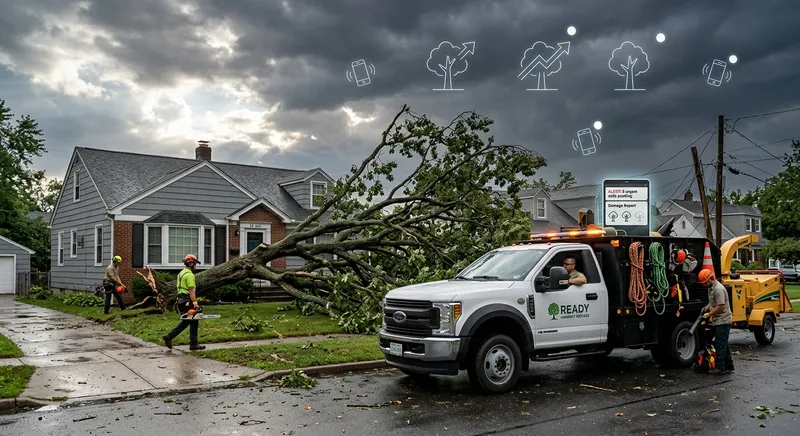
Table of Contents
A line of severe thunderstorms pushes through your service area on a Tuesday evening. By 7:30 PM, your phone starts ringing. It doesn’t stop for three days.
Trees on houses. Trees on cars. Trees blocking driveways. Limbs hanging over power lines. Every caller is urgent. Half of them are panicking.
You’re a tree care company with two crews. You can handle maybe 4-6 emergency jobs per day. But you’re getting 40+ calls. You can’t answer them all. You definitely can’t triage them from a bucket truck with a chainsaw running.
This is the scenario Tinylawn was built to handle.
The Storm-Damage Call Problem for Tree Care
Storm damage creates a call pattern that breaks most tree care businesses’ phone systems.
Volume spikes are sudden and massive
Normal call volume for a mid-size tree care company might be 5-10 calls per day. After a significant storm, that number can hit 40-80 calls in a 24-hour period. The surge typically lasts 3-5 days, with the heaviest volume in the first 48 hours.
Every caller believes their situation is an emergency
A tree leaning on a house is an emergency. A tree blocking a driveway is inconvenient but not dangerous. A broken limb hanging over a yard is somewhere in between. But to the homeowner, all of these feel like emergencies — and they want someone on the phone immediately.
Without a system to triage, you either treat everything as urgent (and overcommit your crews) or you miss genuinely dangerous situations while you’re busy with routine removals.
The calls come at the worst possible times
Storms hit in the evening. Damage is discovered overnight and early morning. Your heaviest call volume arrives exactly when you have the least capacity to answer — you’re either assessing damage in the field, operating equipment, or trying to get a few hours of sleep before a grueling day of emergency work.
You can’t call people back fast enough
Even if every caller leaves a voicemail (they won’t — roughly 80% hang up without leaving a message), listening to and returning 40 voicemails takes hours. By the time you call back, many homeowners have already booked with a competitor. The ones with truly dangerous situations — a tree on their roof, a limb on power lines — needed immediate response, not a callback 6 hours later.
How Tinylawn Handles the Surge
Here’s what the same scenario looks like with Tinylawn’s AI receptionist answering your calls.
Every call gets answered — simultaneously
When 5 homeowners call at 7:45 PM while you’re assessing damage in the field, all 5 calls get answered within seconds. There’s no hold queue. No voicemail. No “please call back during business hours.” The AI handles each conversation independently, at the same time.
This alone changes the equation. Instead of capturing 30% of inbound storm-damage leads, you’re capturing close to 100%.
The AI qualifies and triages each call
During the conversation, the AI receptionist asks callers about their situation. For a tree care company, this means capturing:
- What happened — tree fell, limb broke, tree is leaning, stump needs removal
- Severity — is the tree on a structure? Blocking access? Near power lines?
- Property address — captured for every lead
- Timeline — does this need same-day response or can it wait?
- Contact information — name, phone, email
Each completed call becomes a lead in your Tinylawn dashboard with all of this information organized and ready to review. Instead of listening to frantic voicemails and trying to piece together details, you get a clean summary of every caller’s situation — including their own description of the severity.
Property data arrives automatically
When the AI captures the caller’s address, Tinylawn automatically pulls property data and generates a virtual site visit report. For storm-damage triage, this gives you:
- Satellite imagery of the property showing tree locations, structures, and access points
- Lot size and building footprint so you can estimate scope before driving out
- Parcel boundary map showing exact property lines
- AI-powered property analysis identifying visible trees, structures, slopes, and potential access challenges
Before you’ve left your current job site, you can pull up the satellite view on your phone and see exactly where the caller’s property is, how big it is, what trees are near structures, and how your crew would access the site.
This doesn’t replace an on-site assessment for a dangerous tree on a house. But it lets you prioritize. A caller who says “a tree fell in my yard” looks very different when the satellite view shows a 60-foot oak next to a two-story colonial versus a small ornamental in an open backyard.
Callers get asked to send photos
After the call, Tinylawn sends the homeowner an SMS with a link to upload photos of their property. For storm damage, this is invaluable. A homeowner’s photo of a cracked trunk leaning toward their roof tells you more in 2 seconds than a 5-minute phone conversation.
These photos attach directly to the lead record, alongside the satellite imagery and property data. When you sit down to plan your next day’s emergency schedule, you have aerial views and ground-level photos for every lead — without having driven to a single property.
Appointments get booked on the spot
For non-emergency calls — a broken limb in the yard, a leaning tree that isn’t threatening a structure — Tinylawn can book an appointment while the caller is still on the phone. The homeowner hangs up knowing they have a scheduled time, which dramatically reduces callbacks, follow-up calls asking “when are you coming?”, and leads lost to competitors.
For situations the caller describes as emergencies, the AI captures all the details so the lead appears prominently in your dashboard. You can review it immediately and prioritize your response based on the caller’s description, satellite imagery, and any photos they upload.
Bilingual support handles diverse neighborhoods
Storm damage doesn’t discriminate by language. If a Spanish-speaking homeowner calls about a tree on their roof, Tinylawn handles the conversation in Spanish — qualifying the lead, capturing the address, and generating the same property report. No language barrier. No lost lead. No delayed response because you needed to find someone who speaks Spanish.
A Real-World Scenario: Tuesday Evening Through Friday Morning
Here’s how this plays out over a typical post-storm week.
Tuesday, 7:15 PM — Storms move through. Power flickers. Wind gusts hit 60+ mph.
Tuesday, 7:30 PM - 10:00 PM — 22 calls come in. Tinylawn answers all of them. You’re in your truck assessing your own property and checking on a commercial client. By 10 PM, you have 22 qualified leads in your dashboard, each with caller details, situation description, property address with satellite view, and severity information based on the caller’s description. Several callers have already uploaded photos via SMS.
Tuesday, 10:30 PM — You spend 20 minutes reviewing leads on your phone. Using the satellite imagery and caller descriptions, you identify 4 true emergencies (trees on structures or near power lines) and 6 urgent-but-not-dangerous situations. The remaining 12 are routine storm cleanup. You plan your crew dispatch for morning.
Wednesday, 6:00 AM — 8 more calls came in overnight. Tinylawn answered all of them. Three more emergencies identified. You dispatch both crews to the 7 highest-priority jobs. The AI has already booked non-emergency appointments for Thursday and Friday.
Wednesday through Friday — Calls continue at 15-25 per day. Tinylawn handles all of them. Your crews work through the emergency queue, then the urgent jobs, then the routine cleanup. You’re not spending hours on the phone because every lead is captured, qualified, and either booked or waiting for your review.
By Friday morning, you’ve handled 80+ leads. Your crews have completed 18 jobs. You have 25+ appointments booked for the following week. And you didn’t miss a single call.
Without Tinylawn, the realistic version: you answer maybe 20 of those 80 calls. The other 60 go to voicemail, and 50 of those callers hang up without leaving a message. You spend hours returning calls to people who’ve already hired someone else. You miss two genuine emergencies because they called at 8 PM and you didn’t see the voicemail until morning.
Beyond Storm Season: Ongoing Value for Tree Care
Storm surges are where Tinylawn’s value is most dramatic, but tree care companies benefit year-round:
- Routine estimate requests get qualified and booked without interrupting your crew
- After-hours calls from homeowners who notice a leaning tree or dead branches get captured instead of lost
- Property reports help you prepare for every consultation, not just emergency assessments
- Seasonal surges — spring growth, fall leaf season, winter ice damage — are handled without adding staff
Tree care is a business where every missed call could be a $2,000 removal, a $5,000 crane job, or a $10,000 lot-clearing project. The math on a solution starting at $49/month that captures even a few of those lost leads is straightforward.
Related: Learn more about AI receptionist solutions for tree care businesses, or see how Tinylawn handles a full estimate call step by step.