Landscaping Equipment Financing in 2026: Lease vs Loan vs Buy
A practical breakdown of how to finance landscaping equipment in 2026 — lease, loan, or buy outright. Real numbers, tax notes, and when each one actually makes sense.
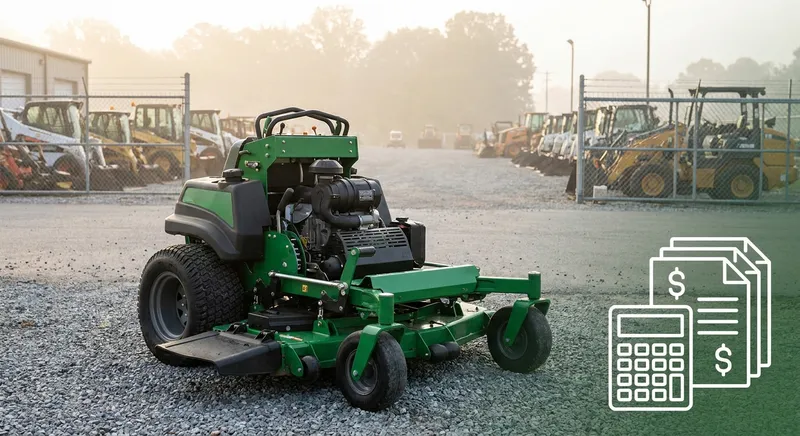
Table of Contents
You need a new zero-turn before peak season. The dealer quotes you $14,200 for the model your lead crew has been asking about. You can pay cash, you can finance it through the dealer at 8.9%, or you can lease it for 36 months and hand it back. Which one actually leaves more money in your business?
That depends on your tax situation, your cash position, and how long you plan to keep the equipment running. There’s no single right answer — but there’s usually a wrong one for every situation, and most small landscaping owners default to it without doing the math.
Here’s how to think through the decision in 2026.
The three real options
You’re choosing between cash purchase, financed purchase, and operating lease. Dealer rent-to-own programs exist but are almost always the most expensive path — skip them unless you have no other option.
Cash purchase. You write a check. The equipment is yours. You depreciate it over the asset’s useful life (or take Section 179 — more on that below). Pros: no monthly payment, no interest, you own a sellable asset. Cons: you just spent $14,200 of working capital that could’ve covered six weeks of payroll.
Financed purchase (equipment loan). Down payment of 0–20%, then 36–60 months at a fixed rate. You own the equipment at the end. Pros: ownership, fixed payment, full depreciation benefit. Cons: you pay interest, and the loan shows up as debt on your balance sheet.
Operating lease. Lower monthly payment than a loan, usually 24–48 months, then you return the equipment (or pay a residual to buy it). Pros: lowest monthly outlay, easier upgrade cycle, full payment is deductible as an operating expense. Cons: you own nothing at the end, and lease totals are usually higher than loan totals if you’d have kept the equipment anyway.
A capital lease (or $1 buyout lease) is technically a lease but functions like a loan — you treat it like financed purchase for tax purposes.
What 2026 rates actually look like
Equipment finance rates moved a lot through 2024 and 2025 as the Fed adjusted policy. As of early 2026, here’s the realistic range for a landscaping business with two years of operating history and decent credit (FICO 680+):
- Dealer-financed equipment loan: 7.9–11.9% APR depending on credit, term, and down payment
- Bank or credit union equipment loan: 6.5–9.5% APR (better rate, more paperwork)
- SBA 7(a) loan for equipment: Prime + 2.25–4.75% (currently around 9.75–12.25%)
- Operating lease (money factor): Effective rate typically 8–13%
- Capital lease ($1 buyout): 7.5–10.5% effective rate
If you’re getting quoted above this range, shop around. Local credit unions, Live Oak Bank, and equipment-specific lenders like Crest Capital compete hard for landscaping accounts.
The Section 179 angle most small owners under-use
Section 179 of the IRS tax code lets you deduct the full purchase price of qualifying equipment in the year you put it into service — instead of depreciating it over five years. The 2026 deduction limit is up to $1,250,000 with a $3,130,000 spending cap, per the IRS Section 179 update.
For a typical small landscaping company, this is huge. That $14,200 mower? Deduct the full amount this year against your taxable income. If you’re in the 24% federal bracket plus state, that’s roughly $4,000–4,800 in tax savings.
Important: Section 179 applies to equipment you finance, not just equipment you pay cash for. You can take out a 60-month loan, put the mower into service in 2026, and still deduct the full purchase price this year. That’s why financed purchases often beat cash purchases on a tax-adjusted basis — you keep your working capital AND get the deduction.
What doesn’t qualify: operating leases (the lease payment is just a regular operating expense), and equipment you didn’t actually put into service before December 31.
When each option actually makes sense
Pay cash when:
- You have at least 4 months of operating expenses in reserve after the purchase
- The equipment will run for 7+ years (so financing cost would exceed the value)
- You’re buying used equipment under $5,000 where financing fees eat the benefit
Finance the purchase when:
- You want the Section 179 deduction without draining cash
- Your business cash flow is seasonal and you need working capital for spring payroll
- You plan to keep the equipment long-term and rates are under 10%
- You’re building business credit history
Operating lease when:
- You want to upgrade equipment every 3–4 years (relevant for technology-heavy gear, less so for mowers)
- You can’t get approved for a loan but qualify for a lease
- You’re testing whether you’ll actually use the equipment enough to justify owning it
- Cash flow needs are tight and the lower monthly payment matters more than total cost
For most small landscaping owners buying mowers, trailers, and trucks they’ll keep for 5+ years, financed purchase with Section 179 is the math-best option. The interest cost is more than offset by the immediate deduction and the working capital you preserve.
The real cost comparison
Let’s run the actual numbers on a $14,200 zero-turn, assuming a small landscaping owner in a combined 32% tax bracket (federal + state).
Option A: Pay cash
- Out of pocket year 1: $14,200
- Section 179 deduction year 1: $14,200
- Tax savings year 1: ~$4,544
- Net year 1 cost: $9,656
- Working capital lost: $14,200 (for ~30 days until taxes filed)
Option B: Finance 60 months at 8.5% APR
- Down payment: $1,420 (10%)
- Monthly payment: $262.45
- Total interest over 60 months: $3,326
- Section 179 deduction year 1: $14,200
- Tax savings year 1: ~$4,544
- Net year 1 out-of-pocket: $1,420 down + $2,624 in payments – $4,544 tax savings = negative $500 (you net positive on cash year one)
- Total 5-year cost: $14,200 + $3,326 interest – $4,544 tax savings = $12,982
Option C: 36-month operating lease at $310/month
- Total payments: $11,160
- Tax-deductible as operating expense: ~$3,571 in savings
- No ownership at end
- Net cost over 3 years: ~$7,589
- But you need to replace/re-lease equipment again in year 4 — multiply the lease cost by useful life
For equipment you’ll keep 5+ years, Option B usually wins. For equipment you’ll cycle every 3 years, Option C can be competitive — but factor in the replacement cycle.
Three things that quietly raise your effective rate
A 7.9% headline rate can become a 12% effective rate fast if you don’t read the paperwork.
1. Documentation fees. $250–$750 added to the loan principal. On a 5-year $14,000 loan, $500 in doc fees adds ~0.8% to your effective APR.
2. Mandatory equipment insurance through the lender. Lenders sometimes require their own insurance product at 2–3x the cost of what your existing commercial policy charges. Confirm your current policy covers financed equipment and push back if they insist on their product.
3. Prepayment penalties. Less common in 2026 than five years ago, but still present in some dealer financing. If you ever want to refinance or pay off early to switch lenders, a 2% prepay penalty on $14,000 is $280 you don’t get back. Ask before you sign.
What to do before talking to any lender
Spend 30 minutes pulling these together before you walk into the dealer’s finance office or your bank:
- Last 2 years of business tax returns (Schedule C, 1120-S, or 1065 depending on entity)
- Last 3 months of business bank statements
- Personal credit report (free at annualcreditreport.com)
- A list of current equipment and any existing equipment debt
Lenders that take more than this on a sub-$25K equipment purchase are slow lenders. The good ones can approve in 24–48 hours.
The bottom line
For most small landscaping companies in 2026, financing a long-life piece of equipment with a 5-year loan and taking the Section 179 deduction is the strongest play. You keep working capital free for spring payroll, you build business credit, and you get the same first-year tax benefit as a cash buyer.
Pay cash only when you’re sitting on surplus reserves and the equipment is cheap enough that financing fees aren’t worth the paperwork. Lease only when you genuinely plan to cycle equipment every 3–4 years or can’t qualify for a loan.
The worst move is the one most owners make: walking into the dealer with no preparation, accepting whatever rate they offer, and signing because the truck is leaving for the next dealership in the morning. The 30 minutes you spend pulling tax returns and shopping two competing quotes is the highest hourly wage you’ll earn all year.