Pest Control Truck Layout: How Veteran Techs Set Up Their Trucks to Save Time at Every Stop
A practical look at how experienced pest control technicians organize their trucks — equipment placement, chemical storage, restocking workflow — and why a few minutes saved per stop compounds across a route.
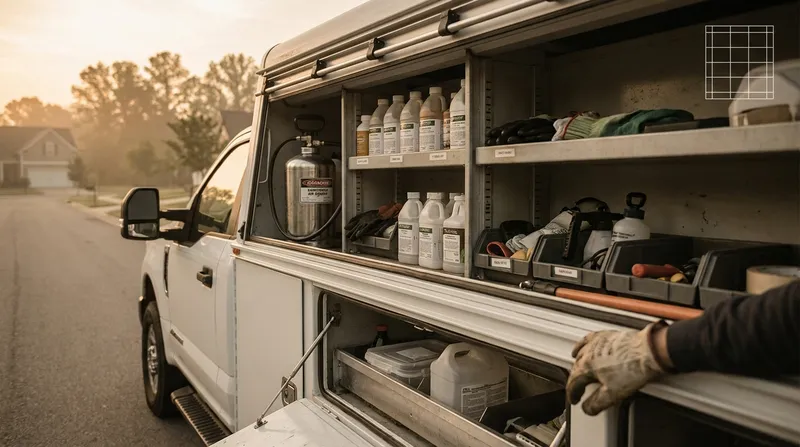
Table of Contents
A pest control technician makes 8 to 14 residential stops on a typical day. At each stop, the tech walks from the truck to the front door, makes contact, walks back to the truck for equipment, treats the property, returns to the truck, documents the stop, and pulls out. The treatment itself is maybe 20 to 30% of the stop time. The rest is movement — between the truck and the property, between products and equipment in the truck, between the truck and the documentation, between the stop and the next one.
Veteran techs save time at every stop by setting their truck up so the movement is short, predictable, and unconscious. The new tech walks back to the truck three times because they forgot something. The 10-year veteran walks back once because the thing they needed was where it always is.
This post is what the inside of a well-organized pest control truck actually looks like — equipment placement, chemical storage, restocking workflow — and why a few minutes saved per stop adds up to one or two additional stops a day across the route.
What is actually in the truck
The contents of a residential pest control truck vary by service mix, but the working list for a general-pest tech is roughly:
Application equipment:
- B&G or similar 1- to 2.5-gallon compressed-air sprayer (the workhorse for liquid applications)
- Backpack sprayer (4-gallon) for larger residential or commercial perimeter work
- Granular spreader (handheld or shoulder-bag for residential; push spreader for larger lots)
- Duster for void treatments (cracks, crevices, attic spaces)
- Vacuum (for bed bug or stored product pest accounts)
- Inspection tools: flashlight, ladder (8’ fiberglass for most residential), mirror on a stick, moisture meter (for termite inspections)
Chemicals and baits:
- 2 to 4 actively-used liquid concentrates (typically a pyrethroid for exterior perimeter, a non-repellent like fipronil or imidacloprid for cockroach work, an IGR for fleas/roaches)
- Granular insecticide for lawn and turf applications
- Rodent bait stations and rodenticide blocks
- Roach bait gel, ant bait
- Termite-specific products for WDIR techs (Termidor, Premise, or whichever the company has standardized on)
- Wasp/hornet aerosol
Documentation and supplies:
- Tablet or phone (running the company’s mobile app — FieldRoutes, GorillaDesk, PestPac, etc.)
- Service tickets, door hangers (for no-shows)
- Pen, sharpie, zip ties
- Trash bags, towels, gloves, eyewear, respirator
Safety equipment:
- First aid kit
- Eyewash bottle
- SDS binder for every chemical on the truck (required by OSHA)
- Spill kit (absorbent, gloves, bags)
- Fire extinguisher
That is the standard loadout. Where techs save time is not in what is on the truck but in where it lives and how predictable that location is.
The principle: one product, one place
The single highest-leverage organizational rule for a pest control truck is this: every product and every piece of equipment has exactly one designated location. Not “usually here, sometimes there.” Exactly one place.
This sounds obvious. It is also where most new techs fall down. The reason is that “putting it back where it goes” feels like an extra step on a busy day, and skipping it once leads to skipping it a second time, and within two weeks the truck is back to the chaos state where the tech is hunting through it at every stop.
Veterans know the math: a 30-second hunt at every stop, 10 stops a day, is 5 minutes a day of lost time. Across a 5-day week that is 25 minutes. Across a year that is roughly 22 hours — three days of treatment work, lost to disorganization. The fix is not technique. The fix is the discipline of putting things back where they go.
Utility body vs. van: the two main truck formats
Utility body pickup (Ford F-150/250 or equivalent with a service body): The dominant format for residential pest control in most U.S. markets. The compartmentalized side boxes give organized exterior access to commonly-used items without climbing into a bed. Best for techs who do mostly residential and want fast access from the side of the truck at curbside.
The trade-off: limited weatherproof storage compared to a van. Chemicals stored in side boxes need to be inside locked, ventilated compartments and protected from direct sun (which can degrade many active ingredients).
Cargo van (Ford Transit, Mercedes Sprinter, or similar): Increasingly popular for techs handling more bed bug, commercial, or higher-touch services. The enclosed space allows for proper shelving systems, climate control of stored chemicals (which matters for product stability), and a more office-like documentation setup inside.
The trade-off: walking around the van to access equipment is slower than reaching into a side-mounted utility box. Less ideal for high-volume residential routes where speed at curbside is the priority.
The “right” format depends on the service mix. A residential-only general-pest tech is usually faster in a utility body. A multi-service tech doing residential plus commercial plus bed bug is usually better off in a van.
The standard utility-body layout
For a typical residential pest control utility-body truck, the experienced layout looks roughly like this:
Driver-side compartments (closest to where the tech approaches from the cab)
- Front compartment: B&G sprayer, ready-mixed for the day’s standard residential treatment. This is the single most-used piece of equipment and lives at the front of the truck for the shortest possible reach time.
- Middle compartment: Granular spreader, granular product (currently mixed), and a small toolbox with documentation supplies — pen, sharpie, zip ties, door hangers.
- Rear compartment: Backup chemicals, secondary products (duster, hand application gear), inspection tools (flashlight, mirror, moisture meter).
Passenger-side compartments
- Front compartment: Backpack sprayer, ready-mixed for perimeter or large-property work.
- Middle compartment: Rodent supplies — bait stations, blocks, gnawed-evidence kit. Termite-specific products if the tech runs WDIR work.
- Rear compartment: Vacuum, bed bug kit, specialized service equipment.
Bed (with cap or tonneau cover)
- Locked chemical storage box (mandatory in most states for stored EPA-registered products that exceed certain quantities — check state-specific rules)
- Ladder (mounted to the cap or to a roof rack)
- Bulk chemical storage for products being used to replenish the daily mix
Cab
- Tablet on a dash mount for the route app
- Clipboard with paper backup for stops where the digital flow fails
- Coffee (the actual workhorse of pest control)
The principle is roughly symmetrical and follows the “frequency of use” rule: the most-used items live closest to the front of the truck where the tech approaches. The least-used items live in the back, accessed via a walk to the rear.
The morning loadout routine
The single most useful habit veteran techs develop is the morning loadout — a 10-to-15 minute pre-route routine done at the shop before the truck rolls.
The components:
- Mix or top off the day’s primary liquid products. A B&G filled to the right level with the right concentration for the day’s first stops. The most common time-waster across pest control routes is “I’ll mix when I get to the first stop” — which adds 8 to 12 minutes to the first stop while the tech mixes in the customer’s driveway.
- Check granular stock. Confirm enough granular product for the day’s lawn applications. Refill from the bulk container in the bed.
- Confirm rodent / termite supplies for the day. Pull tomorrow’s stations or bait blocks based on the route’s anticipated services.
- Stock documentation supplies. Replace any pens, refill the sharpie cup, restock door hangers. (Door hangers are the universal “I missed you” supply; running out mid-day is a common avoidable annoyance.)
- Quick walk-around inspection. Tires, fluids, mirrors, lights. The cost of catching a problem at 7 AM in the shop is dramatically lower than catching it at 11 AM on the side of a highway.
The loadout takes 15 minutes if done deliberately. The tech who skips it almost universally loses more than 15 minutes during the route to mid-day stops at the shop, mid-route mixing, or running out of a supply at stop number five. Whatever urgency the morning has, the loadout is the cheapest investment in the day’s productivity.
End-of-day restocking and reset
The end-of-day routine — done at the shop after the last stop — has roughly the same logic in reverse:
- Unload anything that needs climate control (some products degrade in unconditioned truck storage overnight, especially in summer).
- Restock for tomorrow while the day is fresh in your head. The tech who restocks at 4 PM remembers running low on granular; the tech who postpones to “first thing tomorrow” doesn’t remember and rolls out with the same shortage.
- Reset the truck to “morning ready.” Sprayers refilled, equipment back in designated spots, documentation supplies replenished.
- Note any equipment issues. Sprayer leak, granular spreader gauge sticking, tablet battery not holding charge — flag for the shop manager before leaving for the day.
The discipline gap between techs who do this routinely and techs who do it sometimes shows up most clearly in route consistency. The consistent-routine tech hits roughly the same stops-per-day every week, with predictable mid-day timing. The intermittent-routine tech has good days and bad days, often without being able to articulate why.
What changes for commercial routes
Commercial pest control trucks have a meaningfully different loadout:
- Heavier rodent station inventory for accounts with monthly station servicing
- Barcoded equipment tracking (PestPac, FieldRoutes, and others support barcode scanning for individual stations — the tech scans the station, the system logs the service, the customer gets a portal-accessible report)
- Stainless steel station replacements for food-grade accounts
- More extensive documentation kit — commercial accounts often require photos of every service, signed sheets, GHS-compliant chemical logs
- Larger application equipment for warehouse, manufacturing, or large commercial accounts
The principle is the same — one item, one place — but the inventory is larger and the documentation more rigorous. Commercial-route techs often run with a tablet plus a barcoded scanner gun and a more elaborate in-cab documentation setup.
The compound effect
The “save 2 minutes per stop” framing is the wrong way to think about truck layout. The actual effect is downstream:
- 2 minutes saved at the first stop means the tech leaves the property 2 minutes earlier — which means arriving at stop 2 with 2 minutes more buffer
- That 2-minute buffer absorbs the inevitable overrun at stop 3 (a homeowner with questions, an unexpected access issue)
- Stop 4 starts on schedule instead of running late
- The route’s last stop is hit on time instead of being squeezed
- The tech finishes the route at 4:15 instead of 5:30
The day looks 5 minutes shorter on paper. In practice, the day is 60 to 90 minutes less stressful, the customer interactions are unhurried, the documentation is done at the property instead of at home, and the truck is reset for tomorrow before the tech leaves the shop.
The math behind this compounds along the same lines as the route density work — the operations gains are not from any single change but from the accumulation of small, predictable improvements. Truck layout is one of the cheapest of those changes. Equipment hasn’t changed; the chemical inventory hasn’t changed; only where things live has changed. That’s a free productivity gain.
For more on the inside-the-day operational picture, the tech daily time breakdown covers where the rest of the productivity gains actually come from. The truck is the cheapest one to fix.