What Happens When a Spanish-Speaking Homeowner Calls Your Landscaping Business After Hours
Hispanic households spend $6,000+ on landscaping annually. If your phone system can not handle Spanish-speaking callers, you are losing high-value leads every week.
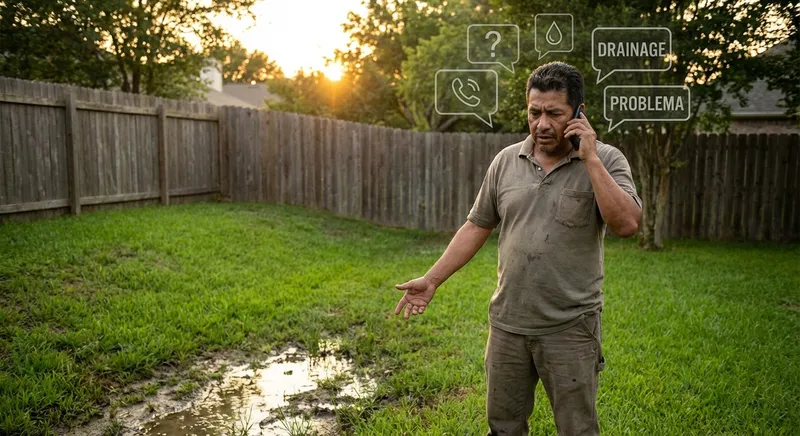
Table of Contents
It’s 7:15 PM on a Wednesday. A homeowner named Carlos walks his backyard after dinner, notices the drainage problem that’s been getting worse all spring, and decides to call a landscaping company. He found yours on Google — good reviews, close to his neighborhood.
He calls. Your voicemail picks up. In English.
Carlos speaks English, but it’s his second language. He’s more comfortable describing a complex project — grading, drainage, maybe a retaining wall — in Spanish. Your voicemail doesn’t give him that option. He hangs up and scrolls to the next result.
That lead just walked away. And depending on your market, this is happening multiple times a week.
The Market You’re Probably Underserving
Hispanic households represent a massive and growing segment of the homeowner market. The numbers are hard to ignore:
- Hispanic homeownership reached a record 9.8 million households in 2024, adding 238,000 net new owner-households in a single year (NAHREP State of Hispanic Homeownership Report, 2024)
- The US Hispanic population reached 65.2 million — 19.5% of the total population (US Census Bureau, 2024)
- Hispanic households are the fastest-growing homeowner demographic, with the homeownership rate climbing from 47.5% in 2019 to near-record levels (NAHREP)
In states like Texas, California, Florida, Arizona, New Mexico, Nevada, Colorado, and Georgia, Hispanic homeowners represent 20-40%+ of the residential market. In some metro areas — Houston, Miami, Los Angeles, Phoenix, San Antonio, Dallas — it’s even higher.
These are homeowners buying houses, investing in their properties, and calling landscaping companies to get work done. And many of them prefer to discuss complex, high-value projects in Spanish.
If your phone system only works in English, you’ve eliminated yourself from a significant share of your market.
What Happens Today (The Language Barrier Problem)
Here’s the typical experience for a Spanish-speaking homeowner calling a landscaping company:
Scenario 1: Voicemail (Most Common)
The call goes to a generic English voicemail. Even if the homeowner speaks conversational English, voicemail is already a barrier — 80% of callers hang up when they reach voicemail. Add a language preference mismatch, and the drop-off is even steeper. They call someone else.
Scenario 2: You Answer, Struggling Through
You pick up between jobs. The caller starts in Spanish. You speak some — enough to say “yes” and “how many square feet” — but not enough to properly qualify a $10,000 drainage-and-hardscape project. The conversation is awkward. You miss important details. The caller senses the friction and decides to go with the company that their neighbor recommended (the one with a bilingual office manager).
Scenario 3: Answering Service
You have an answering service. They take a message: “Carlos called, wants landscaping work, here’s his number.” No details about the project scope, timeline, budget, or property. You call back and start from scratch — if Carlos even answers the callback.
Traditional answering services charge $1-$3 per minute, and bilingual operators typically cost 25-50% more (CMS Answering Service Pricing Guide, 2024). For a small landscaping company, that adds up fast during peak season.
In all three scenarios, the result is the same: a qualified, ready-to-hire homeowner doesn’t get the experience they need to choose your company.
Why Bilingual Leads Are Disproportionately Valuable
Spanish-speaking homeowners who call your landscaping business aren’t browsing. They’re buying. Here’s why these leads tend to convert at higher rates:
Referral-Driven
Hispanic communities tend to rely heavily on word-of-mouth referrals for home services. When Carlos calls you, there’s a good chance his neighbor or coworker recommended you specifically. Referred leads convert 30% better than non-referred leads and have a 16% higher lifetime value (Wharton School of Business / Journal of Marketing, 2013).
A referred lead who can’t communicate effectively with your company is a particularly expensive miss. You’re not just losing one job — you’re breaking a referral chain.
Repeat Business and Community Networks
When you serve a Spanish-speaking homeowner well, you don’t just get one client. You get access to their network. In tight-knit communities, one great patio job can generate 3-5 referrals within a season. The reverse is also true — one bad phone experience can close an entire network.
Higher-Value Projects
Hispanic homeowners are increasingly investing in outdoor living spaces. Nationally, outdoor living and patio projects averaged $7,750-$12,000 in 2024 (HomeAdvisor / Angi, 2024). In Sun Belt states with large Hispanic populations and year-round outdoor living, project values skew higher.
These aren’t $40 mowing jobs. They’re multi-thousand-dollar installations with meaningful margins.
How Tinylawn Handles a Spanish-Speaking Caller
Let’s replay Carlos’s call, but this time your number forwards to Tinylawn.
7:15 PM, Wednesday. Carlos calls.
Tinylawn picks up in under 2 seconds:
“Hola, gracias por llamar a [Your Company Name]. Habla Sarah. ¿En qué le puedo ayudar?”
Tinylawn includes bilingual English/Spanish support in every plan. No menu to navigate. No “para español, oprima el dos.” Just a seamless conversation in the caller’s preferred language.
The call Flows Naturally
Carlos explains his drainage problem in Spanish — the backyard floods when it rains, the slope is getting worse, he thinks he needs grading and maybe a small retaining wall.
The AI asks qualifying questions — in Spanish:
- Name and phone number
- Property address (to pull satellite imagery, lot size, and property data)
- Service needed (what kind of work he’s looking for)
- Scope of the problem (how large an area, how severe the flooding)
Carlos is comfortable. He describes the project in detail because he’s speaking his preferred language. He mentions that his neighbor had a similar drainage issue and got a French drain — he’s wondering if that’s what he needs too.
The AI captures all of this. Every detail. In the transcript, you’ll see both the Spanish conversation and an English summary of the lead.
The Appointment Gets Booked
“Tengo disponibilidad para una consulta este viernes a las 2 de la tarde o el lunes a las 10 de la mañana. ¿Le funciona alguno de esos horarios?”
Carlos picks Friday at 2 PM. The appointment is booked — the AI checks business hours and existing appointments in real time to confirm the slot is open. He hangs up feeling confident that he called the right company.
What You See
You get a notification with:
- Lead name: Carlos [Last Name]
- Language: Spanish
- Property address + satellite view + lot dimensions
- Project: Drainage issue, possible grading + retaining wall + French drain
- Timeline: Wants it addressed this spring
- Appointment: Friday at 2 PM, on-site consultation
- Full transcript (Spanish, with English summary)
You show up Friday already knowing the property layout, the project scope, and what the homeowner is expecting. Carlos is impressed — you prepared. You close the deal.
The Competitive Advantage Nobody Talks About
Most landscaping companies in bilingual markets fall into one of two camps:
Camp 1: English-only phone systems. They miss or fumble Spanish-speaking leads entirely. In a market where 20-40% of homeowners prefer Spanish for complex conversations, that’s a massive blind spot.
Camp 2: Bilingual owner or crew, but no bilingual phone coverage. The owner might speak Spanish, but when they’re on a job site and the call goes to voicemail, it doesn’t matter.
If your phone system handles Spanish-speaking callers professionally, 24/7, you’re capturing leads that most competitors literally can’t service.
This isn’t about being a “bilingual company.” It’s about answering the phone in whatever language the caller prefers, automatically, every time — including at 7 PM on a Wednesday when no one is in the office.
The Revenue Impact
Let’s keep the math simple.
Assume you’re in a market where 25% of residential homeowners are Hispanic. If you get 20 inbound calls per week, roughly 5 of them will be from Spanish-speaking or bilingual homeowners.
Currently, if 3 of those 5 calls go unanswered or get a subpar experience due to language barriers, you’re losing 3 leads per week.
- 3 lost leads/week × 40 weeks = 120 leads/year
- At a 25% close rate = 30 lost jobs
- At an average project value of $3,000 = $90,000/year in lost revenue
Even at half those estimates — 15 lost jobs at $3,000 — you’re looking at $45,000 per year walking to whoever answers the phone in the right language.
Tinylawn’s bilingual support is included in every plan. Starting at $49/month, you don’t pay extra for Spanish-language calls. The same AI that handles your English-speaking callers handles your Spanish-speaking callers, with the same lead qualification, appointment booking, and property enrichment. Tinylawn’s Zapier integration can send selected details from each new lead to a supported CRM or work app. See how the full AI receptionist call flow works.
Related: See how Tinylawn handles a full estimate call step by step or learn about AI receptionist solutions for landscaping businesses.