Gutter Businesses: Choosing an AI Answering Service
Not all answering services handle gutter cleaning calls well. Here is what to evaluate when choosing one for your gutter service business.
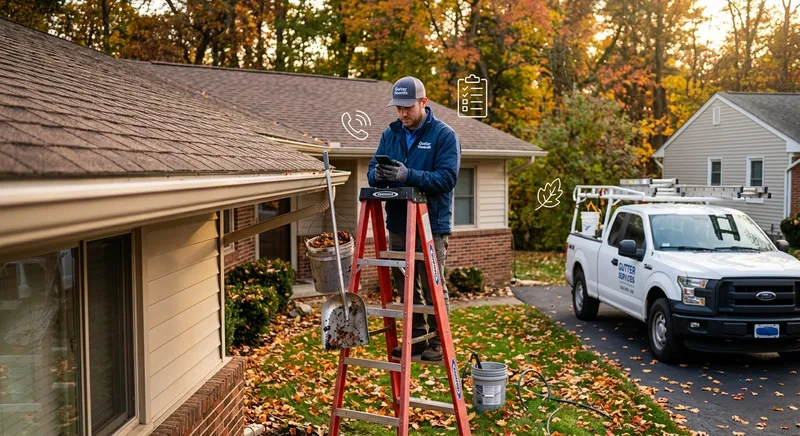
Table of Contents
You’re two stories up on a ladder cleaning gutters. The phone rings. You can’t answer — your hands are full of decomposed leaves and you’re 24 feet off the ground. The caller doesn’t leave a message. They call the next gutter company.
This happens 5-15 times per week during fall season for most gutter cleaning companies. At some point, you start looking at answering services. The question is which one actually works for a gutter cleaning business — because the calls you get are different from what most answering tools are designed to handle.
What makes gutter cleaning calls different
Before evaluating options, it helps to understand why gutter cleaning calls have specific requirements:
Extreme seasonal compression
Most answering services are designed for businesses with steady, year-round call volume. Gutter cleaning has the opposite pattern: 60-70% of your annual call volume arrives in two 6-8 week windows — fall (October-November) and spring (March-April).
That means whatever service you choose needs to handle 4-6x your normal call volume during peak weeks without putting callers on hold, without degrading quality, and ideally without costing 4-6x as much.
Callers describe visible, urgent problems
Gutter cleaning callers aren’t casually shopping for a service. They’re looking at water pouring over their gutters, stains forming on their siding, or water pooling near their foundation. They describe what they see: “The gutters are overflowing on the front of the house,” “There’s a stain running down the siding,” “I think the downspout is clogged.”
An answering service that only captures “needs gutter cleaning” misses the urgency and specifics that help you prioritize callbacks and estimate jobs before you drive out.
Height and access matter for quoting
A single-story ranch with easy ladder access is a $150 job. A three-story Victorian with steep pitch and limited access is a $500+ job. Callers often mention their home’s characteristics: “It’s a two-story colonial,” “The left side is really tall,” “There are trees hanging over the gutters.”
If the answering service captures these details, you can estimate the job before calling back. If it doesn’t, you’re going in blind and either quoting too low or losing the caller with too many questions.
Repair requests are mixed in with cleaning calls
A significant portion of gutter calls (20-30%) include a repair component: “The gutter is pulling away from the house,” “One downspout is disconnected,” “The gutter is sagging in the middle.” An answering service that only handles “gutter cleaning” inquiries misses the repair revenue — which is often higher-margin than cleaning.
You literally cannot answer the phone
This sounds obvious, but it’s more absolute for gutter cleaning than almost any other trade. You’re on a ladder. You can’t safely reach for a phone, hold a conversation, or even glance at a screen. It’s not that answering is inconvenient — it’s that answering is dangerous. The service needs to handle calls fully, not just take a message and expect you to call back in 5 minutes.
What to evaluate: the gutter-specific checklist
1. Surge handling during peak season
Ask: What happens when 8 calls come in within an hour on a Saturday in October?
Human answering services put callers on hold during surges — and gutter cleaning callers won’t wait. They’re looking at a problem and want it solved. If they hear hold music, they hang up and call the next company.
AI services should handle unlimited simultaneous calls without degradation. Verify this explicitly — some AI tools queue calls during high volume.
Your answering service needs to perform at its best during the 12-16 weeks that generate most of your revenue. Ask specifically about peak-season performance, not average performance.
2. Detail capture beyond “needs gutter cleaning”
Ask: What information does the system capture per call?
Minimum: Name, phone number, address, and that they need gutter service.
Better: House type (stories, roof style), which sides have problems, specific symptoms (overflow, sagging, pulling away, clogged downspouts), and timeline urgency.
Best: All of the above, plus whether the caller mentioned repair needs, estimated gutter length or house size, tree coverage, and any access issues.
The more detail captured during the call, the faster and more accurate your callback quote will be. For a business where the difference between a $150 job and a $500 job is the house height and roof pitch, detail matters.
3. Repair inquiry handling
Ask: Can the service recognize and capture repair requests alongside cleaning inquiries?
A caller who says “I need gutter cleaning, and also one section is pulling away from the fascia” is a cleaning + repair lead. If the service only captures the cleaning part, you’re quoting $200 for a cleaning when the real opportunity is a $350 cleaning + repair.
The service should capture multi-service requests and tag them appropriately so you can quote the full scope.
4. FAQ and question handling
Ask: Can the service answer common gutter questions during the call?
Callers ask predictable questions:
- “How much does gutter cleaning cost?”
- “Do you do repairs too?”
- “Do you clean gutter guards?”
- “How soon can you come out?”
- “Do you clean out the downspouts?”
A service that answers “I’ll have someone call you back” for every question creates callback burden and frustrates callers who have simple questions. One that can reference your FAQ answers during the conversation saves you time and keeps the caller engaged.
5. Photo upload capability
Ask: Can callers submit photos after the call?
This is a significant differentiator for gutter work. A photo of the overflowing gutters, the sagging section, or the stained siding tells you more than a 3-minute conversation. Combined with property data, photos let you quote many jobs without a separate site visit — which during a 40-job fall week saves hours of drive time.
Not all services offer this. It’s not a dealbreaker, but it’s a meaningful efficiency gain for gutter companies.
6. Property data and satellite imagery
Ask: Does the service provide property information — lot size, house square footage, or overhead views?
Some AI platforms pull public property records and satellite imagery after a call. For gutter cleaning, this is practical: you can see the roofline from above, estimate gutter runs, identify tree coverage, and spot access challenges — all before calling back.
This feature is less common but particularly valuable for gutter companies that currently do in-person estimates for every job. If you can quote 50% of jobs from photos and property data alone, that’s a significant time savings during your busiest weeks.
7. After-hours and weekend coverage
Ask: Does the service operate 24/7, including weekends?
Gutter problems are often discovered on weekends — homeowners are home, they notice the overflow during Saturday morning rain, and they call. If your answering service only runs Monday through Friday, you’re missing the weekend callers who are some of the most motivated leads of the week.
Saturday and Sunday calls during fall represent a disproportionate share of weekly gutter cleaning bookings. True 24/7 coverage, including holidays, should be non-negotiable.
8. Cost at peak volume
Ask: What will this actually cost during my busiest month?
Calculate your peak-season call volume: if you get 30-40 calls per week during October, that’s 120-160 calls per month. Price the service at that number, not your January volume of 5 calls per week.
Cost comparison at 120 calls/month (typical peak fall month):
| Type | Approximate monthly cost |
|---|---|
| AI receptionist (flat plan) | $100-$200/month |
| AI receptionist (per-call) | $120-$240/month |
| Human answering service (per-minute) | $450-$900/month |
| Part-time office hire (20 hrs/week) | $1,400-$1,800/month |
The gap between AI and human options is significant, especially during peak season. A human answering service that’s affordable in January ($150-$200/month for light volume) becomes expensive in October ($500-$900/month).
The three main options for gutter companies
AI answering service
Best for: Solo operators and small crews who need affordable, 24/7 coverage that scales during peak season.
Pros: Flat or predictable pricing regardless of volume surges. Handles simultaneous calls. Many include photo uploads, property data, and FAQ handling. True 24/7.
Cons: Some callers (especially older homeowners) may prefer a human voice. Requires initial setup time to configure services and FAQs. Can’t handle truly unusual situations the way a human can.
When it makes sense: For most gutter cleaning companies under $500K revenue, an AI service is the most cost-effective option. The pricing stays flat during peak season when every other option gets more expensive.
Human answering service
Best for: Companies that specifically need a human voice for their customer base and are willing to pay 3-5x more for it.
Pros: Real human interaction. Can handle unusual situations with judgment.
Cons: Per-minute billing makes peak season expensive. Operators can’t answer gutter-specific questions beyond their script. Hold times during industry-wide fall surges (every field service company is getting October calls). Limited trade knowledge.
When it makes sense: If your customer base skews older and you’ve tested AI options and found that callers aren’t engaging well.
Part-time office hire
Best for: Companies doing $300K+ revenue that need someone handling phones, scheduling, follow-ups, and invoicing.
Pros: Full control. Can handle complex situations. Does other office work between calls.
Cons: Most expensive option. No coverage on evenings, weekends, or sick days — exactly when many gutter calls arrive. Needs training on gutter terminology and quoting.
When it makes sense: When your call volume and office workload justify a dedicated person (usually at 500+ jobs per year), and you have enough non-phone tasks to keep them productive between calls.
The practical decision
For most gutter cleaning businesses, the evaluation comes down to a simple question: during my busiest 12 weeks of the year, will this service answer every call, capture enough detail for me to call back intelligently, and not destroy my budget?
The tool that does all three is the right choice. Everything else — fancy dashboards, integrations with software you don’t use, analytics you’ll never read — is secondary.
Start with a trial during a busy period if possible. Testing an answering service during a slow January week doesn’t tell you how it’ll perform during an October deluge. The real test is whether it handles your peak volume without missing calls, frustrating callers, or surprising you with a bill that wipes out the profit from the leads it captured.