What Happens When Every Homeowner on the Street Calls Your Landscaping Company the Same Week
Spring call surges overwhelm landscaping companies every year. Here is what happens to your leads, your schedule, and your revenue when the phone won't stop ringing.
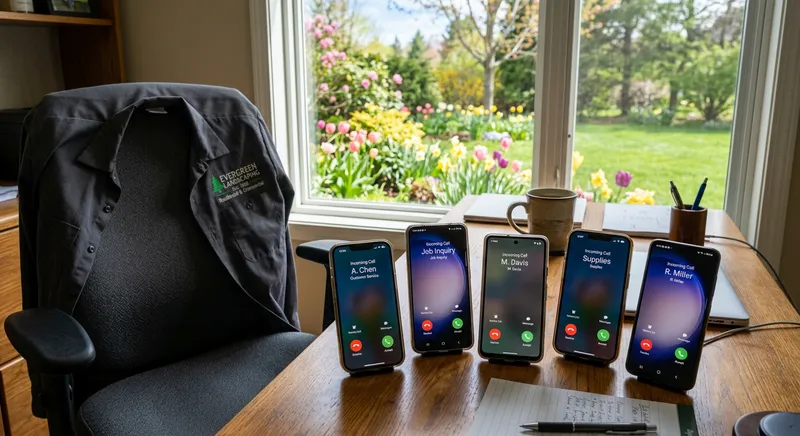
Table of Contents
You know the week. It’s late March or early April, the first stretch of warm days hits, and suddenly every homeowner in your service area remembers their yard exists. The phone starts ringing at 7:30 AM and doesn’t stop until 6 PM.
Monday: 18 calls. Tuesday: 22 calls. Wednesday: 25 calls. Your normal volume is 8–10 per day.
You answer some while driving between jobs. A few more during lunch. Your spouse picks up when she can. The rest go to voicemail. By Wednesday evening, you have 30+ unreturned calls from numbers you don’t recognize. You don’t know which ones are new leads, which ones are existing clients, and which ones are spam.
By Friday, half those callers have hired someone else.
This is the spring overflow problem, and it costs landscaping companies more revenue in a single two-week window than most realize.
The anatomy of a spring call surge
The spring rush isn’t a gradual ramp. It’s a step function. In most markets, there’s a specific trigger — the first week of sustained 60°F+ temperatures — that causes call volume to spike 2–4x almost overnight.
What’s driving the calls:
- Seasonal cleanups. Homeowners who’ve been staring at dead leaves and debris all winter finally want it handled.
- Mowing season kickoff. Customers from last year calling to reactivate service, plus new prospects who moved into the neighborhood or are switching providers.
- Landscape projects. Spring is when homeowners commit to the patio, the retaining wall, the new bed layout, the tree removals they’ve been putting off since fall.
- Mulch. Everyone wants mulch. At the same time. This week.
- Irrigation startups. In markets with freeze risk, spring startups generate a wave of scheduling calls.
Each of these categories generates its own call volume, and they all hit during the same 2–3 week window. A landscaping company that normally handles 8–10 calls per day is suddenly fielding 20–30 — with no change in staff, no additional phone capacity, and no system to triage the flood.
What actually happens to the calls you can’t answer
When call volume exceeds your capacity to answer, calls don’t disappear. They go somewhere — and the destination determines whether you capture the revenue or lose it.
The voicemail trap
Most of the overflow goes to voicemail. And the data on voicemail behavior is consistent across industries: 60–75% of callers who reach voicemail don’t leave a message. They hang up and call the next company.
For a landscaping company getting 25 calls/day during the spring surge:
- You answer 10 (while driving, between jobs, during lunch)
- 15 go to voicemail
- 10 of those 15 hang up without leaving a message
- You return the 5 voicemails, but by the next morning, 2 of those callers have already booked with someone else
Net result: 12 out of 25 daily callers never connect with you. Over a two-week surge, that’s 120 lost connections. If even 30% of those are real prospects (not spam, not existing clients), you’ve missed 36 potential jobs in two weeks.
The busy signal effect
If you’re on a call and another call comes in, most mobile carriers send it straight to voicemail. Some callers hear a busy signal. Either way, the message is: this company is too busy for me.
During the spring surge, you might be on a 5-minute call with a homeowner discussing a cleanup quote while three other calls come in and go to voicemail. You don’t even know those calls happened until you check your phone later. If those three callers were a $2,000 mulch job, a $4,000 patio prospect, and a $1,200 seasonal mowing contract, you just lost $7,200 in potential revenue during a single phone call.
The callback spiral
The calls you do manage to return create their own problem: phone tag. You call back at 5 PM. They don’t answer. They call you the next morning at 10 AM while you’re running a crew. You call back at lunch. They’re in a meeting. Two days later, you connect — but by then they’ve spoken to two other companies who answered on the first call.
Phone tag converts at a fraction of the rate of a live first-call connection. Research on lead response time shows that the odds of qualifying a lead drop by over 10x when the first response takes more than an hour. During the spring surge, your average response time might be 4–8 hours. Some callbacks happen the next day.
The revenue impact most landscapers don’t calculate
Let’s put real numbers to a typical spring surge for a landscaping company doing $400K–$700K in annual revenue:
Normal daily call volume: 8–10 calls Spring surge volume: 20–30 calls/day for 10–15 business days Additional calls during surge: ~150–250 extra calls over the surge period Calls that go unanswered (estimated): 60–70% of the excess = 90–175 unanswered calls Legitimate prospects in that group (removing spam and existing clients): ~40% = 36–70 real prospects Conversion rate on prospects you actually speak with: 35–50% Jobs lost because you never connected: 13–35 jobs
At an average blended job value of $1,800 (mix of cleanups, mowing contracts, mulch, and small projects): $23,000–$63,000 in lost revenue from one spring surge.
And this happens every year. Some years are worse — a late spring that suddenly breaks warm generates an even more compressed surge. The revenue loss compounds because those lost customers become someone else’s customers and someone else’s referral sources.
Why “just work harder” doesn’t scale
The instinct during the spring rush is to push through it: answer more calls, work longer hours, call people back at 9 PM. But this approach has structural limits:
You can only take one call at a time. Even if you answer every call personally, you can’t handle two calls simultaneously. During peak hours (10 AM–2 PM), calls come in clusters. Answering one means missing two.
Your crew needs you. If you’re the owner-operator or lead estimator, every hour you spend on the phone is an hour you’re not on a job site, managing a crew, or running an estimate. The phone pulls you away from the work that generates revenue.
Quality degrades under volume. When you’re trying to answer 25 calls a day, each conversation gets shorter, less detailed, and less personal. The homeowner who needs 10 minutes to describe their landscape project gets 3 minutes because you have 6 other calls to return. That rushed interaction doesn’t inspire confidence or close deals.
You burn out. The spring surge is already the most physically demanding time of the year — long days, crews to manage, equipment breaking down, weather delays. Adding “answer 25 calls a day” to that workload puts owners in a position where something gives. Usually it’s follow-up: the calls get returned later and later, the estimates get delayed, and the leads slip away.
The downstream effects nobody talks about
The spring surge doesn’t just cost you revenue during the surge itself. It creates problems that persist through the rest of the season:
Weaker route density
Every mowing contract you lose during the spring surge is a gap in your weekly route. If you normally service 8 homes on Oak Street and you miss 2 new prospects on that same street, those 2 lawns go to a competitor. Now your competitor has better route density on that street than you do — they’re more efficient, they can price more competitively, and they’re more visible to the remaining neighbors.
Fewer upsell opportunities
A customer who starts with weekly mowing often adds mulch, bed maintenance, fall cleanup, and aeration over time. Losing the initial mowing contract doesn’t just cost you $1,200/year — it costs you the $800–$2,000 in annual add-on services that would have followed.
Damaged reputation
Homeowners who call and can’t reach you don’t just hire someone else — they form an opinion. “I tried calling them and nobody answered” becomes what they tell their neighbor when asked for a landscaping recommendation. You lose not just the direct lead but the referral network around it.
Competitor advantage
Every lead you lose goes to a competitor who answered the phone. That competitor gets stronger — more revenue, better route density, more reviews, more referrals — while your growth stalls. The spring surge is a redistribution event: the companies that handle the volume capture the growth; the companies that don’t fall behind.
What the highest-growth landscaping companies do during the surge
The companies that consistently capture spring demand share a few practices:
1. They plan for the surge before it happens
They know, based on prior years, approximately when the surge will hit and how much additional call volume to expect. They don’t wait until the phone is ringing 25 times a day to figure out how to handle it — they have a system in place by March 1.
2. They have phone capacity beyond one person
Whether it’s an office person, a family member on a second line, an answering service, or a technology solution — they can handle more than one call at a time. During the surge, simultaneous call capacity is the difference between capturing 80% of leads and capturing 40%.
3. They triage calls by type
Not every spring call needs the owner. Existing customers reactivating service can be handled by an office person or an automated system. Mulch scheduling is straightforward. New prospect inquiries need more attention. By routing calls appropriately, they reserve the owner’s time for the high-value conversations.
4. They respond to leads the same day
Even when they can’t answer every call live, they have a system that captures caller information and enables same-day callbacks. A callback at 4 PM the same day converts far better than a callback the next morning — the prospect hasn’t had time to call three other companies and choose one.
5. They measure the surge
They track call volume, answer rate, and lead conversion during the spring window. After the surge passes, they review the data: how many calls came in, how many were answered, how many converted, and what the revenue impact was. This data drives improvements for the following year.
The bottom line
The spring call surge isn’t a surprise. It happens every year, in the same window, for the same reasons. The landscaping companies that grow year-over-year aren’t the ones who work harder during the surge — they’re the ones who build systems to handle the volume before it arrives.
If your phone is the bottleneck — if you’re one person trying to answer 25 calls a day while running crews and estimating jobs — the spring surge will cost you $20,000–$60,000 in missed revenue every single year. That number alone justifies whatever it costs to add phone capacity, whether that’s a part-time hire, an answering service, or a technology solution.
The first step is measuring the problem. Track your call volume for the next two weeks. Count the calls you miss. Estimate the revenue they represent. Then decide whether you can afford to let it happen again next spring.
Related: AI receptionist for landscaping companies | Overflow answering service | Calculate the cost of your missed calls