What Tinylawn's AI Receptionist Sounds Like When a Property Manager Calls About Annual Tree Maintenance
A step-by-step walkthrough of how Tinylawn's AI receptionist handles a call from a commercial property manager requesting annual tree pruning — from greeting to property report.
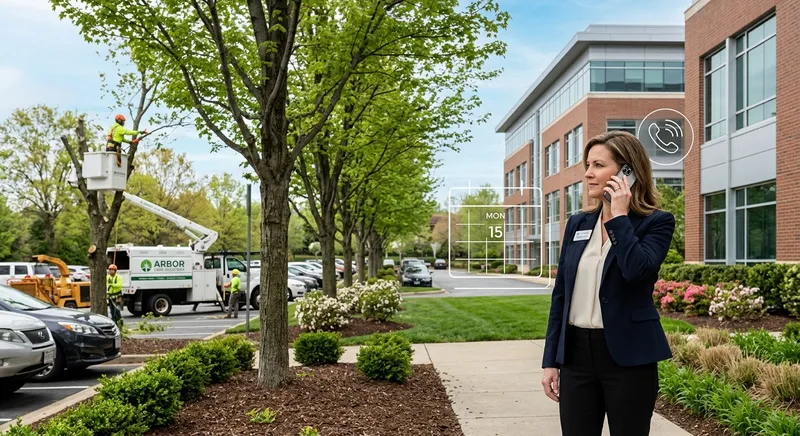
Table of Contents
It’s early March. You’re on a job site — your crew is finishing a large dead elm removal at a municipal park, and you’re running the ground crew while your lead climber works the canopy. Phones are in the truck, 200 feet away.
Meanwhile, a property manager named Jennifer Chen is at her desk. She manages a portfolio of 9 commercial properties for a regional real estate group — three office parks, two apartment complexes, a retail strip center, and three mixed-use developments. She’s working through her Q2 vendor schedule and needs to book the annual tree pruning cycle for all nine properties.
Jennifer’s been using another tree care company for the past two years, but she’s been frustrated. It takes 2–3 days to get a callback, their invoicing is late, and last fall they no-showed a scheduled pruning at one of her office parks. She’s looking for a new arborist — and your company was recommended by a colleague who manages properties in the same area.
Jennifer calls your number.
The call
Your line rings a few times. You’re 200 feet from your phone, running a chainsaw. The call forwards to Tinylawn.
What Jennifer hears:
“Hi, thanks for calling [Your Company Name]. This is Rachel. How can I help you today?”
No phone tree. No hold music. No “all of our representatives are currently busy.” Jennifer starts talking immediately.
Jennifer explains what she needs
Jennifer is experienced at briefing vendors. She’s concise:
“Hi, I’m Jennifer Chen with Pacific Ridge Properties. We manage several commercial properties in the area and I’m looking for a tree care company to handle our annual pruning. We have nine properties that need a full pruning cycle this spring and summer. I’d like to set up a meeting to walk through the scope. Can someone call me back today?”
This is a different kind of call than a homeowner worried about a dead tree. It’s B2B. It’s a potential multi-property contract. The details matter — and Jennifer is evaluating your company’s professionalism from the first interaction.
The AI handles this the way a good receptionist would. It doesn’t try to close a deal or provide pricing. It engages with what Jennifer described and gathers the information you’ll need to follow up effectively.
Based on the FAQs you’ve configured in your dashboard, the AI can respond to questions Jennifer might ask during the conversation:
- “Do you handle commercial properties?” — Yes, if you’ve added this to your FAQ responses. The AI gives your answer about your commercial capabilities.
- “What’s your service area?” — The AI provides the answer you’ve configured.
- “Are you ISA certified?” — If you’ve included your credentials in your FAQs, the AI shares them.
- “Can you handle all nine properties?” — The AI can reference your capacity or let Jennifer know someone will discuss scope in detail during the callback.
The AI recognizes this as a quote request — Jennifer is describing a specific scope of work and wants to set up a meeting. It shifts into information-gathering mode.
Information capture
The AI collects the details you’ll need to prepare for the callback:
- Name: Jennifer Chen
- Company: Pacific Ridge Properties
- Phone number: Confirmed from caller ID
- Email: jennifer@pacificridgeproperties.com (asked and captured during the conversation)
- What she needs: Annual tree pruning cycle across 9 commercial properties. Wants a site meeting to walk the scope.
- Properties: She mentions a few by name — Cascade Office Park, Ridgeline Apartments, Westfield Retail Center — and notes there are six more. She’ll share the full list once you connect.
- Timeline: Wants to start the pruning cycle in April–May. Needs the meeting scheduled within the next two weeks.
- Context: Currently unhappy with their existing vendor. Was referred by a colleague.
The conversation takes about 4 minutes. Jennifer is talking to what feels like a competent receptionist who asks relevant follow-up questions, confirms details, and doesn’t waste her time.
This is critical for commercial leads. A property manager calling about a 9-property contract is forming an impression of your company during this call. A professional, efficient interaction — even with an AI — signals that your operation is organized enough to handle commercial work. A voicemail signals the opposite.
What happens after the call
Immediate notification
Within seconds of the call ending, you receive an SMS and email notification:
New lead — Quote Request
- Jennifer Chen, Pacific Ridge Properties
- Annual tree pruning, 9 commercial properties
- Referred by colleague
- Wants site meeting within 2 weeks
- Requested same-day callback
You check your phone at noon during the lunch break. It’s been 90 minutes since Jennifer’s call. That’s tight for a commercial lead — but you have everything you need to make the callback count.
Lead record details
You open the lead in your Tinylawn dashboard and see:
- Full call transcript. You can read exactly what Jennifer described — the scope, the timeline, her frustration with the current vendor, the referral source. This is intelligence you’d normally lose with a voicemail that says “call me back about tree work.”
- Call recording. If you prefer to listen rather than read, the full audio is there.
- AI-generated summary. A concise recap: “Commercial property manager requesting annual tree pruning cycle for 9 properties. Currently unsatisfied with existing vendor. Referred by colleague. Wants site meeting within 2 weeks. High-priority lead.”
- Contact details. Name, company, phone, email — all captured during the call and organized in the lead record.
Property data
Jennifer mentioned Cascade Office Park during the call. Tinylawn captured the address and automatically pulled property data:
- Lot size and building footprint. You can see the scale of the property before you drive there.
- Satellite imagery. The aerial view shows the tree canopy across the property — you can estimate the number of significant trees, identify species clusters, and get a preliminary sense of the pruning scope.
- Parcel boundaries. You know exactly where the property lines are, which matters for commercial work where adjacent parcels may have different ownership.
This data is available for the properties Jennifer mentioned by address. The full portfolio of 9 properties will require her to share the remaining addresses — but you already have a head start on the properties she named.
The callback
You call Jennifer at 12:05 PM. She picks up on the second ring.
Instead of opening with “Hi, I got your voicemail” — which requires Jennifer to repeat everything — you open with context:
“Hi Jennifer, this is [your name] from [Your Company Name]. I got the details from your call this morning — 9 properties, annual pruning cycle, you’re looking to get started in April. I’d love to set up a walk-through. Which property should we start with?”
Jennifer is immediately impressed. You’re not asking her to repeat herself. You’re not scrambling for a pen. You’re prepared, organized, and ready to talk specifics.
She suggests starting with Cascade Office Park — the largest property — and you schedule a walk-through for Thursday morning. During the call, you mention that you already have the satellite view of the property and can see approximately 40–50 significant trees in the canopy. Jennifer confirms that’s about right.
The meeting is booked. The relationship has started. And it started with a professional first impression — even though you were running a chainsaw when she called.
What this looks like without Tinylawn
Same scenario. Jennifer calls at 10:30 AM. Your phone goes to voicemail.
Jennifer leaves a message: “Hi, this is Jennifer Chen with Pacific Ridge Properties. I manage several commercial properties and I’m looking for a tree care company for annual pruning. Can someone call me back? My number is…”
That voicemail gives you:
- A name
- A company name (which you’ll Google later to figure out what they do)
- A phone number
- Zero details about the scope, timeline, urgency, or referral source
You listen to the voicemail at 4 PM. You call Jennifer. She’s in a meeting. You leave a voicemail. She calls back the next morning at 9 AM. You’re already on a job. You miss it. She calls again at 11 AM. You pick up.
Now — 24 hours after her initial call — you’re finally having the conversation. You ask her to repeat everything she already told your voicemail yesterday. She does, but with less enthusiasm. She’s already called two other tree companies, and one of them answered on the first ring and has a meeting scheduled for tomorrow.
You’re now competing from behind. The other company made a professional first impression. You made a voicemail.
For a residential lead, this might not matter. But for a 9-property commercial contract worth $30,000–$60,000 per year? The first impression is the whole ballgame.
Why this matters for commercial tree care
Commercial tree care leads have three characteristics that make phone handling unusually important:
1. The contracts are large and long
A single property management company can represent $20,000–$60,000 in annual revenue. A multi-year contract at that level can be worth $100,000–$300,000 over the relationship. These are not leads you can afford to fumble with a slow callback.
2. Property managers evaluate professionalism constantly
Every interaction — the first phone call, the response time, the meeting preparation, the proposal format — is an audition. Property managers manage dozens of vendor relationships. They’re pattern-matching your communication style against every other vendor they work with. A company that answers the phone, captures details, and calls back prepared is signaling: “We can handle the coordination that commercial work requires.”
3. The referral network is tight
Property managers talk to each other. A good experience with your company gets shared at industry events, within management companies, and across property portfolios. A single successful commercial contract often leads to 2–3 more through referral. The reverse is also true — a botched first impression travels just as fast.
Setting up Tinylawn for commercial tree care calls
If you want your AI receptionist to handle commercial calls like the one above, configure it for the types of questions property managers ask:
FAQs to add:
- “Do you handle commercial tree care?” → Your answer about commercial capabilities, certifications, and experience.
- “What’s your service area?” → Your geographic coverage.
- “Are your arborists ISA certified?” → Your credentials.
- “Do you carry liability insurance?” → Your coverage details (property managers always ask this).
- “Can you provide proof of insurance?” → How you handle COI requests.
- “What’s your response time for emergencies?” → Your emergency protocol.
- “Do you offer annual maintenance contracts?” → Your contract structure.
Services to configure:
- Tree pruning / structural pruning
- Tree removal
- Stump grinding
- Emergency / storm response
- Plant health care
- Hazard assessment
- Consulting
Notifications:
Set up SMS notifications for yourself and any team member who handles commercial sales. Commercial leads should get a callback within 2 hours maximum — the faster, the better.
If you want to see how Tinylawn handles commercial tree care calls, start a free trial and call as if you were a property manager requesting service. You’ll see exactly how the AI handles the conversation, what gets captured, and how the lead record looks in your dashboard.