Why a $15,000 Patio Job Went to Your Competitor (They Just Picked Up the Phone)
Landscape design-build leads are high-value but time-sensitive. Learn why response speed wins $5K-$30K projects and how to capture every lead without hiring office staff.
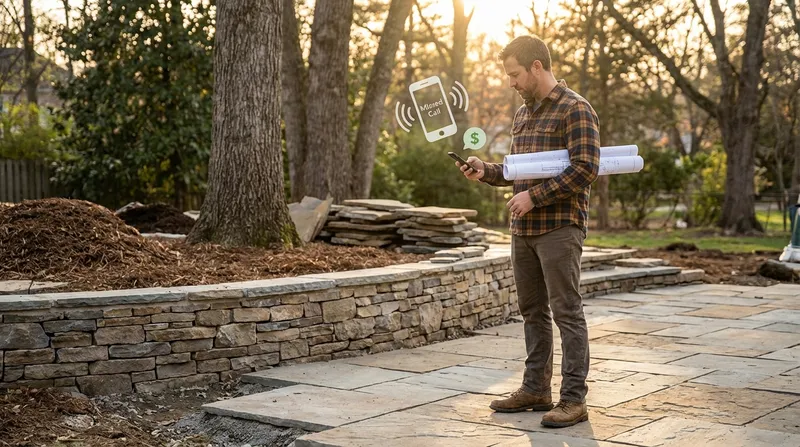
Table of Contents
A homeowner spends three weekends browsing patio designs on Pinterest. They measure their backyard, price out pavers online, and finally decide to call a professional. They find your company on Google, tap the number, and get your voicemail.
They hang up and call the next company on the list. That one answers on the second ring.
A $15,000 patio-and-retaining-wall project just walked away. You’ll never know it happened.
Design-Build Leads Are Different (And More Expensive to Lose)
If you run a landscape design-build operation, your missed calls carry a different price tag than a basic mowing company’s.
The numbers tell the story:
- Average landscaping project cost: $2,600 to $13,700, with a national average of $8,150 (CostHelper, 2024)
- Full backyard renovation: $15,000 to $50,000 (Angi, 2024)
- Outdoor kitchen + paver patio: $25,000 to $35,000 (ProscapeAI, 2025)
Compare that to a $75 mowing visit. One missed design-build call can equal 100+ missed mowing calls in revenue impact.
And the leads don’t come cheap. Landscaping companies pay $40 to $80 per exclusive lead on average (Improve & Grow, 2025). When that lead calls and nobody answers, you’ve burned the acquisition cost and the project revenue.
The First Contractor to Respond Usually Wins
This isn’t opinion. It’s data.
78% of customers buy from the first company that responds to their inquiry (Vendasta, 2025). For home services specifically, the first vendor to respond wins 35-50% of all sales.
The speed advantage is dramatic:
- Responding within 1 minute boosts conversion rates by 391% compared to a 24-hour response (Velocify Lead Response Study)
- Responding within 5 minutes makes you 21x more likely to qualify the lead vs. waiting 30 minutes (MIT/InsideSales.com)
- The average business takes 42 hours to respond to a lead (Rep.ai, 2024)
That last stat should scare you. If you’re calling people back in 42 hours, your competition has already signed the contract and ordered materials.
Why Design-Build Callers Won’t Leave a Voicemail
Here’s the part most landscape contractors underestimate: 80% of callers who reach voicemail hang up without leaving a message (AMBS Call Center, 2026). In home services specifically, Invoca’s platform data suggests the number is even higher — less than 3% of callers pushed to voicemail actually leave one.
Why? Because a homeowner calling about a $15,000 landscape project isn’t desperate. They’re evaluating. They’re calling 2-3 companies to get quotes. If you don’t answer, they don’t need you — they just call the next name on the list.
The psychology is straightforward:
- They interpret voicemail as “this company is too busy for me”
- They interpret a fast answer as “this company is professional and responsive”
- They make snap judgments — and a first phone interaction sets the tone for a multi-month project
For a $300 mowing job, a homeowner might call back. For a $15,000 outdoor living space? They’ve already committed emotionally to the contractor who made them feel heard first.
The Timing Problem: When Leads Call vs. When You’re Available
Design-build contractors have a particularly bad version of this problem. Your workday looks like this:
- 7:00-8:00 AM: Loading materials, crew briefing
- 8:00 AM-4:00 PM: On the job site — running equipment, meeting with subcontractors, problem-solving
- 4:00-6:00 PM: Cleanup, drive back, handle admin
- 6:00-9:00 PM: Finally free — but your leads are eating dinner
Meanwhile, your best leads are calling during your busiest hours. Homeowners take breaks at lunch, leave work early, or call in the evening after walking their property. 60% of service inquiries happen outside traditional business hours.
And when you’re on a job site managing a hardscape installation, you’re not exactly in a position to have a 10-minute qualification call about someone’s dream patio. The noise alone makes it impossible.
What Happens When Every Call Gets Answered
The landscape contractors growing fastest right now aren’t working longer hours or hiring receptionists at $45,000+/year. They’re using AI receptionists that answer every call in under 3 seconds — including evenings, weekends, and holidays.
Here’s what that looks like for a design-build business:
Lead Qualification That Actually Helps
Instead of a generic “someone called” message, the AI asks the questions that matter for design-build:
- What type of project are you looking for? (patio, retaining wall, outdoor kitchen, full renovation)
- What’s the property address?
- What’s your timeline?
- Do you have a budget range in mind?
You get a fully qualified lead summary texted to your phone with the property’s satellite imagery and lot size pulled automatically. Before you even call back, you know whether this is a $3,000 planting job or a $25,000 hardscape project.
Appointments Booked While the Lead Is on the Phone
This is where the real conversion happens. Instead of “I’ll have someone call you back,” the AI checks your calendar and books the consultation on the spot.
The homeowner hangs up feeling taken care of. You haven’t been interrupted. The appointment is on your schedule. No phone tag. No lost leads.
After-Hours Coverage Without After-Hours Work
A homeowner calls at 7:30 PM on a Thursday after measuring their backyard. Instead of voicemail, they get an immediate, professional conversation. Their questions get answered. Their consultation gets booked. They go to bed excited about their project — and locked in with your company.
Your competitor’s voicemail greeting doesn’t stand a chance.
The ROI Math for Design-Build
Let’s run the numbers conservatively:
Your current situation:
- Leads that call per month: 20
- Calls you miss (on job site, after hours): 12 (60%)
- Of those, how many leave voicemail: 2 (less than 20%)
- Leads you actually follow up with: ~8
- Conversion rate: 25%
- Jobs booked: 2
With every call answered:
- Leads that call per month: 20
- Calls answered: 20 (100%)
- Leads qualified and followed up: 20
- Conversion rate: 25%
- Jobs booked: 5
The difference: 3 additional jobs per month.
At an average project value of $8,150 (CostHelper, 2024), that’s $24,450 in additional monthly revenue — or $293,400 per year.
Tinylawn starts at $49/month. Even if you only capture one additional project per month, that’s a 166x return on a design-build average.
Want to see your specific numbers? Calculate your missed call revenue loss in 30 seconds.
Your Leads Are Already Calling. The Question Is Who Answers.
The US landscaping industry hit $188.8 billion in 2025 (IBISWorld), with nearly 700,000 businesses competing for that revenue. The market is fragmented — no single company controls more than 5%.
That fragmentation is actually good news for small design-build firms. Homeowners aren’t loyal to big companies. They’re loyal to whoever answers the phone, shows up on time, and does good work.
You already do the last two. The first one is the easiest to fix.
Related: Learn how Tinylawn helps landscaping businesses capture more leads, or explore how AI appointment scheduling works for contractors.