Why Growing Landscaping Companies Plateau at $500K Revenue
Most landscaping companies stall between $300K and $600K. Here are the operational bottlenecks that cause the plateau and what it takes to break through.
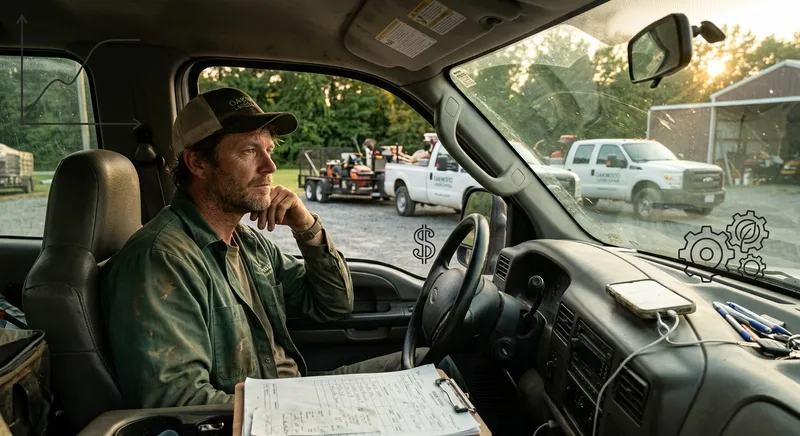
Table of Contents
You started as a solo operator with a truck, a mower, and 15 lawns. Five years later, you’ve got 3 crews, 8-10 employees, and revenue somewhere between $350K and $550K. The phone rings constantly. You’re working 60-hour weeks. And the business feels like it’s running at capacity — but the revenue needle won’t move.
This is the most common stalling point in the landscaping industry. The companies that push past it look fundamentally different on the other side. The ones that don’t usually shrink back down or sell at a discount.
The plateau isn’t caused by one thing. It’s a set of interconnected bottlenecks that all converge around the same revenue range — and most of them are invisible until you’re stuck in them.
The owner-operator trap
The most common bottleneck at $500K is that the owner is still doing everything. Not just managing — everything. Estimating. Selling. Scheduling crews. Handling customer complaints. Ordering materials. Managing payroll. Maintaining equipment. And in many cases, still running a route or working on job sites.
This worked at $150K. It was uncomfortable but manageable at $300K. At $500K, it’s the constraint that prevents growth.
Here’s why: every hour you spend doing work that a $20/hour employee could do is an hour you’re not spending on the activities that actually grow revenue — selling new work, building relationships with commercial property managers, training crew leaders, or improving systems.
The math is instructive. If you’re running a crew route 4 days per week, that’s roughly 32 hours of field time. Add 15-20 hours of office work (estimates, scheduling, billing, customer issues). You’re at 50+ hours before you’ve done any proactive business development.
The companies that break through this plateau share one trait: the owner stops doing and starts managing. This doesn’t mean sitting in an office — it means deliberately removing yourself from daily production so you can focus on the work that generates growth.
What this looks like in practice
- Hire a crew leader (or promote one) who runs the route you’re currently on. Your cost: $45,000-$55,000/year in wages and burden. Your gain: 32 hours per week back.
- Hire a part-time office person (or use technology) to handle scheduling, customer calls, and basic admin. Your cost: $20,000-$30,000/year. Your gain: 15-20 hours per week back.
- Invest those reclaimed hours into sales and business development. One new commercial contract per quarter at $3,000-$5,000/month more than pays for the people you hired.
The resistance is understandable. Hiring feels like adding cost before you have the revenue to justify it. But the revenue ceiling exists precisely because you don’t have time to pursue it. You have to invest before the return appears.
The estimating bottleneck
At $500K, you’re probably doing 5-15 estimates per week during peak season. Each one takes 30-90 minutes — drive time, on-site walkthrough, writing the proposal, follow-up.
If you’re the only person who estimates, that’s 10-20 hours per week during spring — hours that come directly out of your business development, crew management, and sanity.
The bottleneck compounds because estimates have a natural delay. A homeowner calls on Monday. You schedule the estimate for Thursday. You send the proposal on Friday. The homeowner decides the following week. That’s a 7-10 day sales cycle — and during that time, the homeowner may have gotten two other estimates.
How companies break through it
Reduce the number of in-person estimates. Not every lead needs a site visit. For standard services (weekly mowing, spring cleanup, mulching), you can quote many jobs from property data, satellite imagery, and photos. This is where technology that captures property details during the initial call becomes valuable — it lets you quote without driving out.
Quote faster. The industry data is clear: the first company to deliver a detailed, professional estimate wins a disproportionate share of the business. If you’re taking 3-4 days to get a proposal out and your competitor does it in 24 hours, you’re losing winnable jobs to speed.
Standardize pricing. Create a pricing matrix for your standard services. Weekly mowing based on lot size: 5,000 sq ft = $X, 10,000 sq ft = $Y, 15,000 sq ft = $Z. Spring cleanup by property category. Mulch by the cubic yard including labor. The less you have to custom-calculate each estimate, the faster you can turn them around.
Train someone else to estimate basic jobs. Your crew leader or office person can handle straightforward estimates (mowing, cleanups, mulch) with a pricing matrix and some training. You reserve your time for complex jobs — hardscaping, design-build, large commercial bids — where your expertise matters.
The crew quality ceiling
Growing from 1 crew to 3 crews requires hiring 6-10 people. In landscaping, that’s a challenge.
The labor market for landscaping is notoriously tight. Turnover rates in the green industry run 30-50% annually according to the National Association of Landscape Professionals (NALP). That means if you have 10 employees at the start of the year, 3-5 of them will be gone by December — and you’ll spend significant time and money finding replacements.
At the $500K level, crew quality becomes a direct constraint on growth:
- Poor-quality crew work generates complaints, callbacks, and lost customers. Every customer you lose to bad work is a customer you have to replace through marketing — which costs 5-7x more than retaining them.
- Unreliable employees force you back into the field to cover routes, pulling you away from management and sales.
- Crew leaders who can’t manage require constant oversight, which defeats the purpose of having them.
What the companies past $500K do differently
Pay above market. A $2-$3/hour premium over the going rate dramatically reduces turnover and attracts better candidates. On a 10-person crew, that’s $40,000-$60,000/year in additional labor cost — but it’s less than the cost of constant hiring, training, and quality problems.
Invest in crew leader development. Don’t just promote your best laborer to crew leader. Train them: job costing, customer communication, quality standards, conflict management. A strong crew leader is the highest-leverage hire in a landscaping company.
Create a clear advancement path. Laborer → crew member → crew leader → account manager. People stay in jobs where they see a future. If the only promotion available is “start your own company,” that’s what your best people will do.
Fire fast when quality doesn’t improve. One underperforming crew member affects the morale and output of the entire team. Document the issue, provide clear expectations and a timeline, and act if things don’t improve. Carrying dead weight at the $500K level is a luxury you can’t afford.
The phone bottleneck (the invisible one)
This is the bottleneck most landscaping company owners don’t recognize until they measure it.
At $500K revenue with 3 crews, you’re getting 20-40 inbound calls per week. These are a mix of existing customer questions, new leads, vendor calls, and spam. They come in while you’re:
- Managing crews in the morning
- Running estimates midday
- Handling customer issues in the afternoon
- Doing admin work in the evening
The result: 40-60% of inbound calls go unanswered. Of the unanswered calls, 80% of callers don’t leave a voicemail. Those callers dial the next landscaper on Google.
At $500K, a landscaping company typically loses $50,000-$100,000 per year in leads that called but never connected. You don’t see this number because the leads never made it into your pipeline. They’re invisible losses — the estimate you never gave, the contract you never bid, the maintenance customer who went to your competitor because they answered first.
This bottleneck is particularly damaging because it caps growth even when marketing is working. You can invest in Google Ads, SEO, and referral programs — but if half the leads those channels generate hit voicemail, you’re paying for leads and giving them away.
What the companies past $500K do
They solve the phone before they scale marketing. Whether it’s a dedicated office person, an answering service, or an AI receptionist — the phone gets answered during business hours and ideally after hours too. The specific solution matters less than the result: every inbound call is captured, detailed information is collected, and leads are queued for callback.
The companies that skip this step keep investing in marketing while hemorrhaging leads through an unanswered phone. They can’t figure out why growth has stalled when their Google rankings are strong and their trucks are branded. The answer is in their missed call log.
The systems gap
At $150K, you can run the business from your head and your phone. At $500K, you can’t.
The companies that plateau often have no systems beyond:
- A paper route sheet or basic spreadsheet for scheduling
- Invoices created manually in QuickBooks
- Customer information stored in the owner’s phone contacts
- Estimates done on paper or in a Word template
- No time tracking for crews
The lack of systems creates friction at every step: scheduling takes longer than it should, invoicing gets delayed (which hurts cash flow), customer information is lost when an employee leaves, and you have no data on job profitability.
You don’t need enterprise software. But you need some structure:
- A CRM or job management tool that stores customer information, job history, and notes in one place. Jobber, Service Autopilot, and LMN are commonly used in landscaping.
- Digital time tracking for crews. Knowing actual hours per job tells you which accounts are profitable and which are costing you money.
- A standardized estimating process with templates, pricing matrices, and a consistent format.
- Automated invoicing tied to completed jobs, not manual entry at the end of the month.
The goal isn’t to add complexity — it’s to remove the bottleneck of having everything in the owner’s head.
The mindset shift
Breaking through $500K requires the owner to accept an uncomfortable truth: the habits that built the business to this point are the same habits holding it back.
Working harder won’t break the plateau. You’re already working harder than most people. The solution is working differently — removing yourself from production, investing in people and systems before the revenue justifies it, and spending your time on the 20% of activities that generate 80% of the growth.
Every landscaping company past $1M revenue went through this inflection point. It feels risky. It requires spending money on people and tools before you’ve “earned” it. And it means letting go of daily control over every crew, every estimate, and every customer interaction.
The alternative is staying at $500K, working 60-hour weeks, and watching competitors who figured this out grow past you. That’s not a business — it’s a job that owns you.
The plateau is real. But it’s a ceiling, not a wall. The companies that break through are the ones willing to build the business differently than they built it to get here.