How to Market a Landscaping Business Beyond Word of Mouth
Word of mouth built your first 50 customers. It will not get you to 200. Here are the marketing channels that actually work for landscaping companies.
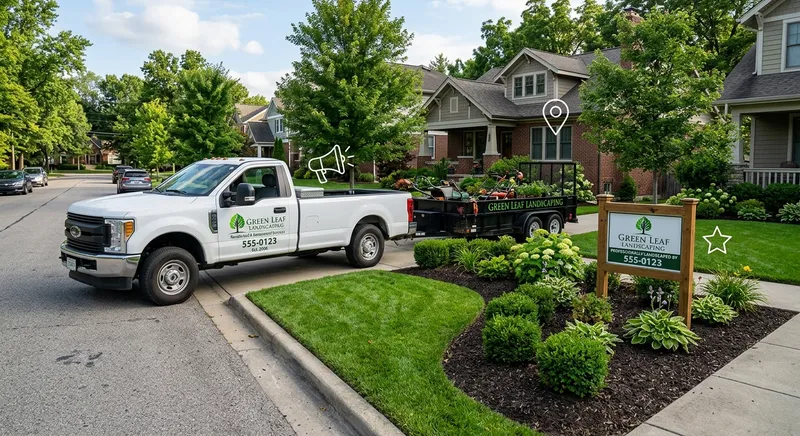
Table of Contents
Word of mouth is how most landscaping companies start. Your first 20-30 customers came from neighbors, friends of friends, and people who saw your truck on the street. It works — until it doesn’t.
The problem with word of mouth isn’t that it stops working. It’s that it stops scaling. You can’t control when someone recommends you. You can’t predict how many referrals you’ll get next month. And when you hit a slow stretch — a rainy spring, a customer who moves, an HOA contract that doesn’t renew — you don’t have a pipeline to backfill.
The landscaping companies that grow past $200K-$300K in revenue do so by building marketing channels that generate leads consistently and predictably. Here’s what actually works — ranked by ROI for a typical landscaping company.
1. Google Business Profile (the single highest-ROI channel)
If you do nothing else on this list, do this. Your Google Business Profile (GBP) is where most of your local leads come from — and most landscaping companies drastically underinvest in it.
When a homeowner Googles “landscaping near me” or “landscaper in [city],” the map pack results (the top 3 local listings) capture roughly 42% of all clicks, according to BrightLocal’s annual local search survey. Your GBP is how you show up there.
What actually moves the needle
Reviews. The single most important factor for map pack ranking and click-through rate. Aim for 50+ reviews with a 4.7+ average. Ask every satisfied customer for a review — in person, the day you finish the job. Send a follow-up text with a direct link to your Google review page. Make it frictionless.
The companies that consistently get reviews don’t rely on customers remembering to leave one. They have a system: finish the job, text the review link within 2 hours, follow up once if no review within 3 days.
Photos. Upload 5-10 high-quality photos of your work per month. Before-and-after shots of cleanups, patio installations, mulch jobs, and lawn transformations. Google rewards active profiles with better visibility, and homeowners who see quality work photos are significantly more likely to call.
Posts. Google Business posts are underused by landscaping companies. Post weekly: seasonal service announcements, completed project photos, tips for homeowners. These show up on your GBP listing and signal to Google that your profile is active.
Categories and services. Make sure your primary category is “Landscaper” and you’ve added all relevant secondary categories (Lawn Care Service, Landscape Designer, Garden Maintenance, etc.). List every service you offer with descriptions.
Respond to every review. Positive or negative. A professional response to a negative review often convinces more prospects than the review itself discourages.
2. Your website (the conversion engine)
Your GBP generates the click. Your website converts the click into a call or form submission.
Most landscaping websites fail at conversion because they’re built for aesthetics, not action. A beautiful hero image of a backyard patio means nothing if there’s no clear phone number, no obvious “Get a Free Estimate” button, and no service area information.
What a converting landscaping website needs
Phone number visible on every page. In the header, clickable on mobile. This is where most of your leads will come from — don’t bury it.
Service pages, not just a service list. Individual pages for each major service (lawn maintenance, landscape design, hardscaping, spring/fall cleanup, mulching, etc.) with descriptions, photos of your work, and a call-to-action. These pages also rank in Google for service-specific searches like “patio installation [city].”
Service area page. List every city, town, and neighborhood you serve. This is critical for local SEO. A page titled “Landscaping Services in [City]” that lists your services and includes local context ranks for “[city] landscaper” searches.
Before-and-after gallery. Homeowners want to see what you’ve done. A gallery with 20-30 project photos — especially before-and-after pairs — builds more trust than any written copy.
Fast load time on mobile. Over 60% of landscaping website traffic comes from phones. If your site takes more than 3 seconds to load on mobile, you’re losing visitors before they see anything.
3. Google Ads (pay-per-click)
Google Ads puts you at the top of search results immediately — no waiting for organic rankings to build. For landscaping companies, the math often works:
Typical numbers:
- Cost per click for landscaping keywords: $5-$15 in most markets
- Conversion rate (click → call or form): 8-15% for a well-built landing page
- Cost per lead: $35-$100
- Close rate on leads: 30-50%
- Average job value: $200-$2,000+ depending on service
At a $50 cost per lead and a 40% close rate, you’re paying $125 per new customer. If that customer’s first job is $500 and they stay for recurring service, the ROI is clear.
What makes landscaping PPC work
Target service-specific keywords, not generic ones. “Landscaping company” is expensive and broad. “Patio installation [city],” “spring cleanup service [city],” or “lawn care [neighborhood]” are cheaper and higher-intent.
Use a dedicated landing page, not your homepage. Each ad group should point to a page specific to that service. A homeowner searching for “mulch installation” should land on a mulch installation page, not your general homepage.
Run ads seasonally. Increase budget in March-May (spring rush) and September-October (fall services). Reduce or pause in winter unless you offer snow removal.
Track phone calls, not just form submissions. Most landscaping leads call rather than fill out a form. Use call tracking so you know which ads and keywords are generating actual phone leads.
4. Nextdoor and local Facebook groups
These platforms work for landscaping because the buying decision is local and trust-based. Homeowners ask their neighborhood for recommendations — if you’re visible in those conversations, you capture leads that no amount of Google advertising reaches.
Nextdoor
Claim your business page and respond to recommendations. When someone posts “Looking for a landscaper in [neighborhood],” your name needs to appear — either because you’re tagged by a satisfied customer or because you respond directly (Nextdoor allows business accounts to reply to recommendation requests).
Post periodically: a photo of a completed job in that neighborhood, a seasonal tip, or a service announcement. Keep it genuinely useful — hard-sell posts get flagged and hidden.
Facebook groups
Join the 2-3 most active neighborhood or city-specific groups in your service area. Same approach: respond to recommendation requests, post helpful content, and share completed project photos. The key is consistency — one post per month won’t move the needle, but weekly presence builds name recognition.
5. Yard signs and truck branding
Old-school, unglamorous, and still effective. Yard signs at completed job sites generate inquiries from neighbors who see the work and want the same thing.
Yard signs: Place them at every job site with permission. Include your company name, phone number, and a simple service description. Leave them for 2-4 weeks after the job is complete.
Truck and trailer branding. Your trucks are mobile billboards that drive through your service area 8-10 hours per day. A professional wrap or vinyl lettering with your name, phone number, and website URL generates impressions constantly — and unlike digital ads, you pay once.
The data on vehicle branding is compelling: the Outdoor Advertising Association of America estimates that a single vehicle wrap generates 30,000-70,000 impressions per day in a metro area. Even in suburban markets, the visibility is significant.
6. Door hangers and neighborhood canvassing
After completing a job in a neighborhood, distribute door hangers to the 20-30 surrounding homes. The pitch: “We just finished a project on your street. Here’s what we do and a special offer for your neighborhood.”
This works because:
- The social proof is immediate — they can walk down the street and see your work
- The geographic targeting is perfect — you’re already servicing that area
- The timing is relevant — they’re seeing your work and getting your flyer the same week
Response rates on door hangers are typically 1-3%. On a 30-home canvass, that’s 1 lead — which at a $200+ average job value covers the cost of the hangers many times over.
7. Email and text marketing to existing customers
Your existing customers are your cheapest source of revenue growth. They already trust you, already pay you, and are more likely to buy additional services than a cold lead is to buy anything.
Seasonal service emails: Send reminders in February for spring cleanup, in August for fall aeration and overseeding, in October for leaf removal, and in November for holiday lighting (if you offer it). These aren’t sales emails — they’re service reminders that generate bookings.
Upsell campaigns: If a customer is on weekly mowing, they’re a candidate for fertilization, weed control, mulch, and hedge trimming. A simple email — “We’re scheduling mulch installations for your neighborhood this month. Want us to add yours?” — generates easy revenue from existing relationships.
Referral requests: Once or twice a year, ask your best customers to refer you. “If you have a neighbor or friend looking for lawn care, we’d love the introduction. We’ll take $25 off your next service for every referral that books.” Formalize what’s already happening informally with word of mouth.
The marketing mix for different revenue levels
Under $100K (solo operator): Focus on Google Business Profile (free), yard signs (cheap), and Nextdoor/Facebook (free). Get to 30+ Google reviews. These three channels alone can sustain a solo operation.
$100K-$300K (growing, 1-3 crews): Add a converting website and start Google Ads with a modest budget ($500-$1,000/month). Begin email marketing to existing customers for upsells and seasonal services. Door hangers after every job.
$300K-$500K+ (established, 3+ crews): All of the above, plus increase Google Ads budget, invest in professional photography for your portfolio, and consider targeted direct mail in high-value neighborhoods. At this stage, your website should be generating 20-40% of your new leads organically.
The common mistake: spending on marketing before fixing the phone
One critical note: every marketing channel on this list drives phone calls. If you’re investing in Google Ads, GBP optimization, and yard signs — but missing 40-50% of the inbound calls because you’re on a mower — you’re paying to generate leads and then losing them.
Before scaling marketing spend, make sure your phone is consistently answered. Whether that’s an office person, an answering service, or another solution, the marketing investment only pays off if someone picks up when the leads call.
The companies that grow fastest invest in lead generation and lead capture simultaneously. One without the other is money left on the table.