How to Sell Tree Preservation Over Removal — And Why It's Better for Your Business
Tree removal is a one-time sale. Tree preservation is a long-term relationship. Here is how to position your tree care company as a consultative partner — not just the crew that shows up with a chainsaw.
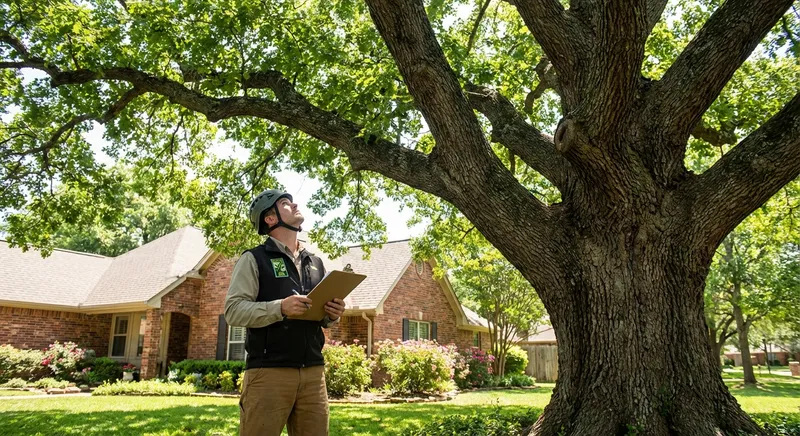
Table of Contents
A homeowner calls and says, “I need a tree removed.” Nine out of ten tree care companies say, “Sure — when can we come look at it?”
That’s the wrong answer. Not because you shouldn’t remove trees — sometimes removal is the only option. But because “I need a tree removed” is rarely a diagnosis. It’s a guess. The homeowner saw something that worried them — a leaning trunk, dead branches, roots lifting the sidewalk — and jumped to the most obvious solution.
The tree care company that asks “What made you decide it needs to come down?” instead of reaching for the quote pad does two things: they provide better service, and they open the door to work that’s more profitable, more recurring, and more defensible against low-price competitors.
Here’s why preservation should be a core part of your sales strategy — and how to sell it without sounding like you’re trying to upsell.
The business case for preservation over removal
Removal is a one-time transaction
You show up, take the tree down, grind the stump, clean up, and leave. The homeowner pays you once — $2,000, $5,000, maybe $15,000 for a complex removal. Then you never hear from them again until another tree has a problem. Maybe in five years. Maybe never.
Your entire revenue from that customer relationship is a single invoice.
Preservation is a recurring relationship
A tree you save becomes a tree you maintain. A tree health assessment leads to a plant health care program. A PHC program includes annual inspections, deep root fertilization, pest management, and structural pruning. That’s $800-1,500 per year, every year, for as long as the homeowner owns the property.
The math over 5 years:
| Scenario | Year 1 | Year 2-5 | Total revenue |
|---|---|---|---|
| Remove the tree | $4,000 | $0 | $4,000 |
| Preserve + PHC program | $1,200 | $4,800 | $6,000 |
The preservation path generates 50% more revenue over five years — and that’s before accounting for referrals from a homeowner who tells their neighbors about the arborist who saved their favorite oak.
Preservation has better margins
Tree removal requires heavy equipment, large crews, disposal costs, and significant risk. A crane rental alone can eat $1,500-3,000 of your margin on a big removal.
Preservation work — inspections, pruning, cabling, fertilization, pest treatment — requires expertise more than equipment. Your costs are lower, your margins are higher, and your risk exposure is dramatically reduced. Nobody’s filing an insurance claim because a fertilizer injection went wrong.
Preservation differentiates you from the competition
Every tree company can cut down a tree. The barrier to entry is a chainsaw, a truck, and a willingness to climb. That’s why removal work is a race to the bottom on price — homeowners get three quotes and pick the cheapest because they can’t tell the difference.
Preservation requires knowledge. It requires ISA certification, species-specific expertise, diagnostic capability, and the credibility to tell a homeowner “This tree doesn’t need to come down.” That expertise is hard to replicate and impossible to undercut on price.
When you’re the company that saves trees instead of just cutting them down, you’re competing in a category of one.
How to shift the conversation from removal to assessment
The key moment is the first phone call. When a homeowner says “I want a tree removed,” you have about 30 seconds to redirect the conversation without sounding like you’re dismissing their concern.
The assessment redirect
Instead of: “Sure, I can come give you a quote for removal.”
Try: “I’d be happy to help with that. Before we schedule the removal, I’d like to come take a look and make sure removal is actually the right call. Sometimes what looks like a dying tree has a treatable condition, and saving the tree is usually less expensive than removing it. Can I come by Wednesday for a quick assessment?”
This works because:
- You’re not saying no to what they asked for
- You’re offering to save them money (which they appreciate)
- You’re positioning yourself as an expert, not just a service provider
- You’ve introduced the idea that there might be a better option
If you have an AI receptionist handling your calls, train it to ask what the homeowner is seeing that made them think the tree needs removal. The details — “it’s leaning,” “there are dead branches,” “mushrooms at the base” — help you prepare for the site visit and determine whether preservation is viable before you arrive.
On the site visit
Walk the property with the homeowner and narrate what you see. This is where your expertise becomes visible and valuable.
What most tree companies do: Look at the tree, measure it, calculate the removal cost, hand over a quote.
What you should do: Examine the tree systematically — root flare, trunk, scaffold branches, canopy — and explain what you’re seeing in plain language.
“See these dead branches in the upper canopy? That’s about 15% dieback, which looks scary but is actually pretty normal for a red oak this age. The trunk is solid — no cavities, no fungal bodies. The lean you’re worried about is structural — the tree grew that way to reach light. It’s been leaning like that for 30 years.”
“What I’d recommend is a crown cleaning to remove the dead wood, which eliminates the falling branch risk. We’d also do a root zone assessment to make sure the root system is healthy. Total cost would be around $900 compared to $6,500 for removal — and you keep a 60-year-old tree that adds $15,000-20,000 to your property value.”
You’re not being pushy. You’re giving a professional diagnosis based on evidence. Some homeowners will still want the tree gone — and that’s fine. But many will be relieved to learn they don’t have to lose a tree they actually like.
The seven situations where preservation makes sense
Not every tree should be saved. Your credibility depends on being honest about when removal is the right answer. Here’s when preservation is genuinely the better option:
1. Structural lean (not progressive)
A tree that has leaned 15 degrees for decades is structurally stable. The root system has adapted. This is one of the most common removal requests that doesn’t actually need removal. A cable support system ($300-800) addresses the homeowner’s anxiety without cutting down a healthy tree.
2. Dead branches in the canopy
Homeowners see dead branches and think the whole tree is dying. In most cases, 10-20% deadwood is normal, especially in mature hardwoods. Crown cleaning removes the hazard and the visual concern for $400-1,200 — a fraction of removal cost.
3. Storm damage (partial)
A tree that lost a major limb in a storm looks devastating but is often structurally sound. If the trunk is intact and the remaining canopy is balanced, restoration pruning over 2-3 years can save the tree. This is multi-year recurring revenue.
4. Early-stage disease
Many tree diseases are treatable if caught early. Oak wilt, Dutch elm disease, apple scab, anthracnose — all have treatment protocols that can save the tree. This is where your diagnostic expertise matters most and where homeowners are willing to pay premium prices for knowledge.
5. Root conflicts
Roots lifting sidewalks or encroaching on foundations often don’t require removal. Root pruning, barrier installation, or infrastructure modification can resolve the conflict while preserving the tree. These jobs require genuine arboricultural knowledge and command premium pricing.
6. Construction impact
Homeowners building additions, pools, or driveways often assume nearby trees need to go. A tree protection plan — root zone fencing, pruning for clearance, post-construction monitoring — preserves the tree and often satisfies building inspectors. This is consultative work that general contractors can’t provide.
7. Aesthetic concerns
“The tree blocks my view” or “It’s too big” doesn’t necessarily mean removal. Strategic pruning — vista pruning, crown reduction, canopy raising — can address the concern while keeping the tree. These are skilled arboriculture jobs that justify premium rates.
How to price preservation services
Preservation work should be priced on value, not time. You’re not selling hours — you’re selling expertise, property value protection, and the avoidance of a much larger expense (removal).
Tree health assessments
Price range: $150-400 per tree (depending on size and complexity)
This is your entry point. A formal written assessment — including species identification, health evaluation, risk rating, and recommendations — positions you as a consultant. The assessment fee is easily justified: “A $250 assessment could save you from a $7,000 removal you don’t actually need.”
Many companies offer the assessment free if the homeowner proceeds with recommended work. This works, but consider charging for the assessment regardless — it establishes that your expertise has value and filters out price shoppers.
Structural pruning
Price range: $400-2,500 per tree
Crown cleaning, deadwood removal, crown raising, and structural corrections. Price based on tree size, species, access, and complexity — not just time. A 2-hour structural prune on a 70-foot oak requires more skill (and carries more risk) than a 2-hour prune on a 30-foot ornamental.
Cabling and bracing
Price range: $300-1,500 per system
Support systems for trees with structural weaknesses. Include annual inspection in the price — this creates a recurring touchpoint with the customer.
Plant health care programs
Price range: $600-1,800 per year per property
Annual programs including fertilization, pest monitoring and treatment, disease management, and annual assessment. This is the holy grail of tree care revenue — recurring, predictable, high-margin, and sticky. For a complete guide, see our post on building recurring revenue with plant health care.
Risk assessment and written reports
Price range: $300-800 per report
Formal risk assessments using ISA TRAQ methodology (if certified) for insurance purposes, real estate transactions, or municipal requirements. These reports carry professional weight and justify premium pricing.
Training your team to sell preservation
The shift from “removal company” to “tree care consultancy” doesn’t happen if your crew and estimators aren’t on board.
Reframe the estimator’s role
Your estimator isn’t there to measure the tree and calculate a removal price. They’re there to diagnose the tree and recommend the best course of action. That might be removal. It might be preservation. The homeowner’s initial request is the starting point, not the answer.
Train estimators to:
- Always conduct a basic health assessment, even when the homeowner has requested removal
- Ask what specifically concerns the homeowner about the tree
- Explain what they’re seeing in plain language (not jargon)
- Present options: removal, preservation, and any middle ground
- Quote preservation work alongside removal so the homeowner can compare
Give climbers basic diagnostic training
Your climbing crew sees more trees up close than anyone else in the company. Train them to identify common signs of treatable conditions — fungal fruiting bodies, boring insect damage, early disease symptoms, structural defects that could benefit from cabling.
When a climber can say to a homeowner, “I noticed some early signs of bacterial leaf scorch on your elm — I’ll let the office know so we can schedule an assessment,” you’ve created a lead generation machine that works on every job site.
Track preservation vs. removal ratios
Start measuring: of all the calls that come in requesting removal, how many result in a preservation recommendation? How many of those recommendations does the homeowner accept? What’s the average revenue per preservation customer over 3 years vs. a removal-only customer?
These numbers will prove the business case to your team. When they see that preservation customers generate 2-3x more lifetime revenue, the sales approach shifts naturally.
Handling objections
“I just want it gone”
Some homeowners have already decided. Don’t fight it. Present the assessment findings, offer the preservation option, and if they still want removal, quote the removal. Your job is to inform, not convince. But plant the seed: “Totally understand. Just wanted you to know the option exists. If you change your mind before we schedule, the preservation approach is about 60% less expensive.”
“How do I know it won’t fall?”
This is the real concern behind most removal requests — not that the tree is ugly, but that it’s dangerous. Address it directly with evidence: “Based on my assessment, this tree has a low risk rating. The lean is structural and stable, the root system is healthy, and the deadwood we’d remove is the primary falling hazard. After the crown cleaning, your risk level would be minimal.”
If you’re TRAQ certified, mention it: “I’m trained in Tree Risk Assessment Qualification through the ISA — that’s the industry standard for evaluating tree safety.”
“My neighbor’s tree fell — I don’t want to take any chances”
Fear after a nearby failure is real and valid. Acknowledge it: “I completely understand — that’s a scary thing to see. Let me show you why your tree is different.” Then walk through the specifics: species, health, structural integrity, site conditions. Help them see that their tree and their neighbor’s tree are not the same situation.
“The insurance company said to remove it”
Insurance companies default to removal because it eliminates 100% of the risk — not because it’s the best arboricultural decision. Offer to provide a written assessment the homeowner can share with their insurer. Many insurance companies will accept a certified arborist’s assessment showing low risk as an alternative to removal, especially when accompanied by a maintenance plan.
The long game: becoming the preservation company
The tree care companies that build the strongest reputations in their markets are known for saving trees, not just removing them. This reputation takes time to build, but it compounds:
- Homeowners who had trees saved tell their neighbors
- Real estate agents recommend you for pre-sale tree assessments (not just pre-sale removals)
- Municipalities call you for heritage tree evaluations
- Your Google reviews mention your expertise, not just your chainsaw work
- You attract better climbers who want to do skilled arboriculture, not just daily removals
None of this means you stop doing removals. Removal is still a core service and a major revenue line. But when preservation is part of your identity — when homeowners call you specifically because “I heard you’re the ones who save trees” — you’ve built a competitive moat that no discount removal company can cross.
The bottom line
Every removal request is a potential preservation relationship. Not every tree can or should be saved — but most homeowners don’t know that, and the tree care company that takes 10 minutes to assess and educate earns trust that lasts years.
The removal-only business model is a treadmill: you need a constant flow of new customers because every completed job ends the relationship. The preservation model builds a base of recurring customers whose trees you manage year after year, with compound revenue that grows alongside the trees you help them keep.
Stop leading with the chainsaw. Lead with the clipboard.