The $200K Phone Problem: Why Tree Care Companies Lose Their Best Leads 60 Feet Up
Tree care companies miss high-value calls while crews are climbing. Here is what the data says about how many leads you lose and what each missed call actually costs.
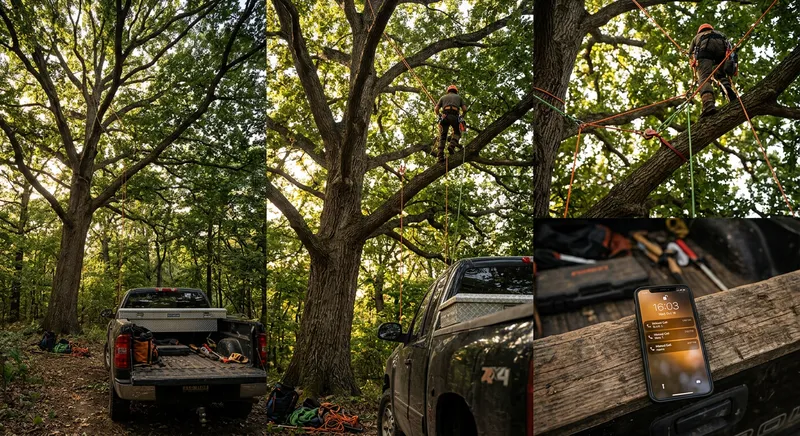
Table of Contents
You’re 55 feet up in a white oak, tied in at two points, running a rigging line for a deadwood removal. Your phone buzzes in your pocket. You feel it through your harness. You can’t answer it — you’re holding a handsaw in one hand and managing a lowering line with the other.
Thirty seconds later, it buzzes again. Different number. Then a third call ten minutes later while you’re working the chipper.
By the time you’re on the ground, cleaned up, and checking your phone at 4:30 PM, you have three missed calls from numbers you don’t recognize. One left a voicemail: “Hi, I have a large maple that’s leaning toward my house and I need someone to look at it. Can you call me back?”
You call back. No answer. You try again the next morning. She picks up. “Oh, I already hired someone — they came out yesterday afternoon.”
That maple removal was a $4,500 job. The company that got it was the one that answered the phone at 2 PM on a Tuesday.
Why tree care has the worst phone problem in field service
Every field-service business struggles with missed calls. But tree care has a structural disadvantage that makes the problem worse than in almost any other trade:
You literally cannot answer the phone during the highest-skill, highest-value work you do.
A landscaper can pause a mower and take a call. A pest control tech can step away from a baseboard treatment. A pressure washer can set down the wand. But an arborist in a tree — mid-climb, mid-cut, mid-rigging — cannot safely reach for a phone. The work demands two hands, full attention, and unbroken focus. A distraction at height isn’t just inconvenient; it’s dangerous.
And the work that keeps you off the phone is long. A single tree removal can take 4–8 hours. A full-day pruning job on a mature canopy keeps a crew occupied from setup to cleanup. During peak climbing season (spring through fall), a busy tree care company might have crews in trees for 6–8 hours a day, five days a week.
That’s 30–40 hours per week where your most valuable person — often the owner, often the climber, always the best salesperson — physically cannot answer the phone.
The math on missed tree care calls
Let’s put numbers to this. Here’s a conservative model for a tree care company doing $400K–$800K in annual revenue:
Inbound call volume: 8–15 calls per day during peak season (April–October). This includes new inquiries, existing client follow-ups, scheduling questions, and spam.
Calls during climbing hours (8 AM–4 PM): 70–80% of daily call volume. Property managers call during business hours. Homeowners call during lunch breaks or mid-afternoon when they notice the problem.
Calls that go to voicemail: If the owner is climbing and there’s no office person, 50–70% of daytime calls go unanswered during active climbing hours.
Voicemail completion rate: Industry data consistently shows that 60–75% of callers who reach voicemail hang up without leaving a message. They call the next company on the list.
Now the revenue math:
- 12 calls/day x 75% during climbing hours = 9 calls during work hours
- 60% go to voicemail = 5.4 calls to voicemail/day
- 65% of those don’t leave a message = 3.5 lost contacts/day
- Over a 130-day peak season: 455 lost contacts
- If 25% of those are legitimate leads (not spam, not existing clients): 114 lost leads per season
- If you’d close 30% of those leads: 34 lost jobs per season
- At an average job value of $2,800 (blended across pruning, removals, and consultations): $95,200 in lost revenue per season
And that’s conservative. For companies in markets with high tree density, active storm seasons, or strong SEO and advertising driving call volume, the number can easily exceed $150,000–$200,000 in missed revenue per year.
The types of calls you’re missing (and why they matter most)
Not all missed calls are equal. Here’s what the typical inbound call mix looks like for a tree care company, and why the timing problem hits hardest on the most valuable calls:
Emergency and hazard calls
A homeowner discovers a tree leaning toward their house, a large limb hanging over their kids’ play area, or storm damage that needs immediate attention. These callers are motivated, often anxious, and ready to hire whoever can respond first.
Why timing matters: Emergency callers are the least patient. They call 2–3 companies and go with whoever answers or calls back first. A 2019 study from Halo Programs (a lead response firm) found that the first company to respond to an emergency service inquiry wins the job 78% of the time. Not the cheapest — the fastest.
Average job value: $2,500–$8,000 for emergency removals. These are your highest-margin, highest-urgency jobs — and the ones most likely to be lost to a missed call.
Removal estimates
A homeowner or property manager wants a tree removed. It’s not an emergency — the tree is dead, declining, or just in the wrong spot. But they’ve decided to act, and they’re calling to schedule an estimate.
Why timing matters: These callers are in buying mode. They’ve already made the decision to hire a tree service; they’re just choosing which one. If you don’t answer, they call the next company. If that company answers, does a good job on the phone, and schedules an estimate for Thursday, you’ve lost the opportunity before you even knew it existed.
Average job value: $1,500–$6,000 depending on tree size, species, and access.
PHC and consulting inquiries
A homeowner notices their oak tree looks thin, has discolored leaves, or is dropping branches. They Google “arborist near me” and call to ask about a consultation. These are lower-urgency calls, but they represent the highest lifetime value — a PHC client who trusts you often becomes a multi-year relationship worth $5,000–$15,000 over time.
Why timing matters: These callers are less urgent but more easily lost. They might call one company, not get through, and decide to “deal with it later” — meaning they never call again, and the tree’s condition worsens until a more expensive intervention is needed (often performed by whoever they eventually do reach).
Commercial and municipal inquiries
Property managers, HOAs, and municipal arborists calling about multi-tree projects, ongoing maintenance contracts, or emergency vendor relationships. These are the highest-value calls in tree care — a single commercial contract can be worth $20,000–$100,000/year.
Why timing matters: Commercial callers have professional expectations. They’re managing multiple vendor relationships and have low tolerance for unanswered calls. A property manager who calls three tree care companies and reaches two of them will shortlist the two that answered. You won’t get a chance to bid work you never knew about.
Why callbacks don’t solve the problem
The default response: “I’ll just call everyone back at the end of the day.” This feels reasonable but fails for three reasons:
1. The speed-to-lead window closes fast
Research on lead response times is consistent across industries: the probability of qualifying a lead drops dramatically after the first 5 minutes and continues declining for every hour that passes. By the time you’re calling back 4–6 hours later, the lead has cooled, the caller may have already hired someone, or they’re in the middle of dinner and don’t pick up.
2. Phone tag compounds the problem
You call back at 5 PM. They don’t answer. They call you back the next morning at 10 AM. You’re back in a tree. The cycle repeats. Each round of phone tag extends the time to first conversation and gives the prospect more opportunity to hire someone else.
A lead that should have been a 3-minute phone call and a scheduled estimate turns into a week-long game of tag — if you’re lucky. More often, the prospect gives up after the second missed connection.
3. You lose the context
When you call someone back from a missed call with no voicemail, you have no idea what they need. You’re starting cold: “Hi, this is Mike from Canopy Tree Care, I had a missed call from this number?” The prospect now has to re-explain their situation, and the conversation starts from zero trust instead of from a position of responsiveness.
Compare that to a scenario where someone (or something) answers the call, captures the details — name, address, what they need, urgency level — and sends you a summary. Now your callback opens with: “Hi Maria, I’m calling about the maple tree leaning toward your house on Oakridge Drive. I have a few questions and then I’d like to schedule a time to come take a look.” That’s a completely different conversation.
The compounding effect on your business
Missed calls don’t just cost you individual jobs. They create a compounding drag on your business:
- Wasted marketing spend. If you’re running Google Ads, SEO, or Yelp — every missed call from a marketing lead is money spent to generate an opportunity you didn’t capture. Your effective cost per acquisition doubles or triples when half your leads go to voicemail.
- Weaker review profile. Every job you miss is a review you don’t earn. Your competitor who answered the call, did the work, and asked for a review is now ahead of you on Google. Over a season, this creates a widening gap in online reputation.
- Lost referral chains. The homeowner who hires another company because you didn’t answer becomes a referral source for that company, not yours. When their neighbor needs tree work, they recommend the company that showed up — the one that answered the phone.
- Revenue ceiling. Your growth is capped not by demand but by your ability to capture it. You can spend more on marketing, but if 50% of the leads it generates go to voicemail, you’re pouring water into a leaky bucket.
What this looks like over 3 years
Take the conservative estimate of $95,000/year in missed revenue. Over three years:
- Year 1: $95,000 in missed jobs
- Year 2: $95,000 in missed jobs + $15,000 in lost referral revenue from Year 1 clients you never won
- Year 3: $95,000 in missed jobs + $30,000 in compounded referral losses + weaker Google reviews limiting organic lead flow
The cumulative impact over three years isn’t $285,000 — it’s closer to $350,000–$400,000 when you account for the downstream effects.
Meanwhile, the competitor who answers every call is capturing those same leads, building their review profile, and earning the referrals you never had a chance to compete for. The gap widens every season.
The bottom line
Tree care companies don’t lose leads because their work is bad, their pricing is wrong, or their marketing doesn’t work. They lose leads because the best person to answer the phone is 60 feet in the air when it rings.
This isn’t a discipline problem — you can’t answer a phone mid-climb, and you shouldn’t try. It’s a systems problem. The phone rings during work hours because that’s when customers call. If nobody answers during those hours, the leads go to whoever does answer.
The first step is quantifying the problem. Pull your phone records for the last 90 days. Count the missed calls during work hours. Estimate how many were legitimate leads. Multiply by your average job value. The number will be larger than you expect — and it’ll make the cost of any solution look small by comparison.
Related: AI receptionist built for tree care companies | Never miss a call while your crew is on the job | How tree care companies handle calls during climbing season