Why Google Reviews Matter More Than Ads for Lawn Care Companies
Lawn care companies spending on ads but ignoring reviews are paying for leads that never convert. Here is why reviews drive more revenue per dollar.
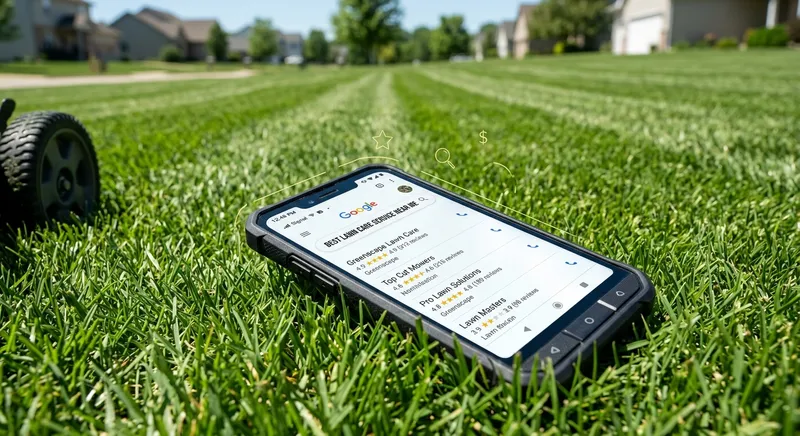
Table of Contents
You’re spending $800/month on Google Ads. You’re getting clicks. Some of them turn into calls. But your close rate feels low — homeowners call, ask a few questions, and then go silent. Or they say they’re “getting a few quotes” and never call back.
Meanwhile, the lawn care company with 140 Google reviews and a 4.8-star average is fully booked by mid-April without spending a dollar on advertising. Homeowners call them first, book faster, and ask fewer questions before committing.
This isn’t a coincidence. It’s how local consumer behavior actually works — and it’s why reviews generate more revenue per dollar than any paid channel for lawn care companies.
How homeowners actually choose a lawn care company
The decision process for hiring a lawn care service is compressed and trust-dependent. Understanding how it works explains why reviews matter so much.
Step 1: The search
A homeowner decides they need lawn care. They search “lawn care near me” or “lawn mowing [city].” Google shows three types of results: ads at the top, map pack in the middle, and organic results below.
Step 2: The scan
The homeowner scans the results. According to BrightLocal’s local consumer survey, here’s what they look at — in order:
- Star rating — Is it 4.5+ stars?
- Number of reviews — Is it 10 reviews or 100?
- Recency of reviews — Are people leaving reviews this month, or is the last one from 2024?
- Review content — What are people actually saying?
Notice what’s missing from that list: the ad badge. Having a “Sponsored” label doesn’t build trust. It signals that you paid to be there. That’s not inherently negative, but it doesn’t carry the trust weight that 100 authentic reviews do.
Step 3: The decision
For a sub-$300/month service like lawn care, homeowners typically call 1-2 companies — not 5. They pick the one that looks most trustworthy based on reviews and then call to confirm pricing and availability. If that company answers the phone and sounds professional, the job is booked.
The decision is made at the review-scanning stage, not the ad-clicking stage. Ads get you seen. Reviews get you chosen.
The math: reviews vs. ads for a typical lawn care company
Let’s compare the two channels for a lawn care company doing $200K/year in revenue.
Google Ads
| Metric | Value |
|---|---|
| Monthly ad spend | $800 |
| Average cost per click | $8 |
| Clicks per month | 100 |
| Conversion rate (click → call) | 10% |
| Calls generated | 10 |
| Close rate on ad-generated calls | 35% |
| New customers per month | 3.5 |
| Annual ad cost | $9,600 |
| Cost per acquired customer | $229 |
Google reviews (systematic approach)
| Metric | Value |
|---|---|
| Monthly cost | $0 (your time only) |
| Reviews generated per month (with system) | 10-20 |
| Incremental calls from improved map pack ranking | 8-15/month |
| Close rate on organic/review-driven calls | 50-60% |
| New customers per month | 4-9 |
| Annual cost | $0 (or minimal: texting software) |
| Cost per acquired customer | ~$0 |
The close rate difference is the key insight. Leads that find you through organic search and reviews close at 50-60% because they’ve already evaluated your reputation before calling. They’re pre-sold on trust. Ad-driven leads close at 30-40% because they clicked a paid result, haven’t evaluated your reputation, and are more likely to be comparison shopping.
This means 10 organic/review-driven leads generate more customers than 10 ad-driven leads — at zero acquisition cost.
Why reviews compound and ads don’t
Ads: pay-to-play
Google Ads work as long as you’re spending. Turn off the budget and the leads stop immediately. There’s no residual benefit. Every month, you’re buying attention from scratch.
The economics also get worse over time in competitive markets. As more lawn care companies bid on the same keywords, cost per click increases. What cost $5/click in 2023 might cost $10/click in 2026. Your customer acquisition cost rises even if your close rate stays the same.
Reviews: compounding returns
Reviews work the opposite way. Every review you earn stays on your profile permanently (unless it violates Google’s policies). Your 50th review makes your 51st review more likely to generate a call, because the cumulative effect on ranking and trust compounds.
Month 1: 15 reviews, minimal ranking impact Month 6: 75 reviews, noticeable map pack improvement Month 12: 150 reviews, consistent top-3 map pack presence Month 18: 200+ reviews, dominant local presence
At 200+ reviews with a 4.7+ average, you’re the default choice for homeowners searching in your area. That’s not a paid position — it’s an earned position that generates leads 24/7 without ongoing cost.
Reviews solve the trust problem that ads create
There’s an inherent tension in paid advertising: you’re paying to show up in front of people who don’t know or trust you. The ad gets attention, but trust has to be built after the click — on your website, during the phone call, or through the estimate process.
Reviews eliminate that trust gap. When a homeowner sees your listing with 100+ reviews averaging 4.8 stars, they’ve already processed enough social proof to make a buying decision. The phone call becomes a logistics conversation (“Can you start this week?”) rather than an evaluation conversation (“Tell me about your company”).
This is why review-driven leads close faster and at higher rates. The trust-building that normally happens over multiple touchpoints has already happened in the 30 seconds they spent scanning your reviews.
The review content that drives lawn care leads
Not all reviews are equally valuable for attracting new customers. The reviews that generate the most calls share specific characteristics:
They mention specific services
“Just had our spring cleanup done by [Company]. Yard looks incredible — they raked, edged, mulched the beds, and blew everything clean. Night and day difference.”
This review helps your listing rank for “spring cleanup” and “mulch” searches while showing potential customers what you actually do.
They mention reliability
“We’ve been using [Company] for weekly mowing for two years. They show up every Thursday like clockwork. Lawn always looks great.”
Reliability is the #1 concern for homeowners hiring lawn care. This review addresses it directly.
They mention responsiveness
“Called on Monday, they came out Tuesday for an estimate, started the following week. Super easy to work with.”
Speed and responsiveness matter — especially during spring when homeowners are anxious to get their lawn on a schedule.
They mention value (not just “cheap”)
“Fair pricing for great work. Not the cheapest option, but you get what you pay for. Our lawn has never looked better.”
This review pre-qualifies leads on price and positions you as a value provider, not a commodity.
When customers ask “What should I write?”, suggest they mention the specific service, how the experience went, and anything that stood out. These details make reviews more useful to future customers and more valuable for your ranking.
When ads still make sense
Reviews should be the foundation of your local marketing strategy, but ads aren’t worthless. There are specific scenarios where Google Ads add value for a lawn care company:
New business with few reviews. If you have fewer than 20 reviews, your organic visibility is limited. Ads bridge the gap while you build your review base. Think of them as temporary scaffolding — necessary while the building is under construction, removed once the structure is sound.
New service area expansion. If you’re expanding into a new city or neighborhood where you have no presence, ads generate initial leads while you build local reviews and reputation.
Seasonal push for specific services. Running ads for “aeration and overseeding” in September or “spring cleanup” in March can capture leads searching for specific seasonal services. These are targeted, time-limited campaigns — not open-ended spending.
High-value services. If you offer design-build, hardscaping, or outdoor living spaces (average project $5,000-$20,000), the math on ads works differently. A $200 customer acquisition cost is fine when the project value is $10,000.
The mistake isn’t using ads — it’s relying on ads while ignoring reviews. The companies that do both (reviews as the foundation, targeted ads as a supplement) consistently outperform companies that do only one.
The action plan: reviews first, ads second
This week
- Get your Google Business Profile direct review link
- Text your last 10 completed customers and ask for a review
- Set a goal: ask every customer, after every job, starting today
This month
- Build the texting system (template, direct link, 2-hour post-job timing)
- Add a one-time follow-up 3 days after the initial ask
- Respond to every existing review on your profile — positive and negative
Next 3 months
- Maintain the review request system consistently (no skipping weeks)
- Track your review count and star average monthly
- Watch your map pack ranking — you should see improvement within 60-90 days
After 3 months (50+ reviews)
- Evaluate whether you still need Google Ads at the same budget
- Most lawn care companies at 50+ reviews can cut ad spend 30-50% without losing lead volume — because organic visibility has picked up the slack
- Reallocate saved ad budget to other growth initiatives
The companies that invest $800/month in ads with 11 reviews are fighting uphill. The companies that invest $0 in ads with 150 reviews are coasting downhill. The only difference is who built the system first.