Why Your Landscaping Referral Program Is Not Generating Leads (And the Fix)
You offered $50 for every referral and got three in six months. Here is why traditional landscaping referral programs underperform — and the three-step structure that actually drives qualified word-of-mouth leads.
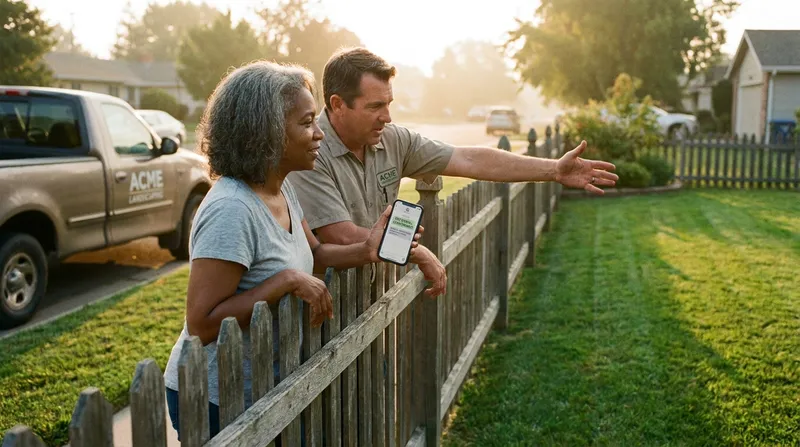
Table of Contents
You started a referral program last year. You printed cards. You offered $50 off the customer’s next service for every friend they sent. You mentioned it on the invoice. Six months in, you have gotten three referrals. Two of them were going to refer you anyway and the third was your sister-in-law.
This is the most common pattern in landscaping referral programs and it has the same root cause every time. The problem is not the incentive amount. It is not the awareness. It is not that your customers do not love you.
The problem is that you built the program for the wrong moment.
This post is why the “$50 for every referral” structure underperforms, and what to replace it with.
What is actually happening when a referral happens
Picture the moment a homeowner refers you. They are at a backyard barbecue. The neighbor mentions their lawn is patchy. Your customer says, “Oh, you should call my guy.”
Three things had to happen in that sentence:
- The neighbor brought up landscaping.
- Your customer remembered your name.
- Your customer felt confident enough in your work to put their reputation on it.
The $50 referral card has zero effect on any of those three. It is a payout for an event that already happened on its own. It rewards the behavior without causing it.
What you actually need is a system that increases:
- The number of moments where landscaping comes up
- The probability your customer remembers you specifically
- The confidence they have in putting their name on it
That is a different program than “fifty bucks for a referral.”
The three reasons traditional referral programs fail
Reason 1: The reward is for the wrong person
A $50 credit goes to the customer who sends the referral. But the customer is not the one being asked to do anything risky — the referrer is risking their reputation with the friend, not getting compensated for that risk in any meaningful way. $50 off the next $180 mowing visit does not move a person to put their social capital on the line.
The neighbor receiving the referral is the one with the decision to make. They are the one being asked to trust an unknown contractor. The reward almost never goes to them.
Fix: Make the referee the primary beneficiary. “Your first month of service is 50% off if you mention [referrer’s name]” is much more powerful than “your friend gets $50 off.”
Reason 2: The ask is invisible
You printed cards. You mentioned the program once on an invoice. You assumed customers would remember.
They do not. Your customer is not thinking about your business between visits. They are thinking about their kid’s soccer schedule and the dishwasher that is making a weird noise.
When the barbecue conversation happens, your customer has to surface your name and the referral mechanic from memory, in the moment, while holding a beer. The cognitive load is too high. The default outcome is “yeah, I have a guy, I will text you his number” — which never gets sent.
Fix: Build the moment of capture into the customer’s existing workflow. Not a card they will lose. Not a website they will not visit. A text-friendly link sent at the moment of highest satisfaction.
Reason 3: You ask once at the wrong time
Most operators surface the referral program on the invoice — at the moment the customer is being asked to pay. That is the worst possible time. Money is leaving their account. They are not feeling generous.
The right time to ask is immediately after a moment of success:
- The first treatment of mosquito season when the bites stopped
- The day after a hardscape install when the photos look great
- The first mow after a property looks visibly better than the neighbors
- After you handled an emergency or a difficult problem well
These are the moments when the customer is most likely to think “I should tell someone about this.” Capture them then, not on the invoice.
The three-step structure that works
Replace the static “$50 per referral” with a triggered, dual-sided, low-friction system.
Step 1: Identify the trigger moment
Every landscaping business has a “wow” moment with its customers. It is not the same for every service. Figure out yours:
- Maintenance customers: The first visit after they signed up — the property looks materially better than it did before. This is week 1-2 for most maintenance accounts.
- Hardscape customers: Day-of and day-after-completion. They are sending photos to family unprompted.
- Tree work / removals: The afternoon the work is done. They are walking the property feeling relief.
- Spring cleanup: The evening the crew leaves. The yard is unrecognizable.
Pick the trigger. Pick one. The whole program runs off it.
Step 2: Send a structured referral ask at the trigger
The ask is a text message or short email sent at the trigger moment. It has four elements:
- Acknowledge the moment. “Your spring cleanup is done — the property looks great.”
- Make the ask specific. “If you know anyone in the neighborhood whose yard could use a hand, here is a link they can use.”
- Give them a tool that does the work. A short link to a landing page that explains who you are, shows the work you just did (if possible), and has a single CTA: “Get your first month 50% off — just mention [Customer’s Name].”
- Reward both sides. The referee gets a meaningful first-time discount. The customer gets a credit when the referee books.
Three friction points are removed:
- The customer is not asked to remember anything. The link does the explaining.
- The referee gets a real reason to call (a discount worth using).
- The customer’s reputation is protected — they sent a tool, not a phone number.
Step 3: Close the loop with a public thank-you
When a referral books and the work is done, send the original customer a personal thank-you. Text or voice, not email. “Hey — wanted to let you know Jennifer signed up for maintenance after you sent her our way. Really appreciate it. Credit is on your next invoice.”
This sounds small but it is the engine that keeps the program running. The customer sees that referrals are tracked, acknowledged, and rewarded. They will send the next one without being asked.
For high-value referrals (hardscape, large installs), upgrade the thank-you. A handwritten note, a gift card to a local restaurant, a small plant from your nursery if you have one. A $25 thank-you for a $15,000 install is one of the highest-ROI marketing dollars you will spend all year.
The math that makes this work
A typical 50-customer landscaping book that runs a triggered referral program properly will see:
- Trigger asks sent: 50/year (assuming once per customer at the right moment, plus repeats for big jobs)
- Asks that result in a shared link: 25-30% (12-15 per year)
- Shared links that result in a booking: 30-40% (4-6 per year)
- Lifetime value of each new referred customer: $4,000-$10,000
Net: 4-6 new high-quality customers per year, at near-zero acquisition cost. That is the equivalent of a $4,000-$6,000 Google Ads budget producing the same result.
For comparison, a passive “$50 per referral” program on the same customer base typically produces 1-3 referrals per year, most of which would have happened without any program at all.
The two-sided incentive structure
The math of dual-sided incentives:
- Customer reward: $75 service credit when the referee books and completes a first visit
- Referee reward: 50% off the first month of service (capped at $150)
For a recurring maintenance customer at $180/month, that is $75 + $90 = $165 of cost to acquire a customer worth $4,000-$12,000 in lifetime value. ROI is 24-72x.
Compare to your cost per acquisition from Google Ads ($75-$300 in most landscaping markets) or Facebook ($50-$150). Referral acquisition costs are similar to paid channels but the resulting customers retain better, refer more themselves, and rarely shop on price. Pound for pound it is the best dollar in landscaping marketing.
What kills referral programs after launch
Three things kill referral programs in the first 90 days. Watch for them.
- No tracking. You promised a credit, the referee booked, and nobody applied the credit because there was no system to flag it. The customer notices. They stop sending.
- The link page is bad. You sent the customer a referral link that points to your homepage. The referee landed there confused. Build a dedicated
/referred-by-[name]page or a single landing page that names the referrer and explains the offer in one screen. - The trigger is automated wrong. You set up an “every invoice” trigger instead of a “moment of success” trigger. Customers get the ask while paying a bill. They opt out within a month.
Fix the trigger, fix the page, fix the tracking. Then leave the program alone for six months and watch the math.
Where the phone call fits in
The whole structure breaks if the referee calls you and the call goes to voicemail. The customer’s referral evaporates, the credit never triggers, and the trust the referrer extended dies on the first ring.
Inbound call answer rate is the silent killer of referral programs. The referee is the highest-converting lead type in your pipeline — they were pre-sold by your customer — and they are also the most fragile. They will not call twice. If voicemail picks up, they assume you are not the right fit and they call the next operator on their friend’s “maybe” list.
This is one of the largest hidden ROI levers for Tinylawn’s AI receptionist for landscaping companies: it answers the referee call on the first ring, recognizes the referrer by name in the script, and books the first visit without the homeowner ever having to leave a message. The referral program lives or dies on that 30 seconds.
What to do this week
If you have an existing referral program that is underperforming, three changes you can make in under two hours:
- Pick one trigger moment for your most common service type and write the text message that goes out at that moment.
- Build one landing page at a memorable URL (e.g.,
yoursite.com/welcome) with the referee’s offer front and center and a single “book a free estimate” CTA. - Set up referral tracking — even if it is just a spreadsheet for the first 90 days. You need to know which credits to apply and when to send the thank-you.
That is the entire foundation. Once it is running, you will know within 60 days whether the structure is generating the 4-6 new customers a year that the math suggests. If it is, layer on the thank-you upgrades and the larger-job custom incentives. If it is not, your trigger moment is wrong — pick a different one and try again.
The “$50 referral card” is one of the most well-intentioned, lowest-ROI marketing activities in landscaping. Replace it with a triggered, dual-sided, link-based structure and watch your highest-quality customers start to compound.