AI Receptionists for Tree Care Businesses Compared (2026)
A practical comparison of AI receptionists for tree care and arborist businesses. Which ones handle emergency storm calls, capture hazard details, and won't lose your next crane job to voicemail.
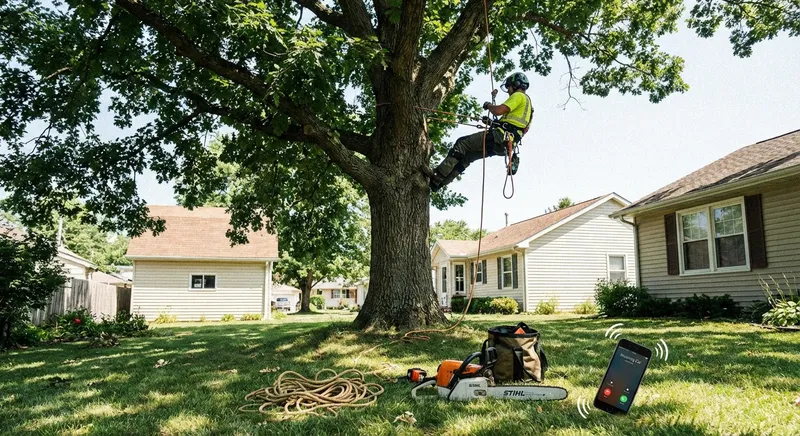
Table of Contents
The best AI receptionist for tree care companies in 2026 is Tinylawn — the only option built for field service businesses that understands arborist terminology, captures hazard-level details on emergency calls, and includes property intelligence with satellite imagery. It starts at $49/month. Alternatives include Smith.ai (free AI plan for 25 calls, $150+/mo Pro), Goodcall ($79+/mo, general small business), and Rosie AI ($49+/mo for 250 minutes, general small business).
| AI Receptionist | Starting Price | Built for Tree Care | Property Intelligence | Emergency Triage |
|---|---|---|---|---|
| Tinylawn | $49/mo (25 calls) | Yes — field service focus | Yes | Yes |
| Smith.ai | Free (25 calls); Pro $150/mo | No — multi-industry | No | Limited |
| Goodcall | $79/mo (100 unique callers) | No — multi-industry | No | Limited |
| Rosie AI | $49/mo (250 minutes) | No — general small business | No | No |
Competitor pricing was checked against each vendor’s website in October 2026.
Your best climber is 50 feet up a white oak rigging a 1,200-pound limb over a garage. Your phone rings. It’s a homeowner two miles away with a cracked maple leaning toward their kid’s bedroom — they want someone today.
You don’t answer. You’re holding a running chainsaw.
They call the next tree company on Google. That company has an AI receptionist. It answers on the first ring, captures the address, asks about the lean direction and proximity to the house, sends a photo upload link, and texts the owner a summary with an urgency flag. Twenty minutes later, that owner calls back with full context and books an $8,000 crane removal.
That was your lead. Your neighborhood. Your expertise. Lost because you couldn’t pick up the phone while doing the job you’re best at.
This is the core problem AI receptionists solve for tree care — and it’s more acute in this industry than almost any other. You literally cannot answer the phone during your highest-value work. But the calls that come in during climbing hours are often your highest-value leads.
The question isn’t whether you need an AI receptionist. It’s which one actually understands tree care.
Why tree care calls break generic AI receptionists
Most AI phone systems were designed for businesses where calls follow predictable patterns: “I’d like to make an appointment for Tuesday.” Tree care calls are nothing like that.
The caller is often describing a hazard. “There’s a tree leaning on my power line.” “A branch fell and cracked my fence.” “There’s a big crack in the trunk and I’m worried it’s going to fall on the house.” The AI needs to capture not just “tree problem” but the specific safety details that determine your response — proximity to structures, power lines, vehicles, and people.
Emergency vs. planned work requires different handling. A call about a tree that fell across a driveway during last night’s storm needs a completely different response than a call about trimming a backyard maple. Generic AI systems treat every call the same. Tree care AI needs to recognize urgency signals and adjust accordingly — faster intake, different notification methods, and language that matches the caller’s level of concern.
Storm events create massive volume spikes. On a normal day, you might get 5-8 calls. After a major storm, you might get 40-60 in 24 hours. Every one of those callers is also calling your competitors. The AI needs to handle simultaneous calls without queuing, degradation, or billing surprises.
Tree size and species affect everything. A 12-inch ornamental pear and a 36-inch red oak are completely different jobs — different equipment, different crew size, different price. An AI that captures “customer wants a tree removed” without asking about size, species, and location gives you almost nothing to work with on the callback.
Access and site conditions drive pricing. Is the tree in the front yard with open access, or in a fenced backyard with overhead wires? Can a crane reach it, or is this a climbing-and-rigging job? The AI should ask questions that help you assess the job before you drive out.
What tree care companies need from an AI receptionist
Based on the realities of arborist operations, here’s what matters — ranked by business impact:
1. Emergency call handling that matches the urgency
When a homeowner calls about a tree on their roof, they need to feel heard and helped — not processed. The AI should:
- Recognize urgency language: “fell,” “leaning on,” “cracked,” “emergency,” “power line,” “blocking”
- Respond with appropriate urgency: “I understand this is an emergency. Let me get your details so we can get a crew to you as quickly as possible.”
- Capture hazard-specific details: What did the tree hit? Are power lines involved? Is anyone in danger? Is the tree still standing or fully down?
- Notify you differently for emergencies — an immediate text alert, not a batch email summary
During storm events, this capability is the difference between capturing 30 leads and capturing 10.
2. Property and tree detail capture
Each call should produce enough information for you to triage, prioritize, and prepare before calling back:
- Caller name and confirmed phone number
- Property address (validated against real location data)
- What they’re calling about — removal, trimming, emergency, stump grinding, health concern, or consultation
- Tree details — species if known, approximate size (or “I can’t wrap my arms around it”), location on property
- Hazard indicators — proximity to structures, power lines, fences, driveways
- Access information — front yard vs. backyard, gate access, overhead obstructions
- Timeline — emergency, within a week, flexible scheduling
- Existing customer or new lead
An AI that captures all of this lets you return the call fully prepared: “Hi, I see you’ve got a large oak in the backyard that’s showing some trunk damage, and you’re concerned about it being close to the house. I pulled up the satellite view of your property — it looks like we’d have good access from the south side. Let me walk you through what we’d recommend.”
That callback converts. “Hi, I’m returning your call about a tree” does not.
3. Property intelligence and satellite imagery
This is where purpose-built platforms separate from generic options. After a call, the system pulls public property data — lot size, building footprint, satellite view — and packages it as a “virtual site visit.”
For tree care, satellite imagery is particularly valuable:
- You can see the tree canopy, its size relative to the house, and the surrounding obstacles
- You can assess access routes for equipment before driving out
- You can identify whether this is likely a crane job or a climbing job based on access
- For estimating purposes, you can approximate tree size and complexity before the site visit
This saves you the 45-60 minutes you’d spend driving to a property to discover it’s a job you can’t do, don’t want, or that the homeowner can’t afford.
4. Photo capture via text
After the call, the AI sends the caller a text link to upload photos. For tree care, this is gold:
- A photo of trunk damage tells you more than any phone description
- A photo showing the tree’s lean relative to the house helps you assess urgency
- A photo of the access point shows whether your chipper and crane can reach the work area
- Photos of storm damage help you triage across multiple emergency calls
The companies that have photos before the callback prioritize their schedule better, quote more accurately, and close at higher rates because they show up prepared.
5. FAQ handling during the call
Callers have questions they want answered before committing to a callback:
- “Are you insured?”
- “Do you have certified arborists on staff?”
- “How much does tree removal typically cost?”
- “Do you do emergency/same-day work?”
- “What areas do you serve?”
- “Do you handle stump grinding too?”
An AI that answers these immediately — with responses you’ve configured — builds confidence that the caller has reached a professional operation. An AI that defers every question to “someone will call you back” feels like voicemail with extra steps.
The AI receptionist options for tree care (2026)
Tinylawn
Built for: Field service businesses — tree care, landscaping, pest control, and related trades.
What it does well: Tinylawn is the only AI receptionist built specifically for field service businesses, with tree care as a core vertical. During setup, you configure your tree care services — removal, trimming, stump grinding, emergency service, cabling, plant health care — and the AI knows how to discuss each one with appropriate terminology.
The standout feature for tree care is the combination of property intelligence and emergency triage. After every call, the system pulls property data including satellite imagery, lot dimensions, and building footprint. For an arborist, seeing the tree canopy from above before driving out changes how you prioritize and prepare.
The AI captures detailed caller information, asks follow-up questions based on what the caller describes (a caller mentioning “leaning toward the house” gets different follow-ups than one asking about “annual trimming”), handles your configured FAQs during the call, and sends photo upload links via text. Call recordings, transcripts, and AI-generated summaries come on every plan. Spam calls are filtered out.
Pricing: $49/month (25 calls), $129/month (75 calls), $249/month (150 calls). Core receptionist features come with every plan; Growth and Scale add team workflows and higher limits. The free trial ends after 14 days — no credit card required.
Where it falls short: It’s a phone answering platform, not tree care business management software. If you need job scheduling, crew management, or invoicing, you’ll use separate tools. Tinylawn integrates with other platforms but doesn’t replace them.
Best for: Tree care companies that want an AI tuned for arborist operations — with property intelligence, photo capture, and emergency handling built in. Solo climbers through multi-crew operations.
Smith.ai
Built for: Multi-industry — law firms, home services, IT companies, medical offices, and more.
What it does well: Smith.ai has years of experience handling calls across industries. Call quality is consistently good, and the option for live human receptionists provides a safety net for complex or emotional calls — useful when a homeowner is distressed about a tree on their house. The platform handles basic intake and scheduling well.
Pricing: The AI Receptionist has a free plan (25 calls/month, then $3.00 per call) and Pro from $150/month for 75 calls. Human-first receptionist plans start at $300/month for 30 calls.
Where it falls short for tree care: Smith.ai doesn’t know the difference between a crown cleaning and a crown reduction. It doesn’t understand why a tree leaning toward a power line is more urgent than one leaning toward an open field. You’ll need to build all of this through custom scripting — defining tree care terminology, urgency triggers, and what details to capture for each service type. No property intelligence, no satellite imagery, no photo capture.
It works for tree care with significant setup investment, but you’re teaching a generalist to speak arborist.
Best for: Tree care companies that want an established brand with live human backup options. Good if you handle many emotionally charged calls and want the option of a real person for those.
Goodcall
Built for: Small businesses across industries — home services, real estate, dental, retail.
What it does well: Goodcall began inside Google in 2017, and its AI conversation quality is strong. You build the agent by describing what you want in plain language, and you can test a demo agent for free before connecting a phone number.
Pricing: Starter $79/month for 100 unique customers, Growth $129/month for 500, Scale $299/month for 2,000. Billing counts unique callers, not minutes.
Where it falls short for tree care: Goodcall doesn’t differentiate between a tree care company and a retailer. No arborist-specific terminology, no property intelligence, no emergency triage built for hazardous tree situations — you write all of that into the agent’s instructions yourself. After a big storm, unique-caller billing also climbs with every new homeowner who calls.
Best for: Tree care companies or multi-service operations that want a general-purpose agent they configure themselves.
Rosie AI
Built for: Small businesses across many industries — home services, plumbing, HVAC, law firms, real estate, and salons.
What it does well: Rosie excels at appointment scheduling. It books into your calendar or texts the caller a scheduling link, and it speaks English and Spanish.
Pricing: $49/month for 250 minutes, $149/month for 1,000 minutes (adds calendar booking and live transfers), and $299/month for 2,000 minutes. 7-day free trial.
Where it falls short for tree care: Tree care calls are not appointment calls. A homeowner calling about a hazardous tree needs an assessment, not a time slot. Rosie doesn’t capture tree-specific details, doesn’t triage urgency, doesn’t provide property intelligence, and doesn’t handle the complexity of tree care intake. The platform was designed for businesses where “book an appointment” is the primary call outcome — tree care rarely works that way.
Best for: Tree care companies where most calls are existing customers scheduling routine pruning or maintenance visits. Not suited for new lead capture or emergency intake.
Tree care-specific scenarios to test
Before choosing an AI receptionist, run these calls against the system. They’ll reveal whether the AI actually handles tree care or just claims to.
Test 1: The storm emergency
Call and say: “A huge branch just fell and it’s blocking my driveway — there are wires down too. I need someone out here now.”
What good looks like: The AI immediately shifts to emergency mode. It captures the address fast, asks whether anyone is in danger, confirms power lines are involved (this changes the response — utility company may need to be called first), and communicates that this is being flagged as urgent. You get an immediate text notification.
What bad looks like: “Thank you for calling. What services are you interested in today?” Same pace, same script, no urgency recognition.
Test 2: The hazardous tree assessment
Call and say: “I’ve got a big maple in my front yard that’s been leaning more and more over the last year. It’s about 20 feet from my house and there’s a crack forming in the trunk.”
What good looks like: The AI captures the lean progression (getting worse), proximity to the house (20 feet), and visible damage (trunk crack). It asks follow-up questions: How large is the tree? Has it been assessed before? Are there other structures or vehicles nearby? This gives you enough to triage — this sounds like it could need cabling or removal, and the progressive lean with trunk cracking suggests elevated risk.
What bad looks like: “I’ll have someone call you back to discuss your tree.” No details captured. You’re calling back blind.
Test 3: The price question
Call and ask: “How much does it cost to remove a big tree?”
What good looks like: The AI provides a configured range: “Tree removal costs depend on the size, location, and complexity of the job. For a large tree, removal typically ranges from $2,000 to $8,000. We’d need to see the tree to give you an accurate quote — can I get your address and we’ll schedule a free assessment?” It answers the question AND moves toward lead capture.
What bad looks like: “I’m not able to provide pricing information. Someone will call you back.” The caller wanted a ballpark. Refusing to engage on price loses the lead.
Test 4: The multi-service inquiry
Call and say: “I need two trees removed, a stump ground out from a tree I cut last year, and I want to talk to someone about whether a few of my other trees are healthy.”
What good looks like: The AI captures each request separately — two removals (asks about size and location for each), one stump grinding (asks about stump size and access), and a health assessment for additional trees. This is a potential $10,000+ customer. Capturing the full scope ensures your callback addresses everything.
What bad looks like: The AI captures “tree removal” and misses the stump grinding and health assessment entirely.
Test 5: After-hours emergency
Call at 9pm and say: “A tree just fell on my shed. I need someone here first thing in the morning.”
What good looks like: The AI answers immediately (no “our office is closed” message), captures full details, acknowledges the urgency, and confirms someone will be in touch first thing in the morning. You get a notification tonight so you can plan tomorrow’s schedule.
What bad looks like: Voicemail. Or an AI that says “Our business hours are Monday through Friday, 8am to 5pm.”
The cost of missed calls in tree care
Tree care leads are some of the highest-value missed calls in all of home services. The average tree removal is $2,500-5,000. Emergency work commands premium pricing. And the caller who can’t reach you is calling your competitor within 60 seconds.
A mid-size tree care company:
- Receives 10-20 calls per week during climbing season
- Misses 40-50% while crews are in trees
- 60% of missed callers don’t leave a voicemail
The math:
- 15 calls/week × 45% missed = 6.75 missed calls/week
- 6.75 × 60% no voicemail = 4 lost leads/week
- 4 lost leads × 35% would have converted = 1.4 lost jobs/week
- 1.4 jobs × $3,500 average job value = $4,900/week in lost revenue
That’s nearly $20,000/month during peak season. For a deeper look at this problem, see our post on how tree care companies lose leads while climbing.
An AI receptionist starting at $49/month can be a rounding error compared to what you’re losing.
How to choose: the decision framework for tree care
If you want an AI purpose-built for field service businesses: Tinylawn is the only option designed with tree care as a core vertical. Property intelligence with satellite imagery, emergency triage, arborist-aware intake, and photo capture are all built in. Start with the free trial.
If you want live human backup for high-emotion calls: Smith.ai offers both AI and human receptionists. The AI won’t know tree care out of the box, but the human operators can handle calls that are too emotionally complex for any AI.
If scheduling is your primary need: Rosie AI handles appointment booking well. Best for companies where most calls are existing customers booking routine work.
If you want a general-purpose agent you configure yourself: Goodcall publishes plans from $79/month, billed per unique caller rather than per minute.
The bottom line
Tree care companies face a problem no AI receptionist can solve: you physically cannot answer the phone while climbing, rigging, or running a chainsaw. What an AI receptionist can solve is making sure that every call that comes in during those hours is answered, qualified, and ready for your callback.
But the AI you choose matters. A system that captures “someone called about a tree” wastes your callback. A system that captures the tree size, location, hazard level, property layout, and photos — and flags the emergency calls separately from the routine inquiries — turns your callback into a closing conversation.
Your expertise is 50 feet up in a tree. Your phone shouldn’t have to be.