Facebook and Instagram Ads for Landscaping: What Works
Meta ads work differently from Google for landscaping companies. What generates leads, what wastes money, and how to set up campaigns that convert.
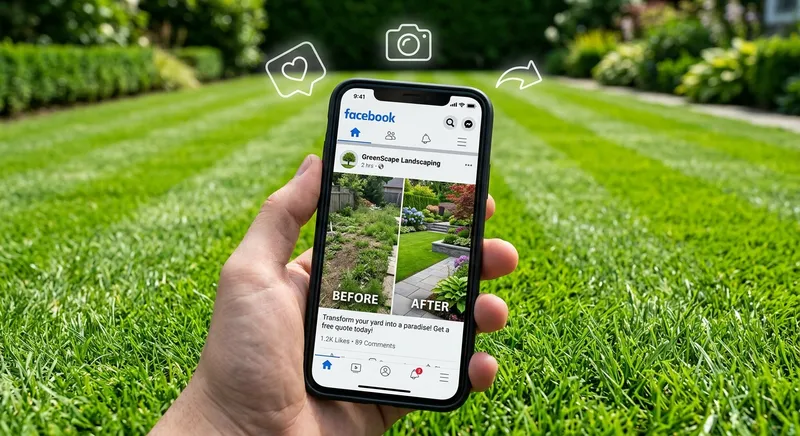
Table of Contents
Google Ads catches people actively searching for a landscaper. Facebook and Instagram ads do the opposite — they put your business in front of people who weren’t looking for you. They’re scrolling through their feed, see your ad, and think: “Actually, my lawn does look terrible. Maybe I should call someone.”
This difference matters because it changes everything about how you run the ads, what you show, and what you expect. Treating Meta ads (Facebook and Instagram) like Google Ads is the most common mistake landscaping companies make — and it’s why most of them give up after wasting a few hundred dollars.
Here’s what actually works.
The fundamental difference: intent vs. interruption
Google Ads = intent. The homeowner searched “lawn care near me.” They want a landscaper. Your ad answers their search.
Meta Ads = interruption. The homeowner is looking at vacation photos and memes. Your ad interrupts their scroll. They weren’t thinking about their lawn until your ad made them think about it.
This means:
- Google leads are hotter. They’re actively shopping and will call you today.
- Meta leads are warmer. They’re interested but may not act immediately. They need a reason to stop scrolling, and they need a low-friction way to take the next step.
- Meta ads require better creative. On Google, text ads work because the searcher is already interested. On Meta, you’re competing with photos of grandkids and funny videos. Your ad has to earn attention visually.
- Meta’s strength is visual services. Landscaping is inherently visual — before-and-after transformations, beautiful patio installations, lush green lawns. This makes Meta ads more effective for landscaping than for most home services.
What works: the ad formats and strategies that generate leads
1. Before-and-after photo ads
This is the single most effective ad format for landscaping on Meta. Nothing stops a homeowner’s scroll like a dramatic transformation.
What to show:
- Overgrown lawn → freshly mowed with crisp stripes
- Neglected beds → clean mulch, trimmed shrubs, seasonal color
- Bare backyard → finished patio with furniture and lighting
- Leaf-covered yard → clean, blown-out property
How to structure the ad:
- Image: Side-by-side or swipe carousel showing before and after. Use your own photos, not stock images. Phone photos are fine — authenticity often outperforms polished professional shots on Meta.
- Caption: Short, specific, local. “We turned this [City] backyard into an outdoor living space in 3 days. Spring booking is open — DM us or call [number] for a free estimate.”
- Call-to-action button: “Get Quote” or “Call Now”
Before-and-after ads work because they do three things simultaneously: demonstrate your quality, show the transformation homeowners want, and provide social proof that you’ve done this before.
2. Video ads (15-30 seconds)
Short videos outperform static images on Meta in most tests. For landscaping, the best videos are:
- Time-lapse of a job. Set up a phone or GoPro and record a cleanup, mulch job, or mow from start to finish. Speed it up to 15-30 seconds. The visual transformation is satisfying and shareable.
- Drone flyover of a completed property. If you have a drone (or a friend with one), a slow aerial sweep of a finished landscape project is attention-grabbing and shows the full scope of your work.
- Quick before/after walk-through. Walk up to a property, show the “before,” then cut to the “after.” Narrate briefly: “Here’s a spring cleanup we did in [neighborhood] yesterday. Three hours, and the yard is ready for the season.”
Keep videos under 30 seconds. Meta users scroll fast. The first 3 seconds determine whether they keep watching — lead with the most visually dramatic moment.
3. Lead form ads
Meta offers “Lead Form” ads where the user can submit their information (name, phone, email, address) without leaving Facebook or Instagram. When someone taps “Get Quote,” a form pops up pre-filled with their Facebook profile information.
Why they work for landscaping:
- Extremely low friction — the user doesn’t have to visit your website or dial a phone number
- Pre-filled forms (name, email, phone are auto-populated from their profile) increase completion rates
- Works well on mobile where most Meta usage happens
Why they can underperform:
- The low friction means some people submit forms casually without strong intent. Lead quality can be lower than Google Ads leads.
- If you don’t follow up within 1-2 hours, the lead goes cold fast. They submitted on impulse while scrolling — they need a quick response while the interest is fresh.
Tip: If you use lead forms, call the lead within 30 minutes of submission. The difference in conversion rate between a 30-minute callback and a 4-hour callback on Meta leads is dramatic — often 3-5x.
4. Retargeting ads
Retargeting shows ads to people who’ve already visited your website but didn’t call or submit a form. These are the warmest Meta leads because they’ve already shown interest.
How to set it up:
- Install the Meta Pixel on your website
- Create a “Custom Audience” of website visitors from the last 30 days
- Run ads specifically to this audience
What to show in retargeting ads:
- A different angle than what they saw on your website. If they visited your mowing page, retarget with a before-and-after of a lawn you maintain.
- Social proof: review count, star rating, customer testimonial
- A specific offer: “Book your spring cleanup by [date] — free aeration included with any cleanup over $300”
Retargeting budgets are small ($3-$10/day) because the audience is limited to your website visitors. But the conversion rate is significantly higher than cold audience ads because these people already know who you are.
What doesn’t work (and what to stop doing)
Boosted posts
The “Boost” button on your Facebook business page is Meta’s simplest ad product — and its least effective. Boosted posts are shown to a broad audience with minimal targeting control. They generate likes and comments (vanity metrics) but rarely generate leads.
If you’re going to spend money on Meta ads, use Ads Manager — not the Boost button. Ads Manager gives you control over audience targeting, placement, bid strategy, and conversion objectives that the Boost button doesn’t. If you want organic reach from your feed, boosting isn’t the answer either — see how landscaping companies actually win on Instagram (organic, not ads) for what to do instead.
Generic “hire us” messaging
An ad that says “We’re a landscaping company in [city]. Call us for all your landscaping needs!” is invisible on Meta. It doesn’t stop the scroll, doesn’t show your work, and doesn’t give the viewer a reason to act.
Every ad needs a specific service, a visual, and a reason to act now. “Spring cleanup season is here — we’re booking [city] properties this week. DM for a free estimate” is specific and timely. “Call us for all your landscaping needs” is wallpaper.
Targeting too broadly
Meta’s targeting is powerful, but most landscaping companies don’t use it well. Running ads to “everyone within 25 miles who owns a home” wastes budget on people who rent, live in apartments, or are outside your actual service area.
Better targeting for landscaping:
- Location: Your actual service area — specific zip codes or a tight radius around your base
- Age: 28-65 (homeowners who make purchasing decisions)
- Homeownership: Meta allows targeting by homeownership status (under Demographics > Home > Homeownership)
- Interests: Home improvement, gardening, outdoor living, HGTV (these indicate homeowners who care about their property)
- Income: If available in your market, targeting upper-middle income brackets tends to generate better leads for premium services
Expecting immediate ROI
Meta ads are not Google Ads. Google captures existing demand (someone searching right now). Meta creates demand (someone who wasn’t thinking about their lawn until they saw your ad).
This means:
- Meta leads take longer to convert. They may not call for 2-7 days after seeing your ad.
- Meta ads build awareness that pays off later. Someone sees your ad in March, saves it, and calls in April when their lawn is overgrown.
- The ROI compounds over time as more people in your service area recognize your brand from repeated exposure.
Give Meta ads 60-90 days before evaluating ROI. The first 30 days are learning — for both the algorithm and your creative testing.
Budget guidelines for Meta ads
Starting budget
$10-$20/day ($300-$600/month) is sufficient for a landscaping company starting on Meta. This generates enough impressions and clicks for the algorithm to optimize and for you to learn what works.
Budget allocation
| Campaign type | % of Meta budget | Monthly spend (at $500 total) |
|---|---|---|
| Before/after photo ads (cold audience) | 50-60% | $250-$300 |
| Video ads (cold audience) | 20-30% | $100-$150 |
| Retargeting (website visitors) | 15-20% | $75-$100 |
Cost benchmarks for landscaping
| Metric | Typical range |
|---|---|
| Cost per 1,000 impressions (CPM) | $8-$25 |
| Cost per click | $1-$4 |
| Cost per lead (lead form) | $15-$50 |
| Cost per lead (website conversion) | $30-$80 |
| Lead-to-customer conversion rate | 15-30% |
| Cost per customer | $75-$300 |
Meta leads are generally cheaper per lead than Google leads ($15-$50 vs. $25-$75) but convert at a lower rate (15-30% vs. 30-50%). The net cost per customer often ends up comparable — but Meta gives you brand awareness as a bonus that Google doesn’t.
Google Ads vs. Meta Ads: which one first?
For most landscaping companies, the priority order is:
- Google Business Profile + reviews (free, highest ROI)
- Google Local Services Ads (pay per lead, high intent)
- Google Search Ads (pay per click, high intent)
- Meta Ads (pay per impression/click, builds awareness + generates leads)
Meta ads work best as a complement to Google, not a replacement. Google captures the homeowner who’s searching today. Meta warms up the homeowner who’ll search next month — and when they do search, your company name is already familiar.
The companies that use both channels effectively — Google for bottom-of-funnel capture, Meta for top-of-funnel awareness — consistently outperform companies that rely on either one alone.
The creative that actually gets results
Photo tips
- Use your own photos. Authentic beats polished on Meta. A phone photo of a freshly edged lawn with morning dew looks better than a stock photo of a model homeowner.
- Shoot in golden hour. Late afternoon light makes every lawn and landscape look dramatically better. Schedule 5 minutes at the end of your best-looking jobs to take photos.
- Show the transformation. Before photos should look genuinely bad (the worse, the better for ad performance). After photos should highlight the dramatic difference.
- Include equipment or crew subtly. A mower visible at the edge of the frame or a crew member walking away adds authenticity and scale.
Caption tips
- Lead with location. “[City] homeowners: spring cleanup season is open.” Location specificity makes the ad feel personal.
- Be specific about the service. “Spring cleanup, mulch, and hedge trimming” beats “landscaping services.”
- Include a clear CTA. “DM us for a free estimate” or “Call [number] — we’re booking this week.”
- Keep it under 3 sentences. Long captions don’t get read on Meta. Get to the point.
Testing
Run 2-3 creative variations simultaneously and let them compete for 7-10 days. Turn off the underperformers and create new variations to test against the winner. This continuous testing cycle — not a single “perfect” ad — is what separates successful Meta advertisers from companies that quit after one failed attempt.
The landscaping companies winning on Meta aren’t doing anything secret. They’re posting photos of their actual work, targeting homeowners in their service area, and following up on leads quickly. The bar isn’t high — most of your competitors aren’t on Meta at all. Showing up with decent creative and consistent spend puts you ahead of the field.