How Landscaping Companies Actually Win on Instagram (Organic, Not Ads)
The organic Instagram playbook for landscaping companies. What to post, how often, what gets saved and shared, and how to turn followers into leads.
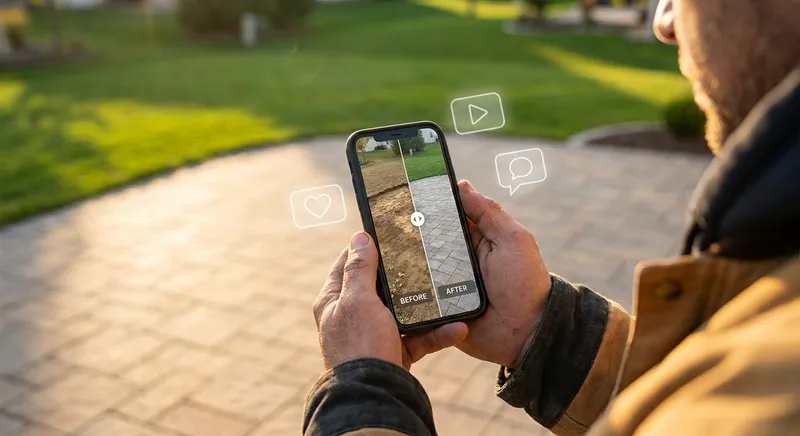
Table of Contents
Most landscaping companies are bad at Instagram in exactly the same way. They post a finished patio once a month, write “another great job for our customer” as the caption, tag nobody, use no hashtags, and wonder why the post gets 14 likes from their aunt and two friends from high school.
Meanwhile, the landscapers making real money from Instagram treat it like a channel — not a chore. They post 4-5 times a week, every post has a job, they understand the difference between a feed post and a reel, and they get consistent DMs from homeowners asking for quotes. No ad spend. No agency.
The gap between those two outcomes isn’t talent. It’s a playbook. Here’s the one that works.
What Instagram is actually good at for landscapers
Instagram isn’t where most homeowners search for a landscaper. Google is. So if you judge Instagram by how many “I saw your Instagram and want a quote” messages you get, you’ll undervalue it badly.
What Instagram is actually good at:
- Making referrals easier. When a neighbor asks “who did your backyard?”, your customer can tag you in a story. That tag becomes a 10-second sales pitch to every local follower.
- Closing the deal once someone’s already interested. A homeowner who found you on Google and is comparing three landscapers will look up your Instagram before calling. A strong feed is often what tips the decision.
- Attracting talent. Good techs and crew leaders scroll Instagram. A company that looks like it’s doing real, interesting work pulls better applicants than one that doesn’t exist online.
- Building local authority. The landscaping company with the most active local feed in a market becomes the “known” company even before a homeowner has hired anyone.
What it’s not good at: direct cold lead generation in the “scroll, see post, call immediately” sense. That happens, but it’s the minority use case. Running your Instagram to maximize that misses the bigger opportunity. (If you’re trying to generate direct leads from Meta, paid ads are a better fit — we cover the differences in Facebook and Instagram ads for landscaping.)
The posting rhythm that works
The companies winning on Instagram post on a rhythm, not when they feel like it. A reliable weekly cadence looks like this:
- 2 reels per week — short vertical videos, 15-45 seconds. These are the growth engine.
- 1-2 feed posts per week — a carousel of 3-8 photos from a finished project, or a single strong before/after image. These are your portfolio.
- 4-6 stories per week — behind-the-scenes moments, crew at work, materials delivery, rain delays, quick wins. These are your personality.
Total production time for a crew that knows what they’re doing: under 2 hours a week. Most of it is editing — the shooting happens naturally during the workday.
The common mistake: posting 10 times in a row after a good job, then going dark for three weeks. Consistency beats volume every time. A feed that posts twice a week for a year will outperform a feed that posts 15 times in a burst and then disappears.
The five post types that actually get traction
1. The before/after reel
The highest-performing format for landscapers, period. Structure: 3-5 seconds of the “before” (overgrown yard, cracked patio, dead lawn), then a snap or swipe transition, then 10-15 seconds slowly revealing the finished work. Music underneath — preferably a trending sound you can find in Reels audio browser.
Why it works: the format matches what Instagram’s algorithm rewards — visual transformation, short duration, high replay rate. And it matches what humans are hardwired to enjoy — dramatic before/after change.
Common mistake: skipping the “before.” A reel of just the finished project is a photograph with motion. The contrast is the story.
2. The “here’s how we did it” project walkthrough
30-60 second reel or a 5-8 slide carousel showing the stages of a project. Demo day → grading → base prep → installation → finish. The homeowner sees the work that went into the result and understands why a real landscaping job costs what it costs.
This format is a quiet sales tool. Homeowners who’ve watched your process are easier to close on price because they already understand what they’re buying.
3. The close-up detail shot
A single photograph — or a 3-photo carousel — zoomed in on one beautiful detail. A paver edge. A stone wall corner. A freshly edged bed line. The irrigation nozzle set perfectly into the mulch.
These posts do two things. They show craft, which matters to high-ticket customers. And they provide content for the weeks when you don’t have a finished project to post — every job has close-up shots worth showing, even mid-project.
4. The “what we’re working on today” story
Not a permanent post — a story that disappears in 24 hours. A quick phone video of the crew unloading, a shot of the material pile, a time-lapse of a bed being dug. Low production value is fine and actually preferable.
Stories are where the loyalty builds. Followers who watch your stories become the people who tag you in their DMs when a friend asks for a recommendation. Feed posts get likes. Stories get referrals.
5. The educational post
Once every week or two, teach something. “Three reasons your lawn has brown spots in August.” “Why we don’t install mulch over landscape fabric.” “What to look for when hiring a hardscape contractor.” Carousel format, 6-8 slides, each slide one punchy point with a supporting visual.
Educational posts are what get shared and saved — the two engagement signals Instagram’s algorithm cares about most. One educational post that gets 40 saves will outrun 10 project photos that each get 80 likes.
Hashtags, geo-tags, and the boring stuff that actually matters
Most landscapers get this wrong. Three rules:
Use 3-5 hashtags, not 30. The “stuff 30 hashtags in every post” era is over. Instagram’s algorithm now treats hashtag-stuffed posts as low-quality. Three to five specific, relevant hashtags outperform thirty generic ones.
Mix local and category. Two hashtags should be location-specific (#[YourCity]Landscaping, #[YourCity]Home). Two should be category (#LandscapeDesign, #HardscapeLife). One can be broad (#BackyardGoals). That’s it.
Geo-tag every post. Tag the city, town, or neighborhood where the work was done. This is how Instagram’s “places” search surfaces your posts to local viewers — and it’s underused by competitors.
Tag the customer (with permission). If the homeowner is on Instagram, tag them. When they see the tag, they’ll often re-share to their own feed or stories, putting your work in front of their neighbors.
Turning followers into DMs and DMs into jobs
Here’s where most landscapers fumble the handoff. They build a nice feed and then never convert it.
The three small moves that make the difference:
Put a clear call-to-action in your bio. “Book a free estimate → [short link]” works. “Premier landscape design and installation” doesn’t. Your bio is the only clickable real estate on Instagram for organic users. Use it like a storefront window, not a resume.
Answer DMs within a few hours. Instagram DMs are where the warm conversations happen. A homeowner who messages you on Instagram has already opted in — they want to hire you. But if you take two days to reply, they’ve moved on. If you can’t watch DMs in real time, set up push notifications specifically for Instagram messages.
Pin three high-performing posts to the top of your feed. When a homeowner lands on your profile from a referral or a Google search, the first three posts they see are the first impression. Pick one great before/after, one educational post, and one close-up detail shot. Don’t let your top-of-feed be a random post that happened to be most recent.
What not to do
- Don’t post inspirational quotes over stock photos. Nobody wants this from a landscaper. Homeowners are here for your work, not your motivational thoughts.
- Don’t repost content from other landscapers. You’re building local authority — reposts dilute it.
- Don’t buy followers. Bot followers crater your engagement rate, which cuts your organic reach for every real post going forward. A real account with 400 engaged local followers beats a bloated one with 10,000 fake ones.
- Don’t obsess over follower count. A landscaper with 800 local followers who convert to jobs is more valuable than one with 15,000 followers scattered across the country who’ll never hire you.
The first 30 days
If you’re starting from zero, the first month looks like this:
Week 1: Optimize the profile. Clear bio, one-sentence description, link to booking or estimate form, high-quality logo, 9 pinned posts from your portfolio to make the grid look established.
Week 2: Post your first reel (before/after) and your first carousel (a finished project). Engage on 15-20 local accounts — homeowners in your service area, other local businesses, community pages. Genuine engagement, not spam comments.
Week 3: Post 4 more times across the week. Start stories — 3-5 per week. Reach out to 5 past customers and ask them to tag you when they share anything about their yard.
Week 4: Review analytics. Which post type got the most saves? The most reach? Double down on whatever worked. Drop whatever didn’t.
By week 12, if you’ve stuck with it, you’ll have 50+ posts, steady stories, and enough traction that the next referral or Google-ads lead who looks you up sees a real, active business — and that alone wins you jobs you’d otherwise lose.
Instagram doesn’t have to be a grind. But it does have to be a habit. Treat it like the 3 hours a week of marketing work it is, and it’ll pay back in referral quality, close rate, and local reputation — the compounding stuff that makes a landscaping company worth owning.