How to Read a Residential Soil Test Report Without Being an Agronomist
A practical guide to interpreting a residential soil test — pH, macronutrients, CEC, organic matter — and what the numbers actually mean for the recommendations you give a homeowner.
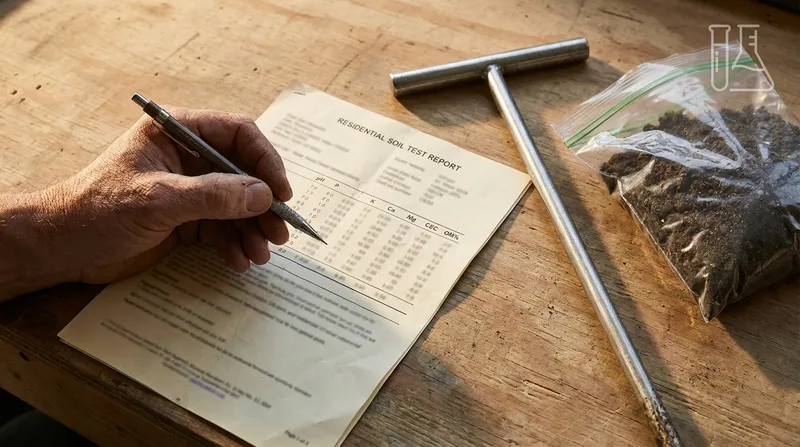
Table of Contents
A homeowner hands you a soil test report from the county extension office. It is a single sheet of paper, dense with numbers and acronyms, and the homeowner is looking at you to translate it into what their lawn needs.
If you are not a trained agronomist, this can feel like a moment to fake your way through. It does not have to be. A residential soil test from a reputable lab — a state university extension service, a private agricultural lab — measures a small, consistent set of things. Once you know what each line is for, the report becomes a useful tool instead of a guess-driven prop.
This post is what each section of a standard soil test report actually measures, why it matters for the recommendations you give, and the parts you can safely ignore for most residential lawn work.
What gets tested in a standard residential report
A typical state extension soil test includes:
- pH (acidity / alkalinity)
- Buffer pH (sometimes — used to calculate lime needs)
- Phosphorus (P) — usually as ppm
- Potassium (K) — usually as ppm
- Calcium (Ca) and Magnesium (Mg) — base cations
- Organic matter percentage
- Cation exchange capacity (CEC)
- Sometimes: sulfur, boron, zinc, manganese, iron, sodium, soluble salts
Nitrogen is conspicuously absent from most reports. That is intentional — soil nitrogen levels fluctuate too fast to measure usefully, so labs do not test for it. Recommendations for nitrogen are made based on plant type and growth stage, not soil testing.
pH: the master variable
If you only look at one thing on the report, look at pH. It governs nutrient availability for every other element on the test.
- Below 5.5: acidic. Most turf species struggle. Aluminum becomes more soluble (toxic to roots). Phosphorus is locked up and unavailable.
- 5.5 to 6.0: slightly acidic. Acceptable for some species (centipedegrass, fescues tolerate the low end).
- 6.0 to 7.0: the sweet spot for most cool-season and warm-season turf. Nutrient availability is at its peak.
- 7.0 to 7.5: slightly alkaline. Mostly fine, though some micronutrients (iron, manganese) start becoming less available.
- Above 7.5: alkaline. Iron chlorosis becomes likely on many ornamentals. Lawn looks pale despite adequate iron in the soil.
A pH of 5.4 means you are applying fertilizer and watching most of it become unavailable to the plant. Lime is the fix for acidic soils; elemental sulfur is the fix for alkaline soils. Both take months to move pH meaningfully — soil pH is a slow variable.
Buffer pH (the second number)
Some reports include a “buffer pH” or “lime index” alongside regular pH. This is not a second measurement — it is a derived number labs use to calculate exactly how much lime is needed to raise pH to a target value. If you see a recommendation of “apply 50 lbs of dolomitic lime per 1,000 sq ft,” that number came from the buffer pH calculation, not the pH itself.
The takeaway: do not try to interpret buffer pH directly. Trust the lime recommendation.
Phosphorus and potassium
These two macronutrients are the workhorses of the recommendation section.
Phosphorus (P)
Reports usually classify P levels as Low, Medium, High, or Very High based on ppm thresholds that vary by region and soil type (the lab calibrates ranges for your area). What you actually care about:
- Low: the lawn or planting is starved for P. Apply a starter fertilizer with phosphorus included, or a P-only amendment if your jurisdiction permits.
- Medium / Optimum: maintain. No additional P needed beyond normal fertilization.
- High / Very High: do not apply phosphorus. Many residential soils in long-established suburbs are already saturated with P from decades of fertilization. Most U.S. states now restrict P application on established turf because of runoff into waterways — check your state’s regulations before recommending a P-containing fertilizer at all.
The single biggest mistake non-agronomists make: defaulting to a “starter fertilizer” (high P) on every lawn regardless of soil P levels. Half the time, you are adding P the soil already has in surplus, and contributing to surface water pollution in the process.
Potassium (K)
Similar Low / Medium / High classification. K is rarely the limiting nutrient on a residential lawn — most soils have plenty unless they are sandy or have been heavily harvested by intensive cropping in their past life.
- Low K: apply a fertilizer with a meaningful K component. Important for cold-hardiness and disease resistance in turf.
- Medium / High: a balanced fertilizer is fine; do not over-apply potassium.
Calcium, magnesium, and the base cations
These are often listed together because they are part of the CEC story (next section).
The numbers are useful mostly for catching imbalances:
- Low calcium: usually correlated with low pH. Lime corrects both at once (dolomitic lime adds calcium AND magnesium; calcitic lime adds calcium only).
- Low magnesium: shows up on sandy, leached soils. Dolomitic lime or Epsom salt corrects.
- Very high sodium (some reports include this, especially in arid regions): saltwater intrusion, road salt drift, or water with high sodium. Indicates a drainage or water-source problem you need to flag separately.
Most residential reports show Ca and Mg in the Optimum range and do not require action. Just glance and move on.
CEC: the part everyone is afraid of
Cation Exchange Capacity sounds intimidating but is actually a useful one-number summary of your soil’s ability to hold nutrients.
The number is in meq/100g (milliequivalents per 100 grams of soil). What the value tells you:
- CEC under 5: sandy soil. Holds water poorly, holds nutrients poorly. Fertilizer leaches through quickly. Recommendation: light, frequent feeding rather than heavy infrequent applications.
- CEC 5 to 15: loam or silt loam. Most U.S. residential soils. Normal fertilization works fine.
- CEC 15 to 25: clay loam or clay. Holds nutrients well but also holds onto problems (compaction, drainage). Recommendation: standard fertilization is fine, but pay attention to aeration and drainage.
- CEC above 25: heavy clay. Drainage and compaction are now the limiting factors, not nutrition. Throwing fertilizer at a CEC-30 compacted clay lawn is not the answer — aeration and topdressing with compost are.
CEC is also useful for talking to a sandy-soil homeowner about why their lawn looks hungry six weeks after a fertilizer application. The fertilizer washed through. That is not a fertilizer problem — that is a soil-holding-capacity problem, which you fix with organic matter over years, not with another bag of fertilizer.
Organic matter percentage
This is the number that tells you whether the soil is biologically alive. Organic matter is the food source for soil microbes, the source of slow-release nutrients, and the thing that gives a soil its dark color and crumbly structure.
- Under 2%: depleted soil. Common on newer construction lots where topsoil was stripped during building, or on sandy soils in dry regions.
- 2 to 4%: typical residential range across most U.S. lawns.
- 4 to 6%: healthy. Often seen on properties with long-term mulching, compost amendment, or naturally rich soils.
- Above 6%: rare in turf, more common in established perennial beds.
Recommendations for low organic matter: topdress with compost (1/4 to 1/2 inch annually), leave clippings, reduce blanket fungicide use that suppresses soil biology. These are slow fixes, but they are the real fix. There is no shortcut.
Soluble salts (when present)
Some reports include “soluble salts” or “EC” (electrical conductivity). High values indicate:
- Excess fertilizer (recently applied or accumulated over years)
- Road salt intrusion
- Saltwater irrigation or coastal influence
- Pet urine spots (on a localized sample)
If salts are high, the plant is stressed even if all the other nutrients look fine. The fix is leaching with clean water — slow, deep irrigation — and stopping whatever is adding salts.
Micronutrients
Iron, manganese, zinc, boron, copper, and sulfur sometimes appear on reports. For residential turf, these are usually optimum and rarely the limiting factor. The exceptions:
- Iron deficiency on alkaline soils: causes yellowing despite the lawn being fed. Iron chelate sprays or sulfur amendments to lower pH are the fix.
- Sulfur deficiency on sandy, leached soils: rare but real. Ammonium sulfate fertilizer corrects both N and S.
If micronutrients all read normal, ignore them and focus on pH, P, K, and organic matter.
What the lab’s recommendation section is actually doing
The “Recommendations” or “Suggested Amendments” section at the bottom of the report is the lab’s interpretation of the numbers above. It is generally trustworthy, but you should still read the underlying numbers because:
- The lab does not know what plant the soil is supporting. Recommendations may default to “lawn” assumptions when the homeowner is actually planning a vegetable garden or an ornamental bed.
- The lab does not know your local conditions — irrigation water quality, microclimate, recent construction history.
- The lab does not know what the homeowner has been doing for the last decade. A high P number plus a “do not add P” recommendation only makes sense if you know they have been over-applying for years.
The numbers tell you the story. The recommendation tells you what to do if the story is typical. Your job is to know whether the story is typical.
What you can ignore on most residential reports
To keep this practical, things that are usually not worth chasing on a standard residential lawn:
- Trace micronutrients (boron, copper, zinc) unless flagged as deficient
- Base saturation percentages — interesting for advanced soil science, rarely actionable for residential turf
- Specific calcium-to-magnesium ratios (the “Albrecht ratios” debate — disputed in modern soil science; do not over-index on this)
- Soluble salts if in the normal range
- Buffer pH as a standalone number — let the lime recommendation use it
Spend your time on pH, P, K, organic matter, and CEC. Those five numbers will tell you 90% of what you need to know.
What to actually tell the homeowner
A useful translation, given a typical report:
“Your soil pH is 5.6 — slightly acidic. We are going to apply about 40 pounds of pelletized lime per thousand square feet to bring that up over the next six months. Phosphorus is high already, so we are switching you to a no-phosphorus fertilizer. Potassium is medium — we will use a balanced product with a meaningful K component. Organic matter is 2.1 percent, which is on the low end — we are going to topdress with a quarter inch of compost in the fall. CEC is 7, which is sandy-leaning loam, so we are going to break the fertilizer applications into more frequent, lighter doses rather than two big ones a year.”
That paragraph, delivered to a homeowner, is what a soil test report is for. It justifies your specific recommendations, separates you from the company that applies the same fertilizer to every lawn regardless of soil, and earns the trust that recurring contracts are built on.
The test usually costs the homeowner $15 to $30 through a state extension service. The conversation it enables is worth multiples of that — both to the lawn and to your relationship with the customer. If you are not already pulling soil samples on the high-value installs or for any customer who asks why their lawn looks tired, this is the cheapest diagnostic in landscaping.
For estimators, this is also a worthwhile pre-site-visit item. If you know a pre-estimate property walk is going to surface a turf condition the customer wants explained, taking a probe-and-bag soil sample on the same visit (and dropping it at the extension office on the way back) makes the follow-up proposal substantially more credible.