AI Answering Service for Landscaping: Do You Need One?
How AI answering services work for landscaping companies: what they handle, what they cost, and how to tell if your business is ready for one.
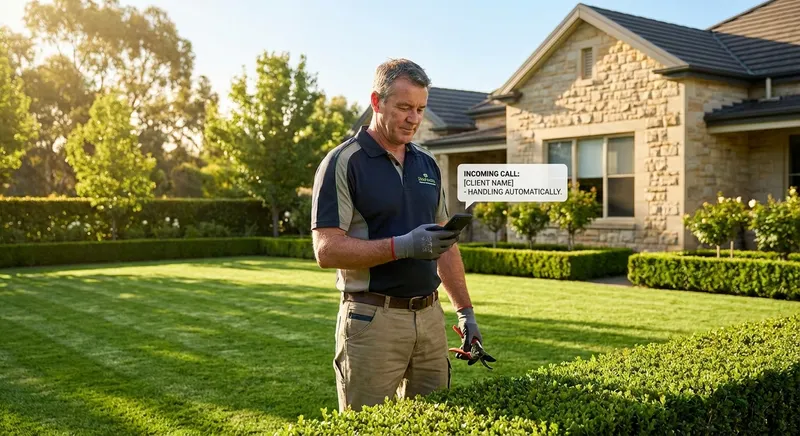
Table of Contents
An AI answering service picks up your phone, talks to the caller like a real person, and handles the conversation — booking estimates, answering questions, capturing lead details — without a human on the line.
For landscaping companies, this solves a specific problem: you can’t answer the phone when you’re running a mower, operating equipment, or managing a crew. But the homeowner calling you right now will call the next landscaper on Google if you don’t pick up.
Here’s how it works, what it costs, and how to figure out if it makes sense for your business.
How an AI answering service actually works
When a customer calls your business number, the call routes to the AI system instead of ringing your phone (or in addition to it — most services let you set rules like “answer if I don’t pick up within 4 rings”).
The AI answers with a greeting customized to your business. It sounds like a natural phone conversation, not a robotic menu. The caller doesn’t press buttons or navigate a phone tree — they just talk.
From there, the AI can:
- Ask qualifying questions. What service do you need? What’s your address? How large is the property? When would you like the work done?
- Answer common questions. Do you offer free estimates? What areas do you serve? Do you handle hardscaping? What are your hours?
- Book appointments. If connected to your calendar, it can schedule estimate visits in available time slots.
- Send you a summary. After every call, you get a text or email with the caller’s name, number, address, what they need, and any notes from the conversation.
The key difference from a traditional answering service: there’s no human operator reading from a script. The AI understands context, handles follow-up questions, and can have a genuine back-and-forth conversation about your services.
Why landscaping companies specifically benefit
AI answering services work for a lot of industries, but landscaping has a few characteristics that make the ROI particularly clear.
You’re physically unable to answer during working hours
A lawyer can step out of their office to take a call. A landscaper on a zero-turn at 10am cannot. Your peak calling hours — 9am to 3pm on weekdays — overlap almost perfectly with your peak working hours. Without help answering the phone, you miss the majority of new leads during the exact hours they’re most likely to call.
Your calls require property-specific information
A generic answering service takes a name, number, and message. But for a landscaping estimate, you need the property address, what services they want, the approximate lot size, and any access issues. An AI answering service built for landscaping asks these questions automatically, so by the time you see the lead summary, you have enough information to decide whether to follow up — or even provide a ballpark quote.
Seasonal call volume is unpredictable
Spring brings a wave of calls that’s nearly impossible to staff for. You might get 8 calls on Monday and 35 calls on Thursday after the first warm weekend. Hiring a part-time receptionist for a 6-week surge doesn’t make sense financially. An AI handles 1 call or 100 calls with the same quality and zero overtime.
After-hours calls are high-value
Homeowners often research and call landscapers in the evening after work. These aren’t casual inquiries — they’re people ready to book. If your phone goes to voicemail at 7pm, that lead is gone. An AI answering service works 24/7, capturing leads at 9pm on a Tuesday or 7am on a Saturday with the same professionalism as a weekday afternoon.
What a typical call looks like
Here’s a realistic example of how an AI answering service handles a landscaping inquiry:
Caller: Hi, I’m looking to get my yard cleaned up for spring. Do you guys do that?
AI: Absolutely — spring cleanup is one of our most popular services. We handle debris removal, bed edging, pruning, mulch, and first mow of the season. Can I get a few details so we can put together an estimate for you?
Caller: Sure. It’s a regular-sized lot, maybe a quarter acre. We’ve got some overgrown beds and a lot of leaves left from fall.
AI: Got it. And what’s the property address?
Caller: 142 Maple Drive in Springfield.
AI: Perfect. And what’s the best name and number to reach you?
Caller: Sarah Mitchell, 555-0147.
AI: Thanks, Sarah. I’ll pass this along to the team — someone will follow up with you within one business day to schedule a site visit. Is there anything else I can help with?
Caller: Nope, that’s it. Thanks!
Within seconds of that call ending, you’d get a notification with Sarah’s name, number, address, and exactly what she’s looking for. No voicemail to listen to. No callback to make just to get basic details. You can review the lead between jobs and decide how to follow up.
What AI answering services cost
Pricing varies, but here’s what to expect for landscaping-specific and general-purpose options:
| Service type | Typical cost | What you get |
|---|---|---|
| AI-specific for landscaping | $49–149/mo | Industry-trained AI, property-aware intake, landscaping terminology, integrations with field service tools |
| General AI receptionist | $79–200/mo | Customizable scripts, calendar booking, call summaries, multi-industry |
| Traditional answering service | $150–500/mo | Human operators, per-minute billing, basic message taking |
| In-house receptionist | $2,500–3,500/mo | Full-time employee, benefits, training, desk space |
The cost difference between an AI answering service and a human alternative is significant. But cost isn’t the only factor — what matters is whether the AI can handle your specific call types well enough that callers don’t hang up frustrated.
For most landscaping calls — estimate requests, service inquiries, scheduling questions — a well-configured AI handles them as well or better than a receptionist who doesn’t know the difference between aeration and dethatching.
When an AI answering service makes sense
Not every landscaping company needs this. Here’s how to tell if you’re a good fit:
You’re missing more than 5 calls per week. Check your phone’s missed call log. If you’re regularly missing 5+ calls during working hours, each one is a potential $500–$5,000 job walking to a competitor. At that volume, an AI answering service pays for itself in the first captured lead.
You’re a solo operator or small crew without office staff. If there’s nobody in the office to answer the phone, every call during fieldwork is a gamble. An AI gives you office-level phone coverage without office-level overhead.
You’re getting after-hours calls that go to voicemail. Check your voicemail timestamps. If you see calls at 6pm, 8pm, or on weekends, those are leads you’re losing to companies that answer.
You’re growing and call volume is outpacing your ability to respond. This is the inflection point where most landscaping companies either hire help or start losing leads. An AI answering service bridges the gap at a fraction of the cost of an employee.
You’re spending too much time on the phone instead of in the field. If you’re the owner and you’re answering every call yourself, you’re doing $15/hour work instead of $75/hour work. Delegating phone answering — even to an AI — frees you to focus on operations and revenue.
When it might not be the right fit
Your business runs on complex consultative sales. If every project requires a 30-minute conversation about design preferences, materials, and budget before you can even schedule a site visit, an AI won’t replace that conversation. It can capture the initial inquiry and schedule the consultation, but the selling still needs to be you.
You only get a few calls per week. If you’re getting 3-4 calls per week and you can answer most of them, the ROI may not justify even a $49/month tool. Focus on growing call volume first through marketing and Google Business Profile optimization.
Your callers are exclusively existing customers with account-specific questions. AI answering services excel at new lead capture. If 90% of your calls are existing customers asking about their specific service schedule or billing, you may need a CRM with customer lookup capabilities instead.
How to set one up
Setup for most AI answering services takes 30-60 minutes:
-
Choose your call routing. Most landscapers use “ring my phone first, then forward to AI if I don’t answer within 3-4 rings.” This means you still answer when you can, and the AI catches everything you miss.
-
Configure your business details. Services offered, service area, hours, pricing guidance (if you want the AI to give ranges), and any FAQs specific to your business.
-
Set up notifications. Choose how you want to receive lead summaries — text, email, or app notification. Most owners prefer text for immediate visibility.
-
Test it. Call your own number a few times. Pretend to be a customer asking about spring cleanup, a patio project, and lawn maintenance. Make sure the AI handles each scenario naturally.
-
Go live. Set your call forwarding and let it run. Review the first week of call summaries to fine-tune anything the AI could handle better.
The whole process can be done in an afternoon. No technical expertise needed — if you can set up call forwarding on your phone (which your carrier can walk you through), you can set up an AI answering service.
The bottom line
An AI answering service isn’t magic. It won’t close deals for you, it won’t replace a skilled salesperson for high-end design work, and it won’t fix a marketing problem if your phone isn’t ringing in the first place.
What it does is make sure that when a homeowner calls your landscaping business — at 10am while you’re on a job, at 7pm while you’re at dinner, or during the spring rush when your phone won’t stop ringing — someone answers. And that someone captures the information you need to follow up and win the job.
For most landscaping companies doing $150K+ in revenue, that’s worth far more than the $49–149/month it costs.