How to Market a Pressure Washing Business Without Wasting Money on Ads That Don't Convert
A practical marketing guide for pressure washing business owners. What actually works, what wastes money, and how to build a lead pipeline that fills your schedule.
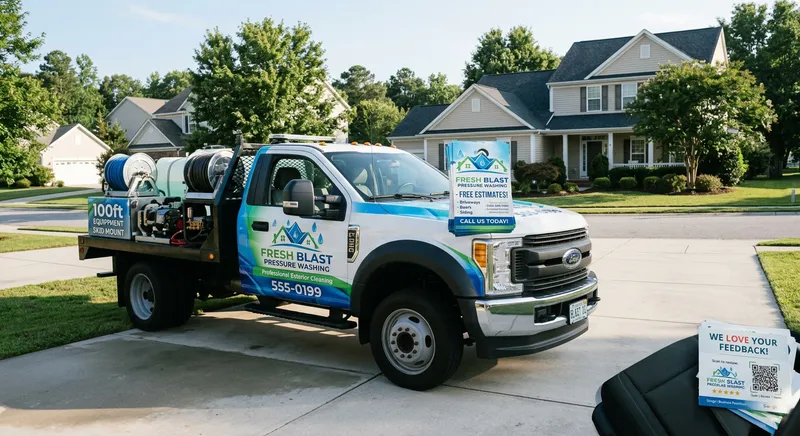
Table of Contents
Most pressure washing business owners market the same way: run a few Google Ads, post before-and-after photos on Facebook, maybe print some door hangers. When leads slow down, they throw more money at whatever they tried last. When leads pick up, they stop marketing entirely because they’re too busy washing to think about it.
The result is a revenue roller coaster — feast or famine, with no predictable pipeline and no clear understanding of what’s actually generating business versus what’s just burning cash.
Here’s a practical breakdown of what works, what doesn’t, and how to build a marketing system that fills your schedule consistently — without requiring a marketing degree or a $5,000/month ad budget.
Start with what actually drives pressure washing leads
Before spending a dollar on marketing, understand where pressure washing customers actually come from. The data from hundreds of small service businesses is consistent:
- Google search (organic and paid): 40–55% of new leads
- Referrals and word-of-mouth: 20–35% of new leads
- Repeat customers: 10–20% of revenue
- Everything else (social media, door hangers, yard signs, Nextdoor): 5–15%
This distribution matters because it tells you where to focus. Google dominates because pressure washing is an intent-driven purchase — nobody browses for fun. When a homeowner wants their driveway cleaned, they Google “pressure washing near me,” call 2–3 companies, and hire one. If you’re not showing up in that search, you’re invisible to half your potential market.
Google: the channel that matters most
Google Business Profile (free)
Your Google Business Profile (GBP) is the single most important marketing asset for a pressure washing company. When someone searches “pressure washing near me” or “driveway cleaning [your city],” the Google Map Pack results show first — above the paid ads, above the organic results. That map pack is driven by your GBP.
How to optimize it:
- Complete every field. Business name, address, phone, hours, website, service area, services offered. Google rewards completeness.
- Choose the right primary category. “Pressure washing service” is your primary. Add secondary categories: “power washing service,” “exterior cleaning service,” “roof cleaning service” if applicable.
- Add photos weekly. Before-and-after photos of real jobs perform best. Google’s algorithm favors profiles that are regularly updated with fresh content. Aim for 2–3 new photos per week during busy season.
- Get reviews consistently. Not all at once — a steady flow matters more than a burst. Ask every customer. A simple text after the job: “Thanks for choosing us! If you have a minute, a Google review helps our small business: [link].” Aim for 2–4 new reviews per month.
- Respond to every review. Positive and negative. Keep responses short and professional. Google tracks response rates.
Google Ads (paid)
Google Ads can work extremely well for pressure washing — if you set them up correctly. The problem: most pressure washing owners set up a campaign once, let it run on autopilot, and wonder why they’re spending $800/month and getting 3 leads.
What works:
- Search campaigns only (initially). Don’t run display ads or Performance Max campaigns until your search campaigns are profitable. Search ads target people actively looking for pressure washing — that’s your highest-intent audience.
- Tight keyword targeting. Focus on high-intent keywords: “pressure washing near me,” “driveway cleaning [city],” “house washing [city],” “deck cleaning service [city].” Avoid broad keywords like “pressure washer” (people shopping for equipment, not services).
- Negative keywords. Add “rental,” “buy,” “DIY,” “how to,” “equipment,” “machine” as negative keywords immediately. These are people who want to do it themselves, not hire you.
- Location targeting. Target your actual service area, not a 50-mile radius. A 15–20 mile radius from your base is typical. Every click from outside your service area is wasted money.
- Call-only or call extensions. Pressure washing customers prefer to call. Make the phone number prominent — or use call-only ads that dial your number directly from the search results.
- Budget: Start with $15–25/day. Track cost per lead (every call from an ad, every form submission). If your cost per lead is under $40 and your average job is $250+, the math works. Adjust from there.
What doesn’t work:
- Running ads without tracking. If you can’t tell which calls came from ads, you can’t optimize. Set up call tracking at minimum.
- Sending ad traffic to a generic homepage. Create a landing page for each service (driveway cleaning, house washing, deck/fence cleaning) with a phone number, a form, and before-and-after photos. No navigation menu, no distractions — just the service and a way to contact you.
- Set-and-forget campaigns. Check your search terms report weekly. You’ll find irrelevant searches eating your budget that need to be added as negative keywords.
SEO (organic search)
SEO takes longer than paid ads but generates leads at no marginal cost once it’s working. For pressure washing, the opportunity is large because most competitors have weak websites.
The basics that matter:
- One page per service. Don’t cram everything onto your homepage. Create separate pages for driveway cleaning, house washing, roof cleaning, deck and fence cleaning, commercial pressure washing, and any specialty services. Each page targets different keywords.
- Location pages. If you serve multiple cities or neighborhoods, create a page for each: “Pressure Washing in [City Name].” Include the city name in the title, a paragraph about servicing that area, and photos from jobs in that area. This helps you rank in local searches.
- Blog content (light touch). You don’t need to publish weekly. 1–2 posts per month on topics homeowners actually search: “how often should you pressure wash your driveway,” “pressure washing vs soft washing: what’s the difference,” “does pressure washing damage concrete.” These pages rank for informational queries and drive traffic to your site.
- Speed and mobile. Most pressure washing searches happen on phones. If your site takes 4+ seconds to load on mobile, you’re losing visitors before they see your content.
Referrals: the highest-converting channel you’re probably neglecting
Referral leads convert at 50–70% — roughly double the rate of Google leads. Yet most pressure washing companies do nothing to systematically generate them.
Three referral systems that work:
1. The post-job ask
After every job, when the customer is standing in their driveway admiring the clean concrete, ask: “We love working in this neighborhood. If any of your neighbors are thinking about getting their driveway or house washed, we’d appreciate the referral.” Then hand them 2–3 business cards.
This works because the timing is perfect — the customer is happy, the result is visually obvious, and neighbors can literally see the difference from across the street.
2. The neighbor door hanger
While you’re set up on a job, place door hangers on the 5–10 nearest houses. The message: “We just pressure washed your neighbor’s home at [address]. Want yours done too? Call for a same-week quote: [phone number].”
This is one of the most cost-effective marketing tactics in pressure washing. The door hanger costs $0.10–$0.20 each, and the conversion rate is high because the proof of work is literally visible next door.
3. The referral incentive
Offer existing customers $25–$50 credit toward future service for every referral that books. Some companies offer a flat discount on the next job instead. Either way, the incentive formalizes what was previously happening by chance.
Track where referrals come from. If 40% of your referral leads originate from 10% of your customers, those are your advocates — consider offering them a bigger incentive or a VIP treatment (priority scheduling, first-mow-free in spring for their lawn).
Repeat customers: the revenue most pressure washing companies ignore
Pressure washing is perceived as a one-time service — the customer calls when the driveway looks bad, you wash it, and they don’t think about you again for two years. This perception costs you enormous revenue.
The fix: annual service agreements.
A driveway that gets pressure washed annually stays cleaner, lasts longer, and costs the customer less per wash (because there’s less buildup to remove). A house wash done every 12–18 months prevents mold and mildew from causing damage. These are genuine benefits — not upsells for the sake of upselling.
How to sell annual service:
- At the end of every job, mention: “Most homeowners find that annual washing keeps things looking great and prevents buildup from causing damage. If you want, I can put you on our schedule for the same time next year — we’ll call a few weeks ahead to confirm.”
- Send a reminder 11 months after the last service: “Hi [Name], it’s been about a year since we washed your driveway/house at [address]. Ready to schedule this year’s wash?”
- Offer a 10% loyalty discount for returning customers. The discount costs you less than acquiring a new customer through advertising.
A pressure washing company that converts 30% of one-time customers into annual repeat customers transforms its revenue model. Instead of chasing 100% new leads every year, 20–30% of your revenue becomes predictable and pre-booked.
What doesn’t work (but everyone tries)
Social media posting without a strategy
Posting before-and-after photos on Facebook and Instagram can build awareness, but it rarely generates direct leads. The people scrolling past your posts aren’t looking for pressure washing right now — they’re looking at memes and vacation photos.
Social media works for pressure washing in two specific ways:
- Retargeting. Run ads on Facebook/Instagram to people who already visited your website. This keeps you top-of-mind when they’re ready to book. Cost: $3–5/day.
- Social proof. A Facebook page with regular posts, reviews, and before-and-after photos builds credibility when a prospect checks you out before calling. It’s not the lead source — it’s the trust builder.
Don’t spend hours creating social content expecting the phone to ring. Spend that time on Google and referrals instead.
Vehicle wraps (as a primary lead source)
A clean wrap on your truck and trailer looks professional and generates some awareness. But vehicle wraps are a passive channel — they work slowly and are impossible to track precisely. A wrap costs $2,500–$5,000 and might generate 1–3 leads per month over its lifetime.
A vehicle wrap is worth doing once your other channels are working. It’s not the foundation of your marketing — it’s the finishing touch.
Buying leads from aggregators
HomeAdvisor, Thumbtack, Angi, and similar platforms sell leads to multiple companies simultaneously. You pay $15–$40 per lead, and the homeowner is also talking to 3–4 of your competitors. Close rates are typically 10–20% — far lower than Google or referral leads.
These platforms can supplement your pipeline when you’re starting out and have no online presence. But relying on them long-term means you’re paying someone else to own your customer relationship. Build your own lead channels as fast as possible.
The marketing budget that works
For a pressure washing company doing $100K–$300K in revenue, here’s a marketing allocation that balances cost and return:
| Channel | Monthly budget | Expected leads/month |
|---|---|---|
| Google Business Profile (optimization) | $0 (your time) | 5–15 |
| Google Ads | $400–800 | 10–25 |
| Door hangers (20–30 per job) | $50–100 | 3–8 |
| Review generation | $0 (your time) | Indirect — builds Google ranking |
| Referral incentives | $50–150 (credits) | 2–5 |
| Website/SEO (ongoing) | $0–200 (DIY or basic hosting) | 3–10 (grows over time) |
| Total | $500–$1,250/month | 23–63 leads/month |
At a 35% close rate and $300 average job: 8–22 jobs/month = $2,400–$6,600/month in revenue from $500–$1,250 in marketing spend. That’s a 3–5x return.
The key is tracking. Know your cost per lead for each channel. Know your close rate. Know your average job value. When a channel stops performing, cut it. When a channel is crushing it, invest more.
The system beats the tactic
The pressure washing companies that grow predictably don’t rely on one marketing trick. They build a system:
- Google captures high-intent searchers (paid and organic)
- Referrals and door hangers convert neighbors of existing jobs
- Annual service agreements retain customers and create predictable revenue
- Reviews fuel the Google ranking, which generates more leads, which generates more reviews
Each piece reinforces the others. The flywheel takes 6–12 months to build, but once it’s spinning, your marketing costs decrease while your lead volume increases.
The worst thing you can do is marketing in bursts — panic-spending when leads dry up and stopping when you’re busy. Consistency beats intensity every time. Set a monthly budget, allocate it across the channels above, and run it every month regardless of how busy you are. Future-you will thank present-you when the schedule is full in August because you kept marketing in June.
Related: AI receptionist for pressure washing companies | The hidden cost of missed calls for pressure washing businesses | Answering service for service businesses