Off-Season Revenue in Lawn Care: What Actually Pays When Mowing Stops
Winter lawn care income is not a motivational poster. Ranked options, honest margins, and how to keep 2027 customers from shopping in March.
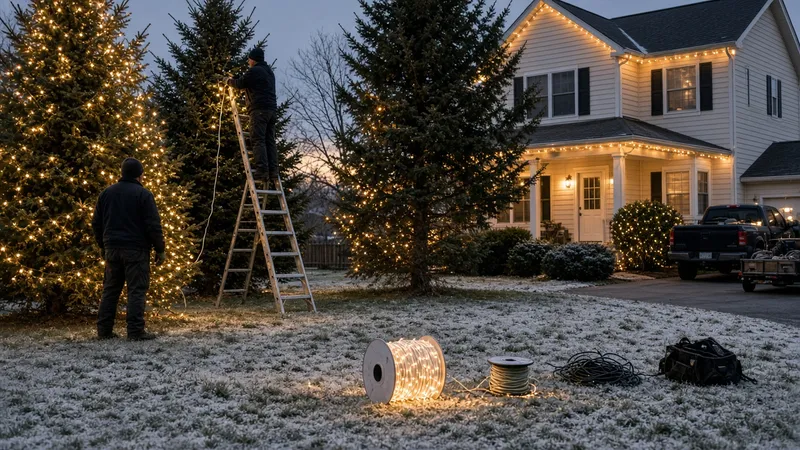
Table of Contents
Off-season revenue in lawn care is money that lands between the last mow and the first mow, not “productivity” you invent to feel busy. A lot of winter advice is really landscape-maintenance advice (hardscape, lighting, snow, holiday installs). A mowing-first shop has a thinner menu. That is the point of this post.
If you run full grounds maintenance, also read how landscape maintenance companies keep routes full off-season. This one is for the company whose identity is still weekly lawns.
Why lawn care winters feel worse than “landscaping” winters
Mowing is 70%+ of many lawn books. When grass stops, the product stops. Design-build and irrigation shops still have indoor quoting and punch lists. You have trucks, insurance, and a crew you either lay off or invent work for.
The labor market agrees. The Bureau of Labor Statistics groups landscaping services with industries whose employment rises fast in spring, peaks in summer, and sits at the low point in January. That is not a motivation problem. It is a calendar.
NALP’s published industry snapshot, drawing on IBISWorld, puts US landscaping services around $188.8 billion in 2025, with more than 1.4 million people and hundreds of thousands of firms (NALP landscape industry statistics). Most of that money still bunches into the growing season. A mowing shop in Ohio or Pennsylvania is not “failing” because January is quiet. It is failing if it treats quiet as a surprise every year.
Typical temperate-climate shape:
- April–October: most of the year’s lawn revenue
- November–March: a hole, unless you sold something else on purpose
NALP’s cost-of-doing-business work has long put typical landscape-maintenance net margins in the 5–10% range, with shops that actually cost jobs closer to 15–20% (how to price maintenance contracts). A 6% net business that loses four months of mowing does not have a “slow season.” It has a cash-flow problem. Seasonal cash flow is why a “profitable” year still needs a credit card in February. Off-season revenue is how you shrink that hole. Cash reserves are how you survive if you cannot shrink it this year. Do both.
Ranked ways to make winter money (lawn-care edition)
1. Prepaid 2027 lawn programs (highest ROI on time)
January homeowners plan the year. A 10–15% prepay or a locked-in first mow date is not a discount war. It is a deposit against April chaos. This is sales, not a new service line. Your “winter revenue” is cash now for work later. Accountants will argue about recognition. Your payroll will not.
2. Holiday lighting
High margin if you already have residential density and a crew that will work cold nights in November–December. Ugly if you underprice takedown in January. Quote install and takedown together.
This is not folklore. In NALP’s Lessons Learned from Offering Holiday Décor and Lighting Services, operators reported roughly 50% gross profit on lighting at one Massachusetts shop, and 60–65% gross / 20–30% net at a dedicated lighting brand, with year-one profit lower if you are still paying off rental inventory. Landscape Management has published shops where lighting was $250,000 of a $2.8 million book, and others where it was $40,000 of $1.4 million. Treat those as proof the product exists, not as your forecast. Sell to streets you already mow. Start in September. Do not invent a city-wide lighting company in week two of November.
3. Snow and ice
Only if the market, insurance, and lots line up. Decision: should you add snow. How: how to add snow to a landscaping business. Lawn-only shops often have the wrong trucks. Be honest.
The Snow & Ice Management Association’s 2022 industry impact work, summarized by Turf Magazine, is the cleanest public snapshot: private US snow and ice is about $20.8 billion, 88,200 businesses, 180,000 workers, and four out of five operators are sole proprietors. More than half of providers also do lawn and landscape. For a typical multi-line shop, snow is about one third of earnings. The same report puts a one-in-six chance of a slip-and-fall claim each season, with an average medical claim around $33,000. That is why “we’ll just put a plow on the F-150” is not a winter plan.
4. Leaf, debris, and “one more” fall services you already sold
If you are reading this in September, you still have a fall product. Gutter coordination, last aeration/overseed follow-up, and winterization referrals beat inventing a January service you have never done.
5. Small winter property work
Hauling, storm debris, firewood, fence repair, if you have the skill and the insurance. Do not become a general contractor because February is quiet.
6. Equipment rebuild as “revenue”
It is not revenue. It is a 2027 cost you pay in December instead of in a panic on April 2. Still do it. Do not file it under “off-season services” on the P&L.
Skip: random handyman, cheap interior jobs that beat up crews, and “content creation” as a business line. Posting lawn photos in January is marketing, not income.
| Winter product | What it really is | Honest constraint |
|---|---|---|
| Prepaid 2027 lawns | Cash now, mowing later | Needs a real April capacity plan, not a discount war |
| Holiday lighting | High-gross seasonal install + takedown | Inventory, boom/ladder safety, January labor |
| Snow and ice | Event-driven second business | Insurance, trucks, 2 a.m. phones, slip-and-fall docs |
| Late-fall agronomy | Last paid work of this year | Timing window closes; do not invent a January spray |
| Hauling / debris | Fills hours | Insurance and dump fees eat “busy” work |
| Shop rebuild | 2027 cost paid in December | Not revenue. Still do it. |
The slow-season job that is not a service: stay findable
Homeowners do not stop thinking about lawns. They stop seeing grass. They still search in February for a company for 2027. They still call the number on last year’s invoice to ask if you are “doing lawns again.”
If you forward the business line to a cell you ignore until March, you donate that renewal. The competitor who answers books the street.
Winter call types for a mowing company:
- “Are you taking new customers in spring?”
- “Can I lock in last year’s price?”
- Holiday lighting / gutter / snow if you offer them
- “The neighbor’s company left, can you add us?”
You do not need a full-time CSR for eight calls a day. You need those eight calls to become 2027 stops, not voicemails. An AI receptionist for lawn care can take the name, address, and “existing vs. new,” book a spring window you publish, or log a callback. Tinylawn starts at $49/month. Trial is 14 days or 10 calls, no card. You can keep forwarding only after hours until volume justifies more.
Going dark is how best customers leave after one season.
A winter money plan that fits on one page
- List every lawn account. Mark renew / raise / fire for 2027.
- Send prepay or early-book offers in November–January, not on the first 70-degree day.
- Pick one extra winter product you can staff (lights or snow, not both in year one unless you already do them).
- Rebuild the two pieces of iron that cost you April last year.
- Keep the public number live. Test a call on New Year’s week.
That is off-season revenue work. Everything else is optional theater.