Rainy Day Tips for Landscaping Businesses: Stay Productive
Rain days don't have to mean lost revenue. How landscaping companies stay productive, protect equipment, and keep crews busy when storms roll in.
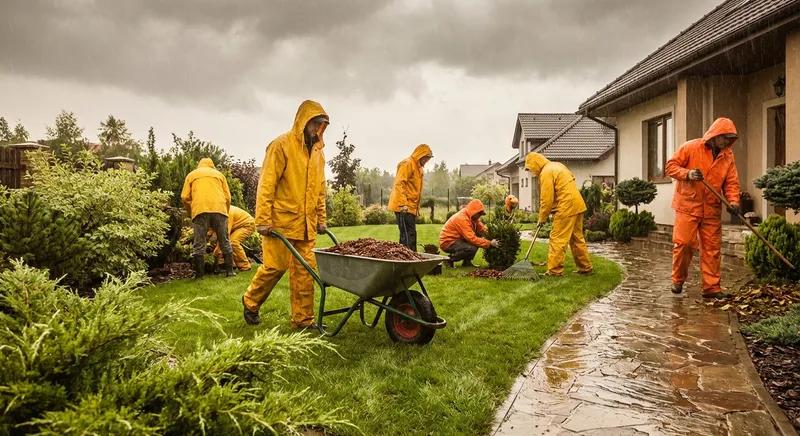
Table of Contents
You checked the forecast Sunday night. Monday through Wednesday looked good. Thursday: 80% chance of rain. By Wednesday evening it’s upgraded to all-day storms — and you’ve got 6 properties on the schedule.
Now you’re sitting in your truck at 6am Thursday, watching the radar, doing the mental math. Can you push through the morning before it hits? Do you send the crew home? Do you call every customer and reschedule? What do you do with the day?
If you’re running a landscaping business in most of the country, you lose 30-50 working days per year to weather. That’s 6-10 weeks of potential revenue — gone. The companies that figure out how to handle rain days don’t just survive the lost field time. They use it to get ahead.
Here’s how to make rain days work for you instead of against you.
The real cost of rain days
Before the tactics, let’s understand what a rain day actually costs.
A 3-person crew billing at $65/hour generates roughly $520 in revenue per 8-hour day. If you lose 40 days to weather per year, that’s $20,800 in lost production — per crew. A two-crew operation is looking at $40,000+ in weather-related revenue loss annually.
But the direct lost revenue is only part of the cost:
Schedule compression. Every rain day pushes work forward, creating a backlog. The week after a rain day, you’re trying to cram 6 days of work into 4. That leads to rushed work, longer days, and the burnout spiral that costs you crew members.
Customer frustration. Homeowners don’t always understand why their cleanup got pushed back. If you don’t communicate proactively, they assume you forgot about them.
Crew instability. If your crew is hourly and you send them home every time it rains, they start looking for jobs with more reliable hours. You lose people not because the pay is bad, but because the paycheck is unpredictable.
Build rain days into your schedule from the start
The biggest mistake landscaping companies make with weather is treating every rain day like a surprise. It rains every month. In most markets, you can predict within a reasonable range how many rain days you’ll lose per month based on historical data.
The 4.5-day scheduling method
Instead of scheduling 5 full days of field work every week, schedule 4.5 days. Leave a half-day buffer — typically Friday afternoon — for overflow and rain makeup work.
If the weather cooperates all week, use that half day for estimates, smaller add-on jobs, or equipment maintenance. If you lose a day to rain mid-week, you have built-in capacity to catch up without working the weekend.
This means you’ll book slightly fewer jobs per week. But you’ll actually complete more, because you won’t be constantly pushing work forward and playing catch-up.
Front-load the week
If Thursday and Friday show rain in the forecast, don’t save your biggest jobs for the end of the week. Move them to Monday and Tuesday. Stack the dry days heavy, keep the uncertain days light.
This sounds obvious, but most landscaping companies build their schedule on Monday morning and don’t adjust it based on the 5-day forecast. Spending 10 minutes Sunday night rearranging the week based on weather can save you hours of reshuffling later.
Set customer expectations at booking
When you book a spring cleanup or any weather-dependent job, include a simple statement: “We’re scheduled for Thursday. If heavy rain forces a delay, we’ll contact you the day before to reschedule within 2-3 days.”
Customers who know the policy in advance don’t get frustrated when it’s applied. Customers who expect you Thursday and hear nothing until Friday morning feel forgotten.
What your crew can do on rain days
Sending your crew home at 6am because of rain is the most expensive option. Here’s a list of productive rain day activities, roughly ordered by value:
Equipment maintenance and repair
This is the highest-value rain day activity for most landscaping companies. During the season, equipment maintenance gets deferred because every dry hour is spent on billable work. Rain days are the time to catch up.
The rain day maintenance checklist:
- Sharpen mower blades (dull blades tear grass, creating a brown appearance customers notice)
- Change oil and filters on all mowers and trucks
- Grease all equipment — zero-turns, trailers, gate hinges
- Check and replace trimmer line, edger blades, and blower filters
- Inspect trailer lights, tires, and safety chains
- Clean out trucks and trailers (a messy trailer wastes 10-15 minutes per day in searching for tools)
- Inventory supplies — mulch, fertilizer, bed edging, landscape fabric — and place orders for anything running low
A well-maintained fleet runs more efficiently, breaks down less often on job sites (which costs you an hour plus the repair), and lasts longer. Most landscaping companies only do this maintenance when something breaks. Rain days let you do it proactively.
Training
Rain days are the best training opportunity you’ll get all season because everyone is together with no time pressure.
Training topics that pay for themselves:
- New equipment operation. If you bought a new stand-on mower or skid steer, rain day is when your crew learns to use it properly instead of figuring it out on a customer’s property.
- Efficiency techniques. Walk through the ideal workflow for a spring cleanup or mowing route. Where should the trailer park? Who does what? What’s the order of operations? Small workflow improvements compound across hundreds of jobs.
- Safety review. Eye protection, hearing protection, proper lifting technique, trailer loading. One workers’ comp claim costs more than a full season of rain days.
- Plant identification. Help your crew learn to identify common weeds, turf diseases, and ornamental plants. A crew that can spot dollar spot fungus or crabgrass early adds value that homeowners notice — and it opens the door to upselling treatment services.
- Customer interaction. Role-play common scenarios: a homeowner asks about adding mulch, a customer complains about a missed spot, someone wants a price for a new service. Your crew’s ability to handle these conversations well directly impacts retention and referrals.
Shop and yard organization
If your shop or staging yard looks like a tornado hit it — and in April, it probably does — rain days are clean-up time.
- Organize material storage (mulch, stone, edging)
- Label and sort hand tools
- Set up a system for tracking which tools are on which truck
- Clean and organize the office/admin area
- Sort and file paperwork, invoices, and contracts
A well-organized operation saves 15-30 minutes per day in reduced searching and setup time. Over a season, that’s 50-100 hours of recovered productivity.
Estimates and sales follow-up
Rain days are perfect for the CRM and follow-up work that gets neglected during busy field days.
- Call back leads who requested estimates
- Follow up on outstanding proposals
- Send estimate reminders to customers who haven’t responded
- Review your pipeline and identify deals that need attention
- Plan your route for upcoming estimate visits
If you’ve been letting follow-ups slip because you’re too busy in the field, a rain day can recover thousands in potential revenue from leads that were about to go cold.
Administrative work
The back-office work that piles up during the season:
- Update your website and Google Business Profile with new photos from recent jobs
- Send invoices for completed work
- Review financial reports and job costing
- Plan upcoming weeks’ schedules
- Order materials for upcoming projects
- Update your social media with before/after photos
Rain day pay: how to handle crew compensation
This is the question that makes every landscaping business owner uncomfortable. Do you pay your crew for rain days?
The case for paying rain day hours
Retention. Crews that get sent home without pay on rain days look for other jobs. You’ll spend far more recruiting and training replacements than you would paying 4-6 hours of rain day wages a few times per month.
Productivity. If you’re paying your crew, you can put them to work on maintenance, training, and shop organization. If you send them home, none of that gets done and you’re doing it yourself at 8pm.
Loyalty. A crew that knows you’ll take care of them when the weather doesn’t cooperate works harder when it does. This is one of those investments that doesn’t show up on a spreadsheet but absolutely shows up in your bottom line.
Practical approaches
Full rain day pay for productive hours. Pay your crew their normal rate for rain day work — maintenance, training, shop organization. If you genuinely have nothing for them to do (rare, if you plan ahead), send them home after 4 hours with 4 hours of pay.
Rain day bank. Some companies “bank” hours during good weather (e.g., working 9-hour days when it’s dry) and draw from the bank on rain days. This keeps weekly paychecks consistent without increasing your total labor cost.
Guaranteed minimum hours. Promise your crew a minimum of 35-40 hours per week regardless of weather. This gives them paycheck stability and gives you the flexibility to use them on rain day tasks. Build this cost into your pricing.
The approach you choose matters less than having a clear, communicated policy. Your crew should know before the first rain day of the season exactly what happens when it rains.
Wet-weather field work: what you can and can’t do
Not every rain day is a total washout. Light rain or intermittent showers don’t necessarily mean the whole day is lost.
Work you can do in light rain
- Hardscape projects. Patio installation, retaining wall work, and grading can often continue in light rain. Wet soil is actually easier to compact in some cases.
- Pruning and trimming. Tree and shrub work isn’t affected by light rain. This is a good opportunity to knock out pruning jobs that don’t require dry conditions.
- Debris removal and hauling. If you’ve got cleanup jobs that are primarily hauling brush, leaves, or construction debris, light rain doesn’t stop that work.
- Mulch installation. Spreading mulch in light rain works fine. Avoid it in heavy rain as the mulch can wash and create uneven coverage.
- Fence and structure repair. Minor repairs to fences, pergolas, or other structures can proceed in light rain.
Work you should NOT do in rain
- Mowing. Wet grass clumps, clogs decks, and leaves visible clippings that look terrible. It also tears up soft turf. Never mow in the rain — the finished product will generate callbacks.
- Fertilizer and chemical application. Most granular fertilizers and herbicides need dry conditions to work properly. Rain washes product off target areas and can cause runoff into storm drains.
- Grading and fine soil work. Heavy rain turns soil work into mud work. You’ll do more damage than good trying to grade or fine-level in saturated conditions.
- Sod installation. Laying sod on waterlogged soil creates drainage problems and poor root establishment.
- Any work on slopes. Wet slopes are a safety hazard for your crew and equipment. Don’t risk it.
The judgment call
The hard part isn’t knowing what you can do in rain — it’s deciding whether to start work when rain is uncertain. Here’s a simple framework:
- Less than 40% chance of rain: Schedule normally.
- 40-60% chance: Schedule, but have a backup plan for the afternoon. Front-load critical work.
- 60-80% chance: Schedule light or rain-appropriate work only. Have indoor backup tasks ready.
- 80%+ chance: Switch to rain day mode. Don’t start field work that will get interrupted.
The worst scenario is sending your crew to a job site, having them set up, work for 45 minutes, then get rained out. They’ve now lost the setup time, the drive time, and they’ll have to set up again when they come back. Better to make the call early.
Communicating weather delays to customers
How you communicate rain delays determines whether customers are understanding or frustrated. The difference is almost always proactive vs. reactive communication.
The day-before call or text
When rain is likely tomorrow, contact affected customers the afternoon before:
“Hi [Name], this is [Your Company]. Tomorrow’s forecast shows rain all day, so we’ll need to reschedule your spring cleanup. We’ve moved you to [new date]. Let us know if that doesn’t work — we’ll find another time that does.”
This takes 2 minutes per customer — less if you use a texting system — and it completely prevents the “Where’s my landscaper?” call at 10am.
Batch your rescheduling
Don’t reschedule one customer at a time. When a rain day hits, look at the full impact: which jobs need to move, what’s the next available slot for each, and how does the cascading reschedule affect the rest of the week?
Do this once, communicate it all at once, and you’re done. Random, one-off rescheduling throughout the day creates confusion for everyone.
Keep a waitlist
When you’re fully booked and a rain day pushes work back, some customers will end up waiting longer than others. Keep a simple waitlist — who’s been waiting longest gets priority when the schedule opens up. This prevents the squeaky-wheel problem where the loudest customer gets served first regardless of when they booked.
Long-term weather strategy
Beyond individual rain days, the best landscaping companies build weather resilience into their business model.
Diversify your services
Companies that only offer mowing and cleanup are 100% weather-dependent. Adding services that can be performed in varied conditions reduces your weather exposure:
- Landscape design and consultation (can happen at a desk or over video)
- Hardscaping (less weather-sensitive than softscape work)
- Drainage solutions (rain actually helps you sell these — “See how your yard floods?”)
- Indoor plant maintenance for commercial clients
- Holiday lighting installation (off-season revenue that isn’t weather-dependent)
Track your weather data
Keep a simple log: date, weather, hours lost, revenue impact. After a full season, you’ll know exactly how much weather costs you and can price accordingly. Most landscaping companies underestimate their weather losses by 30-40% because they don’t track them.
If you lose 40 days per year to weather, your pricing needs to account for a 230-day working year, not a 260-day one. Many companies price as if they’ll work every scheduled day, then wonder why they’re short on revenue by October.
Build a weather fund
Set aside 5-10% of revenue during good months to cover rain day crew pay and lost production during bad months. This smooths out your cash flow and ensures you can afford to pay your crew on rain days without stressing about the week’s revenue.
The bottom line
Rain days are inevitable. Lost revenue doesn’t have to be.
The landscaping companies that handle weather best share three traits: they build buffer into their schedule so one rain day doesn’t cascade into a week of chaos, they have a productive rain day plan so crews stay busy and paid, and they communicate proactively with customers so delays don’t become complaints.
You can’t control the weather. You can control how prepared you are when it shows up. And the difference between a $20,000 annual weather loss and a $5,000 one isn’t luck — it’s planning.
Next time the radar turns green, don’t sit in your truck stressing. Pull out the rain day checklist and put the day to work.