Your First Snow Job Starts on Dry Pavement
Walk a commercial snow site before winter hides the details. See how a curb, a locked gate, and a bad snow pile can change the job you thought you priced.
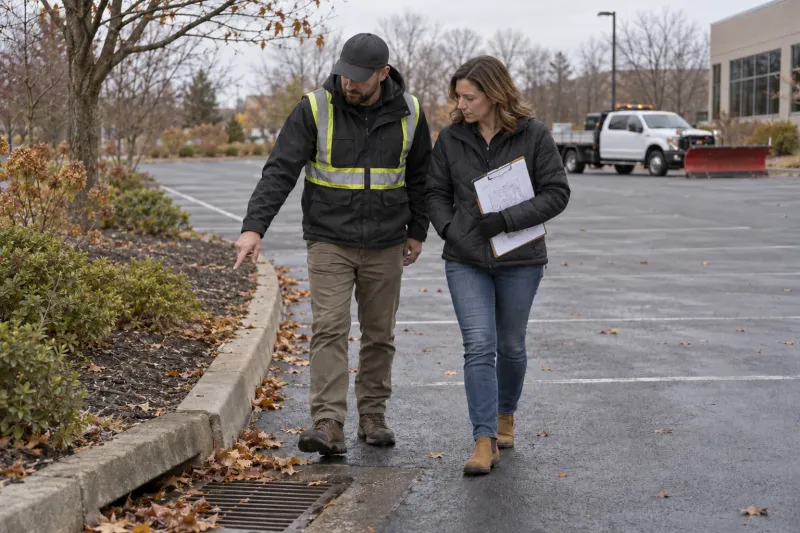
Table of Contents
Picture an empty commercial parking lot in September. The pavement is dry. You can see every curb. A property manager is walking beside you, and neither of you is wearing a heavy coat.
This is a good time to discover that the rear gate locks at six.
Discovering it in a plow truck at three in the morning is more expensive. By then, the customer may already be expecting the lot to open, the driver has other properties to reach, and the person with the answer may be asleep.
A preseason snow site visit gives you a chance to make those decisions while the site is visible and the right people are available.
SIMA’s planning standard treats assessment and documentation as part of professional snow management. The practical question is straightforward: can the crew carry out the work you think you sold?
Start where the first person arrives
In this hypothetical walkthrough, the manager points to the front entrance. The office opens at nine.
Ask who arrives earlier.
There may be cleaning staff, a delivery, or employees who use a side door. Now the work sequence looks different from a plan built around the public opening time alone.
Walk that route with the manager. Look at the distance from parking to the door and the parts of the property people actually use. A paved area can be small on the map and central to whether the building functions.
This conversation helps establish the service priorities. Make sure the resulting scope and operating plan reflect the decisions both parties have made.
A customer saying “have it ready before we open” may mean something more specific than either side first understood.
Follow the water while you can still see it
Near the entrance, a downspout empties toward a paved path.
You do not need to wait for winter to ask who is dealing with that condition. Photograph the location, record the concern, and get the appropriate decision into the site plan.
The same goes for damaged surfaces and low obstacles. A close-up photo is useful, but add a wider view so someone who did not attend the visit can find the location later.
Give unresolved issues a name and an owner. “Noted drainage issue” does not tell the crew whether anything changed. Record what remains to be addressed and who will confirm the next step.
A tidy folder of photographs can create a false sense of completion. The important part is what the team can decide from it.
Find out who owns the other half of the driveway
The lot appears to share an entrance with the neighboring property. Ask before drawing a boundary through it.
Who controls the shared access? Which areas are included in your proposed work? Who should the office contact if a neighboring operation affects your access?
These are commercial questions as much as map questions. A driver cannot resolve a disputed service boundary with a property manager’s neighbor during a busy event.
Mark the agreed areas on a usable site map. Make sure the customer and the people performing the work are looking at the same version.
If the boundaries change the scope, bring that back into the proposal. The snow pricing article explains the contract models; the property visit establishes what those prices actually have to cover.
The obvious snow pile may be the wrong one
An empty corner looks convenient. In winter, it may block a sight line, conflict with access, or become unusable after repeated events.
Ask where snow may be placed and how that space is used. Review the proposed arrangement with the person qualified to plan the work and the manager responsible for the site.
It is easier to discuss a different approach now than to discover halfway through the season that the original plan only worked for the first event.
The same reasoning applies to equipment. Review the property using the machines and crew you expect to assign. A tight area that needs a different operation does not become accessible because the proposal used the phrase “complete service.”
If the visit reveals work your company cannot perform well, revise the plan before accepting it. For a landscape company entering snow, the guide to adding the service is useful context for that decision.
Give the driver something better than “you’ll figure it out”
At the end of the walk, imagine handing the site to a crew member who was not there.
Could they identify the work areas, find the relevant photos, understand the agreed priorities, and contact the right person if access changes?
A marked map, a few labeled photos, and clear site instructions can do more than a long account note. Date the active version. Keep outdated versions from becoming the one a driver happens to open.
Have the assigned crew lead talk through the site before the season. Their questions will show you where a conversation with the manager never became a usable instruction.
This is also where the office belongs. During an event, a caller may describe a problem using a location name the driver never heard. Consistent site labels help the office pass the concern along accurately.
The overnight snow call article covers that part of the operation. A good site record gives those calls context; the operator still controls dispatch.
The first storm is a bad time to invent the agreement
A new customer may call when snow is already falling. Take the inquiry seriously, but keep the site review and capacity decision intact.
Get enough information for the operator to assess the request. A polite answer can acknowledge the need without promising a truck, a price, or a response time that nobody has approved.
After the event, some of those inquiries may become worthwhile accounts. Arrange the visit, understand the site, and price the work you can perform.
Before leaving the dry lot in September, go back to the gate. Who arranges entry? Where will that instruction live? Does the crew know it?
The answer belongs in the plan now, while the person with the key is standing next to you.